Recently in Advice Category

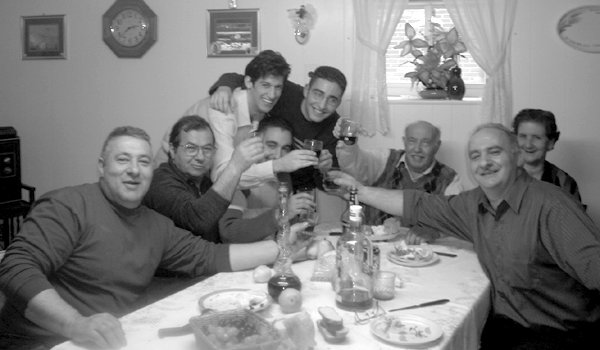
italy_father_brothers
(photo: my grandfather and his sons in mid 1960 Pellegrina <Bagnara Calabra> Calabria)

The year was 1997 and I was a college junior applying for a prestigious fellowship for first generation college students.  The fellowship provided funds and a mentor to guide and prepare students for graduate work in the humanities and sciences.  The fellowship had strict academic and social-economic requirements.  On the socio-economic side, students were expected to be first generation college students, fall on the lower end of the income scale, and come from an ethic group that were/are underrepresented at US graduate programs.

In my view, I was qualified for the above fellowship and was excited to apply.  The question as to whether I was from a distinct ethnic group (underrepresented in academic circles) was not an issue in  my mind (the last I checked most prestigious universities had faculties brimming with Waspy sounding last names and not surnames ending in vowels).  After all, I did not learn to speak English until I was 5 and thought the American side of my Italian-American moniker was just a way of acknowledging that we breathed the air in New Jersey and not Calabria; I spoke, ate, lived amongst, and thought like an Italian, so I was a true Italian.  

italy_wedding
(photo: typical Italian wedding in Pellegrina, <Bagnara Calabra> Calabria) 

When I got the call from the faculty advisor alerting me that I would not be selected for the summer fellowship program, my immediate reaction was rage.  Not because I had been denied, but rather because I had been denied for not being from an appropriate "ethnic group"; at least the groups that were currently in fashion as being minorities in the US and in turn at Academic institutions.  I pleaded my case with the advisor and asked, for example, how many of the students that had been selected spoke a second language or had been to the region/country that deemed them to be a minority, for example?  The answers that came back were disheartening and I felt betrayed.  

The incident made me think long and hard about what it means to be an Italian-American living in the United States today.  Unlike Geremio and his son Paul in Pietro DiDonato's classic novel Christ in Concrete, being an Italian American in New York at the turn of 20th century did not come with the added effort of proving one's status as an American with Italian ancestry.  After all, Geremio's son Paul was Italian, although born in New York (like the author who was born in West Hoboken).  No one at the turn of the 20th century would accuse Paul as being an American, rather he was an Italian who happened to be born to recent immigrants from Italy.  Suffice it to say, if such an academic fellowship existed in Paul's time, he would have surely qualified as being part of a true ethnic group.

italy2_greatgreat
(photo: my grandmother's family posing as though they were well off - they were not)

So, what has happened to the Italian-American in the 90+ years since DiDonato's seminal novel?  Has the Italian-American remained truly unique with strong ties to what it means to live like an Italian?  Or have the images of Sonny, Tony Soprano and the cast of Jersey Shore penetrated our media driven society so deeply that to be Italian in America is solely about being involved in crime, putting gel in one's dark colored hair, and consuming tomato sauce?  What has happened to the attributes of the Italian American that were so pronounced and vivid in DiDonato's America yet so dull and mis-represented in our current epoch?   In short, what has happened is as simple as unadulterated assimilation (some self induced and some pushed by the larger American society) of the negative kind that leaves the current Italian American in a state of watered down culture and misrepresentation (in short, a sort of sudo Italian-American).

All is not lost for the modern Italian American, however, and there are glimpses of living the Italian way in America that are centered on core attributes like practical living, working hard, recognizing quality food and products, and just, plan, living well.  I see first and second generation Italian Americans shunning the popular, and myth driven, portrayals of the goofy, unintelligent, "Tony" (don't let the literary critics convince you he was seminal TV figure) and "Sonny" characters and argue strongly that being Italian in America is just that; namely, living like a typical Italian that has been transplanted to North America (with a focus on food, family, friends, and enjoying deep and meaningful experiences every day).  

How do you live as an Italian in America today?

Related Posts with Thumbnails
wheat_harvest_pellegrina 
(photo: Various family members during the late summer wheat harvest in Pellegrina, Calabria.  When wheat is king, you learn from a young age the beauty of delicate bread and pasta versus Beef) 

You can say, unequivocally, that Americans love their beef. Compared to their Mediterranean counterparts, American's are ranked third in the world (only behind Argentina and Uruguay) when it comes to choosing beef for their dinner table (Italy is ranked 9th, per 1999 statistics).  An educated guess as to why beef consumption has skyrocketed in the US, post WWII, is probably linked to access, price, and perceived nutritional value (if McDonald's sells a mediocre hamburger for less than $2.00 then why would the average US consumer spend, say, $2.99 per pound on organic peaches or $8.99 per pound on Wild Cod).  Moreover, given how quickly fast food establishments have scaled (from a franchise and business perspective) in the US since 1950, for example, it's probably easier for you to find a Burger King than a quality food market (you can blame capitalism and the subsidized food system for the proliferation of what I like to call, "big box crap food" <read Pollen's work for a more elegant explanation>).  


Contrary to the American food system, meat, especially beef (and especially in Southern Italy) is a nice to have at the dinner table in Italy, as opposed to a given.  Poultry, while abundant in the Italian country side is consumed even less; while the much beloved Italian pig is only ranked in the middle of the world pack (according to rate of consumption).   Specifically, here are how Italians rank in terms of per capita meat consumption (globally):

- Poultry: 23rd
- Pork: 15th   
- Beef: 9th

(source: Source: U.S. Department of Agriculture, Foreign Agricultural Service, Livestock and Poultry: World Markets and Trade, annual.)

What are we to make when we think deeply about how Italians view meat consumption?  One conclusion we can draw, because of access and price (food, like gasoline, clothing, and housing, is very expensive in most parts of Europe, including Italy) is that cheaper and healthier food items (such as dairy, fruits, vegetables, grains, olive oil, legumes, nuts, etc.) are more popular in Italy ; hence the so-called Mediterranean Diet.  But what about when access and price do not enter the equation, do rich Americans eat better than middle class     
Americans?  Does beef consumption scale with income?  Maybe by way of cut, but, anecdotally, eating well in American is still NOT about a delicately prepared plate of pasta or a bowl of just ripe, locally farmed, fruits., rather eating well is about feeling full, salt, and protein via meat (all in relation to price, of course).  


While the Mediterranean Diet has received lots of good publicity here in the United States, we've yet to see the large scale shift in eating preferences because it's still not in our Anglo-Saxon DNA (culture) to put food at the top of list of what's most important to us.  Children do not grow up in a culture of seeing mom or dad prepare, from scratch meals, fruit at the end of a meal, or the local farm that raised the cow they grilled, for example.  In turn, food is more akin to something that is a "given" in American society; that is to say, it's been branded as something available 24 hours a day, with little or no taste/quality, and at a absurdly low price.  

It's not all doom and gloom for the American food system, especially on the coasts and near large cities with ethnic populations (where demand for high quality food is intense). In fact, demand is the key concept here; Americans should demand better quality food types, just like the Italian born ladies do at my local market.  So, forget about the Mediterranean Diet and think high quality foods instead (specifically, the best ingredients you can find in your area).  

Happy eating!   


Related Posts with Thumbnails
ingredients

Many personal finance gurus will tell you to head to your local food market with only certain items in mind and shop only by price.  Moreover, the penny pinching crowd would argue that the purpose of buying, and in turn consuming, food is to be as efficient and cost effective as possible.  

As you probably guessed, I don't subscribe to buying food based on price or coupons available.  Rather, I purchase food based on freshness, quality, and value (don't interpret value as buying the lowest priced item, this behavior is illogical!).  I place a high value on the happiness and pleasure I derive from eating well and, in turn, I often spend a bit more than average on fresh produce, good quality meats and fish, bread, wine, dairy, eggs, etc.  In terms of eating out, I do cringe on spending a ton of money on restaurant food (even the variety that garners accolades from Michelin and the NY Times).  For example, I recently dined at the Blue Hill restaurant in New York (famed for their association with Blue Hill Farm and locally produced items) and came away disappointed in terms of the quality of the ingredients, preparation and outlandish cost (in my mind, there was no value in dining at Blue Hill because the cost did not justify the overall experience).  

IMG_6243[1]

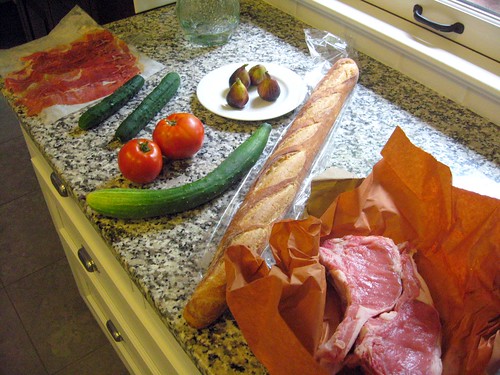
With the above observation in mind, I put together a leisurely Sunday meal of grilled veal loin chops with Chinese eggplant and feta and a tomato salad.  I also had a few pieces of thinly sliced prosciutto and figs to hold me over during the cooking process.  

IMG_6241[1]

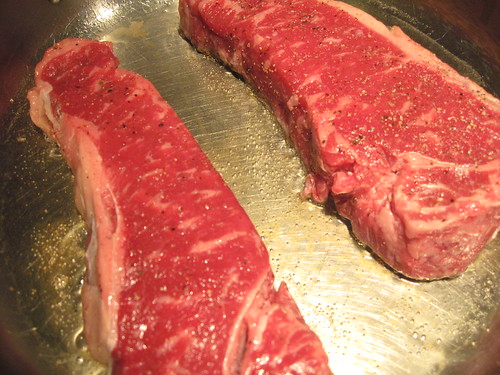
I prepared the locally raised veal chops on an outdoor grill with a generous amount of salt and pepper.  I use an old fashion Weber grill with wood charcoal (I think this is important).  The Chinese eggplant was grilled as well and tossed with feta cheese, lots of freshly ground pepper, kosher salt, olive oil, and chopped parsley.  Finely, I assembled a tomato salad with some very local tomatoes (from my parent's backyard), local basil, local cucumber, red onion, and lots of olive oil, salt, pepper, and dried oregano from Calabria!

IMG_6245[1]

IMG_6247[1]

We consumed our meal with a glass of Pinot Noir from California (not my first choice, again, based on value, but it was a nice choice considering the oppressive heat and the grilled veal).
  
IMG_6246[1] Related Posts with Thumbnails
IMG_5852[1]

Recently, a heated food debate has surfaced between the dyed in the wool "food expert" Michael Ruhlman (he's written some fine books on food, appeared on TV, and speaks at conferences) and the food philosophies espoused by celluloid FoodTV starts such as Rachel Ray and Jamie Oliver.  In a Huffington Post article, Ruhlman argues that people should make the time to cook a whole chicken (w/ potatoes) in the oven for an hour and that if you, as an adult in America, choose to heat up a Lean Cuisine meal instead of cooking that chicken it's not because you don't have the time, but rather you choose not to make the time to cook, from scratch, food at home.  

Personally, I'm torn with Ruhlman's assertion.  On the one hand, my nose turns ever so northward when I hear the phrase cooking is too complicated and takes time (and as Michael asserts, I say, bullshit!), yet I can clearly see the want and need to cook a quick meal in under 30 minutes after a long day at the office and a constantly screaming baby.  However, there is one thing that I do know, and assert boldly; that is, the American public should stop listening to the so called "food experts."  And, moreover, it's ok to read Ruhlman's books, watch Pepin on PBS, and maybe even spend a few minutes with Mario Batali and Rachel Ray on FoodTV, but for God's sake don't take what these people say as "food truth."  

I've arrived at my food philosophy via my Italian heritage. I grew up with "from scratch" food and, on the occasion, was allowed to dabble in the processed food world (my mother allowed me to eat potato chips and the occasional "Steak'um sandwich."  So, I cringe whenever I hear someone in the food industry utter the words local, organic, Sous vide (French for under vacuum), micro-gastronomy, etc. as a reference to some sort of Über-cuisine.  To anyone looking to appreciate food, I say to them go out and buy nice ingredients (the best you can afford - see my article on the myth of equating good food with spending power) and experiment at home.  Go and buy some good dry pasta, a nice bottle of extra virgin olive, and a hunk of Grana Padano.  Thereafter, go home and boil some pasta and combine it with the olive oil and grated cheese (that will take you 15 minutes; hence a "15 minute meal").  Is this a bad thing?  No, rather it's a pragmatic truth that modern life does have drastically different time constraints (regardless of how a family or individual made their way, or "choose their way", into this situation) and that most individuals want to eat tasty meals that do not require excessive amounts of time to consume.  Given a long day at the office, I'd rather, for example, purchase a rotisserie chicken from my local market than spend an hour watching it roast in my oven.  If I had a light day and I'd like to stand in my kitchen come dinner time for about an hour and half, I'll roast a chicken, make risotto, finely chop some fennel and parsley for a salad, and even make a small appetizer of toasted bread with homemade ricotta.  

The point is that it's too easy to say that folks should both turn away from 30 minutes meals and healthy and high quality foods prepared by someone else.  Yes, on most occasions, folks should find time to cook from scratch meals at home, however there are pragmatic times when "making time to cook" is truly not a possibility (this is a hard truth, even epistemic if I can get fancy!).  

Related Posts with Thumbnails
ocean2
(photo: the beach in Bagnara Calabra - pure happiness!)

At times, I think the political and cultural columnist David Brooks has a little bit of Mediterranean blood flowing through his body (regardless of his Anglo-Saxon appearance).  Time and time again Brooks puts together elegant arguments on the paradox of American living, why gun control is necessary, or, say, how most people struggle to find happiness.  While I don't agree with every opinion Brooks' holds, I did enjoy a recent New York Time Op-Ed where he argues that we, as a society, should spend more time chasing what truly makes us happy versus material wealth .  The article got me thinking about how many of Italians I know have high levels of happiness (especially the ones living in Italy) and why they so easily grasp how to lead a good life. 

It's no secret that Europeans, generally speaking, have a higher quality of life than most Americans.  The "European way of life" is known throughout the world as emphasizing family, food, and overall well being, while here in the United States the perception is that the more money one makes the better off he or she will live.   Are the Europeans just freaks of nature high on multiple cups of espresso; afterall, isn't a flashy career more important than an afternoon siesta and a pre dinner aperitif?

The above questions beg the ultimate question; namely, why wouldn't everyone want to live like an Italian (or their Europeans neighbors)?  Are we too focused on capitalist models here in the United States training our best and brightest to become investment bankers versus well rounded individuals who have a passion for leading a happy life?  

Prescribing how to lead a happy life is akin to telling someone how to dress or which religion to follow; that is to say, most folks don't want to be told that they would be happier only if they did X, rather they want to discover their own path to smiling each and every day.  

My advice is to listen to the latest psychological research on what makes people happy throughout the world and follow a little bit of Brooks' advice.  In turn, here's a quick summary of how Brooks interprets the latest empirical findings from the new field of "happiness studies" and why living the "Italian way" may be more beneficial than chasing the almighty dollar (or living like an American):   


1. "Marital happiness is far more important than anything else in determining personal well-being. If you have a successful marriage, it doesn't matter how many professional setbacks you endure, you will be reasonably happy."

2. "Poor nations become happier as they become middle-class nations, but once the basic necessities have been achieved, future income is lightly connected to well-being."

3. "The US is much richer than it was 50 years ago, but this has produced no measurable increase in overall happiness. On the other hand, it has become a much more unequal country, but this inequality doesn't seem to have reduced national happiness."

4. "Winning the lottery doesn't seem to produce lasting gains in well-being. People aren't happiest during the years when they are winning the most promotions. Instead, people are happy in their 20's, dip in middle age and then, on average, hit peak happiness just after retirement at age 65."

5. "People get slightly happier as they climb the income scale, but this depends on how they experience growth. Does wealth inflame unrealistic expectations? Does it destabilize settled relationships? Or does it flow from a virtuous cycle in which an interesting job produces hard work that in turn leads to more interesting opportunities?"

6. "The daily activities most associated with happiness are sex, socializing after work and having dinner with others. The daily activity most injurious to happiness is commuting. According to one study, joining a group that meets even just once a month produces the same happiness gain as doubling your income. According to another, being married produces a psychic gain equivalent to more than $100,000 a year."

7. "If you want to find a good place to live, just ask people if they trust their neighbors. Levels of social trust vary enormously, but countries with high social trust have happier people, better health, more efficient government, more economic growth, and less fear of crime (regardless of whether actual crime rates are increasing or decreasing)."

8. "Most of us pay attention to the wrong things. Most people vastly overestimate the extent to which more money would improve our lives. Most schools and colleges spend too much time preparing students for careers and not enough preparing them to make social decisions."

9. "Interpersonal bonds are critical to being happy day in and day out...overall, economic and professional success exists on the surface of life, and that they emerge out of interpersonal relationships, which are much deeper and more important."

There have been a slew of new and recently published books on happiness including Stumbling On Happiness by Gilbert, The Politics of Happiness by Bok, and the Hidden Wealth of Nations by Halpern.  Here's an interesting talk from Halpern, which includes some great data/findings on happiness levels throughout the world.

Related Posts with Thumbnails
figleaf
(photo: Many Italians are frugal, but ask an Italian what he or she loves better, a fig or money and the answer will almost always be the king of fruits, the fig)

If you haven't noticed, Scordo.com has been focusing on living the Italian Way recently.  Scordo began as a practical living and personal finance blog, but what I noticed with each post was that my way of living was, ultimately, informed by my Italian heritage.  In turn, I thought I would focus on what I know best, namely, how to live the Italian way in terms of food, lifestyle, money, family, home, etc.  

If you're new to Scordo.com and interested mostly in personal finance and saving money then don't fret and click here to read my "best of" article in personal finance, home improvement, and home and garden.  You can also sign up for the Scordo.com quarterly newsletter and become a fan on Facebook.

Without further ado, then, lets get to edition #221 of the Festival of Frugality - Italian style!

Editor's Picks: Top Seven

1.  Financial Uproar on his argument against tipping.  This is a great topic and I'm always asking myself: why doesn't the restaurant owner pay his staff a living wage?

2. Organic Eating Daily asks if one can eat organic on a budget and it's an important question as many folks rush to their local Whole Foods and spend a ton on product that may not have any ROI in terms of quality and health.

3. My Wealth Builder on DIY home repairs - I'm an avid home improvement person and this hits home.  

4. Digerati Life shows us how to sew a button correctly.  I love this article because it's obviously not about saving money on a lousy button but the idea of doing it yourself.  

5. Journal of Healthy Living try to argue that going to the gym can save you money.  Do you buy the argument?  

6. Money Help... is reading my mind as he advocates for buying a car with cash.  My Italian father is smiling and it's the only way to buy a car!

7. Every good frugal master knows the benefits of his or her local library and Money Beagle does a good job reminding us of the benefits.  
Related Posts with Thumbnails
IMG_5481[1]
(photo: Bok Choy with garlic, olive oil, and red pepper flakes: $2.00 for 2 pounds)

One of the critical life lessons I learned from my Italian family is how to value food. Specifically, I was taught: 

1., how to cook and the closely associated idea of, 

2., why food is important and should be taken seriously.  

My mother taught me the mechanics of making all sorts of foods from scratch, ranging from pasta to risotto and roasted baby goat to pan seared swordfish.  And at the same time, I learned how important it was to make time for preparing food and, thereafter, sharing it at a communal table with family and friends (and to repeat the process as much as possible).  I equate the latter lesson I was taught as an Italian boy to the importance of reading and scholarly endeavors in the Jewish tradition, for example.  The idea of food being important and necessary for a good quality life is in my blood and I can't imagine living any other way (I know people who place incredible value on Yankee baseball or a shiny new car every three years; misguided values or to each his own?).

In turn, it comes as a great shock and disappointment when one looks around and sees a culture of fast food, obesity, and the general lack of importance in relation to consuming homemade food in the US.  Specifically, we hear many reasons from the so-called "food experts", including the notion that buying quality ingredients to produce fresh and homemade food is an expensive endeavor in the United States (ask a European how expensive food can be and did you know that food in the US is actually cheaper than it was, say, 50 years ago <see the documentary Food, Inc.?>).  And, moreover, it's more economical for a family of four to purchase dinner and lunch from McDonald's, for example, then to go out and buy fresh food (this isn't the view of the food expert).  What the experts are implying is that poor people choose fast food and other high calorie meals because they have no choice and are priced out from shopping for fruits, vegetables, fish, meats, grains, etc.  

To the latter assertion I say, "that's nonsense!"  And, yes, I'm going to turn to the recent immigrant storybook to illustrate that one doesn't not need to spend a fortune to eat well and, moreover, that a family of four can take his or her fast food budget and prepare "from scratch" meals that are quick, cheap, healthy, and taste good (eating well doesn't equate to the need for great spending power, as the folks at SeriousEats.com seem to suggest when responding to one of Pollan's eating tips). 

IMG_5483[1]
(photo: One pound of Wild Flounder made with breadcrumbs, olive oil, and lemon zest.  The fish easily fed four people: $9.99 per pound or $10.00 for serving of four).

Let's take the price of an average meal at McDonalds for four and say that the Smith family will consume 4 medium size French fries, 3 cheeseburgers, 1 6 piece chicken McNugget, and 4 medium sizes Cokes (let's assume dinner will cost about $20; I don't have access to a menu with prices so I just estimated).  With that same $20 I can head to my local independent market (some would call it a gourmet market) and purchase the following items for dinner (I actually bought these items for dinner two days ago):

- 1 pounds of wild flounder fillet for $9.99 per pound or $10.00
- 1 box of artisan ravioli from Vitamia in Lodi, NJ (16 total ravioli) for  $4.50
- 2 medium sized Bok Choy heads (about 2lbs for 99 cents a poud) for $2.00
- 1 loaf of Sullivan Street bread (this is a large bread which will last a few days) for $3.50
- Total: $20.00

Note: I live in a region of the US where the cost of living is high.  

With the above ingredients I made baked flounder with breadcrumbs, lemon zest, and olive oil, ravioli with already prepared homemade tomato sauce, and sautéed bok choy with garlic and olive oil.  We consumed the bread with our fish and vegetable.  We did finish up our meal with two fresh pears and two oranges that were purchased during a different trip to the market.  The meal fed 4 adults (with an appropriate sized portion of fish, vegetable, and bread per person and we started the meal with 4 ravioli per serving).  

Our meal was tasty, satisfying, made with fresh ingredients, and for the exception of the ravioli and bread, prepared at home.  You could certainly make your own bread and pasta at home, and keep price down, but for a Mon-Fri type of meal this is the sort of "pre packaged" items that are ok to buy, in my view.

IMG_5480[1]
(photo: Artisan ravioli made by Vitamia in Lodi, NJ with homemade tomato sauce with mushrooms, made a few nights earlier: 1 pound for $4.50 ).

So, why is it that many poor to middle income families choose the fast food route when it comes to meal choice?  Could the families who choose prepared food not be ingrained with the idea that consuming quality food is important?  If not for my specific culture and upbringing, for example, I certainly would not consider food an important part of living in the US because it's not taught at school or praised in the media.  Therefore, a probable explanation for eating habits in the US may be cultural norms rather than income or access to fresh ingredients.  In sum, I choose to spend my twenty dollars for wild/fresh fish, greens, artisan bread, and handmade ravioli, as opposed to prepared French fries, cheeseburgers, Coke, and deep fried chicken nuggets, because I was taught from an early age to value food and make it at home.  Eating well isn't a byproduct of socio-economic factors (don't listen to the food experts), but rather how one is raised and views the preparation and consumption of food.  Being poor doesn't force you to eat at McDonald's, rather being taught that consuming pre-made food is acceptable (from an early age) and part of how one lives is the culprit.
Related Posts with Thumbnails
jackielawyer
(photo: Jackie the Lawyer from Seinfeld)

I spent my undergraduate days studying philosophy, linguistics, and psychology and, as I've told many close friends (and anyone else who wants to listen), Philosophy provides an excellent academic and pragmatic (yes I mean practical) foundation for countless careers and professions.  One profession that is closely associated with studying philosophy as an undergrad is Law.  Philosophy provides excellent training for prospective attorneys given rigorous course work in logic, notoriously difficult text, and training in constructing and presenting cohesive arguments.  However, the necessary training in order to practice law (viz., law school) is not for everyone. 

Law school (at the top tier academic intuitions) is intense and not for every student (certainly not for the student who can't think of anything else to do with his or her life and figures becoming a lawyer sounds like a good idea).

What follows below is the best advice I've read on whether one should go to law school.  Specifically, the advice comes from Professor Nick Smith at the University of New Hampshire.  Nick holds a J.D. and before becoming a full time Philosophy Professor he worked as an attorney at a prestigious Manhattan law firm.  Nick's advice is brutally honest and a must read for any Junior or Senior undergrad considering law school.

Related Posts with Thumbnails
kidfountain
(photo: my young uncle washing his hands in an outdoor fountain in Bagnara, Calabra - Village of Pellegrina)

One of the most important life skills you can teach your child is how to save or, more specifically, why it's important to save.   My parents would often bring me to the bank as a small child and I observed my mother writing and cashing checks, depositing money, etc.  By the time I was 7 or 8 my parents told me about a little blue passbook they had opened for me when I was born.  The passbook (or savings account) contained some regular deposits and a healthy amount of money.  I had no sense of the value of the account or what the cash really represented, but I do remember my parents telling me:

1. This is where you will (not can) save any money you come across (birthday, holiday, etc.).

2. Once you put money into the little blue book you really do not want to take it out.

3. The bank will give you some money in return for keeping a little blue book full of money.

The lesson above was very simplistic; namely, that saving is good and should be taken seriously.  Beyond setting up a savings account for me, my parents also exposed me to their financial goings-on from a very early age (I knew for example how much my father made via his paycheck, what our tenants would pay in rent each month, and how much my dad would collect for small handy-man type projects).  My parents hid nothing about our financial life or status, so I was "in the know" from a very early age.  Some experts have argued, especially in light of the recent recession, that parents should aim to shelter financial goings on from their kids given stress, anxiety, etc.  And while every parents should customize parental advice for his or her child (read: understand what type of child you have and adjust parents style), I believe in empowering children and raising smart, pragmatic, kids who will be ready to face the world!

So, when beginning your child's fiscal eduction you want to make sure you do the following:

1. Set up a savings account
 and describe what it is meant for and how you make regular deposits.

2. Expose your child to every inch of your family's financial life (in a sense treat the child as an adult and describe how much money the family makes <and the different sources of money>, what the family does with money, and what money can and cannot provide).

Start the personal finance discussion slowly and make it as easy to digest as possible.  That is to say, talk about saving money and not interest rates or how money is needed for a home, food, and security and not to buy video games, go out to eat, or impress people.  

I know of some families that never discuss money matters and this can be potentially dangerous to a child's personal finance eduction (which isn't taught in schools, unfortunately, and is the responsibility of the parent).  Money is not a dirty word nor should parents treat it as formal topic only open to adults.  The sooner a child feels comfortable dealing with money the quicker he/she can begin to see the value of money what it can and cannot provide an individual (security versus happiness, for example).  

Related Posts with Thumbnails
apps

Around the same time last year, I offered some no-brainer tips on how to get along with everyone at Thanksgiving.  The tips emanated from the fact that even if you love most of your family members there comes a point during the holiday season when you'd like to get Uncle Pasquale in a headlock and give him a good noogie.  

Personally, I enjoy hanging out with the extended family but come New Year's Day I'm ready to spend a few weeks in isolation in an undisclosed New England cabin (and, yes,  I have preached on the virtues of keeping your family close!). So, without further ado here are 4 tips on how to get along with your dinner companions on Thanksgiving Day  

1. Be nice. Getting along with people is not rocket science.  If you're coming across as cold, snobby, and unwilling to engage in a conversation, you'll most likely be sitting by yourself watching some mediocre football game.  Try extra hard and smile, comb your hair, and engage people in conversation.

2. Have a glass of wine.  I'm not advocating funneling a bottle of Cote du Rhone, but grab a glass of wine when you arrive and it will help you engage people in conversation and just make you feel relaxed.
 
carving

3. Dress nice.
 Everyone likes being around people who look good, so keep your jeans and the 30 year old wool sweater in the closet and put on a nice pair of pants and dress shirt.  It also tells the Thanksgiving Day crowd that you acknowledge the holiday and are ready to celebrate or give thanks (if that's your thing)!  Don't pay attention to the above pictures.

4. Bring something to dinner.  Not only will your host appreciate a nice bottle of wine, a fruit platter, or a home made pie, but, again, the gesture will signal to the dinner table that you are excited about the holiday and ready to have a good time.

If you hate Thanksgiving then I can't help you, but it tends to be once of the nicer holidays of the season so enjoy and Happy Turkey Day!

Related Posts with Thumbnails
walmart

With the notorious holiday shopping season fast approaching I'm having nauseous visions of deals, coupons, free mass produced turkeys and hams, free shipping, wal-mart, and 40 percent off blow out sales.  The visions are not only vivid and haunting they are actually true!  

Don't get me wrong, I wouldn't pass up a deal on a particular consumer item that I needed, but much of the typical consumer's behavior and the retail and/or manufacture's promotional tactics to sell a product are logic defying acts.   Especially when you think hard about what the entities in question are trying to get you to do and what channels they are utilizing.   Let's look at a few examples:

1.  Free Shipping.  The typical ground shipping cost for a consumer electronic items like a GPS device or digital camera is between $7-$9 (I used Best Buy as an example).  The typical cost for a middle of the road GPS device or digital camera is about $150-$250.  Using common sense does it make sense to purchase an item you don't need in order to obtain or "save" on free shipping?  The answer, of course, is no.  This tactic aims to bring a nominal cost, such as shipping, to the forefront of the shopping experience in order to downplay the actual cost of the item.  Think actual need ahead of nominal savings.

2.  Percentage off / Deals.  The main tactic here, again, is highlighting a percentage off a certain item.  You see the deals language lots a week or so before "Black Friday" (or the day right after Thanksgiving) so that retailers can attract foot traffic and curious shoppers.  Often, if you look closely at the products being discounted they are not only items you can probably do without (mediocre electronic devices, men's gloves made of fake leather, a set of 5 Teflon-like pans, etc.) but the quantity or model number is often limited.  This is the same tactic car dealers use to lure you into the dealership in Sunday morning newspapers (i.e., you'll see a ridiculously low price for a certain unreliable and gas-guzzling model which is often tied to a single VIN number).  Again, think about whether you need the item ahead of savings measly 10-20 percent.  

3.  Coupons.  The number of coupons sites on the web must double each and every day (I haven't validated this, but it's just a hunch).  These days you can save twenty five cents on yogurt at ShopRite, get two large pizzas at Domino's for $5.99, and find an oil change joint that will replace your engine oil and filter for $15.  I have to admit that coupons don't excite me, rather what excites me is value.  For example, if I see generic yogurt on sale that contains tons of sugar and limited real fruit/flavor I'll often pass on the sale item and spend an extra couple of cents per container because I'd rather purchase the brand that uses real sugar, organic milk, and fresh, real, fruit.  With food specifically, I don't want my choices of what I prepare for my family and myself to be influenced by a circular in the paper or a mass email campaign from Stop & Shop.  The bottom line is that the choice in the food that I consume is something I value highly and don't want influenced by saving, for example, five dollars at check out at my local market (this shouldn't be interpreted as some sort of elitist, East Coast, view, but rather a viewpoint that is centered on quality of life and the best choice).

cart 

Overall, when it comes to shopping and buying stuff (including clothes, food, shoes, consumer electronics, auto renewing services and subscriptions, etc.) I'm a big believer in putting 1. real need and 2. value ahead of spontaneous and pure "saving" shopping behavior.  What I'm driving at is that you shouldn't buy what you don't need regardless of a blockbuster deal or free shipping and you shouldn't let important consumer decisions, like food choice, be driven by coupons; instead, look for value when shopping (which I define as the best product for the best price).      

Related Posts with Thumbnails
men_eating_front_church_pellegrina

I've often stated here and to many friends directly that recent immigrants have an intuitive personal finance philosophy that not only embraces the pillars associated with the American dream but also runs counter to the deeply entrenched, and ugly side, of modern American life: consumerism and materialism.  

Some friends get the above point quickly and agree, while others look at me like I'm an alien and think: "this guy is crazy, why wouldn't everyone want an iPhone, a shiny black German sedan, and several Coach handbags?!"   

Well, to answer the question from my skeptical friends I wrote an article for Wisebread.com entitled, "10 Life and Money Lessons My Immigrant Parents Taught Me".  Read the article and pass it along (via Digg or Tip'd). 
Related Posts with Thumbnails
hamsmithfinal

I'm a student that needs to decide on a Major. Besides my credits being in a complicated mumbo jumbo from transfers and other what-have-you's I'm a normal student. I was doing some searching about philosophy majors and found your article on "Why I Should Major In Philosophy". So you have good things to say about the Majors. I'm split between a decision to major in phil or to major in phil/pol-sci/econ (a major that puts an equal, but diminished, emphasis on all three). After getting my bachelors I'm considering joining the military for the funding to get a masters degree, in something....I checked what you had to say about yourself and your career and despite being from opposite coasts, your interests are not dissimilar to my own (especially a love for garlic). You have a philanthropic blog and perhaps you could just help shed some light on my situation. How has a phil major helped you, has it been a burden ever, yada yada yada.

Thanks,
Andrew

Andrew asks some good questions and I thought I would address some specifics below.  

1. Major in one subject or do a combination of double majors or multiple minors?  
The first thing to realize about an undergraduate education is that it's opportunity for students to study a subject that they are actually interested in and that the first couple of years of an undergraduate education are going to be fairly broad (from a course selection perspective).  That is to say, most colleges and universities require that a student take a minimum amount of general education credits.  If it were up to me, I'd make it a requirement for all undergraduate students to obtain a dual major and, specifically, one major would be in the humanities and the other would need to be in some applied field such as Engineering, Agriculture, Economics, etc.  Universities should be producing thinkers and doers (not just one or the other).

2. I've talked about the benefits of completing a Philosophy major (Bachelor of Arts degree) in detail.  However, the prospective Philosophy major should also be forewarned in terms of:

- You will need plenty of self discipline to distil the real gold nuggets from a philosophy major; viz, critical thinking skills and ability to clearly write and communicate. 

- No one is going to hand you a job after you graduate with your degree and you will need to work extra hard to turn the skills you learned as a Philosophy major into practical, applicable, knowledge that translates well within the marketplace (sorry, this is just a reality).

- You may need a professional degree if you can't apply skills learned as an undergraduate into a job category that is in demand.  That is to say, you may need to quickly aquire an MBA, JD, or other professional degree to get a job.  I graduated from University in the late 1990's and the .com boom was underway and many jobs were available (this is currently not the case in the US) and I had a practical skill set thanks to work-study position I held for a number of years.

3. Has Your Philosophy degree ever been a burden?  
I think the only time I've felt negative about studying Philosophy as an undergraduate was during my first two years at University.  Studying Philosophy comes with lots of criticism from peers, parents, professors, etc. and it's especially tough to ignore the negative comments when you're still new to campus and college life, in general.  A typical scenario is your Engineering major roommate constantly bombarding you with questions on why you're wasting your time studying something so obtuse and unimportant (be ready with thick skin and a couple of good arguments).

4. I recommend doing a full Philosophy major because only then will you get to take some intense seminar level classes on specific philosophers and topics.  You may even become interested in some specific aspect of Philosophy (such as Philosophy of Mind) and may want to write a senior thesis (this is great practice for the real world in terms of thinking through an idea, justifying the idea, and thereafter defending the premise of your argument).  In addition to my Philosophy major I have two minors in Linguistics and Psychology.  Looking back, I may have opted for a dual major in Philosophy and Economics.  

Related Posts with Thumbnails
river_final

Living life is joyous on occasion, rough going sporadically (hopefully), and even keel on most days.  The aforementioned goes for superstar power brokers and well endowed professional athletes - life, as a matter of fact, is ever changing and a challenge (and mundane at times).  

There are, however ,a few simple tips you can keep in mind to optimize life (the tips, of course, are not exhaustive and are meant as a discussion starter while you're showering in the morning pondering those great thoughts): 
 
1. Thinking On Your Feet
Thinking on your feet is quite possibly the No. 1 practical skill set of all time.  The skill set can aid in a multitude of scenarios from an impromptu discussion on the value of the product line you manage with the company CEO to the ability to argue a position or answer a question in your college seminar. Thinking on your feet can also land you the ideal job you are looking for because, at the heart of it, a job interview is a sort of spontaneous conversation where the hiring manager is evaluating your ability to speak and formulate ideas.  Simply put, if you can't think on your feet you might as well be flipping burgers as the local McDonalds.

2. Meaningful Small Talk
If you distill small talk to it's very essence, it's about being able to handle social situations well.  A person who does small talk well can relate to just about anyone (from the local sanitation worker to the academic at the local college) and quickly situate himself in a social setting and make friends, communicate that he or she is a trustworthy individual, and ultimately put the group or person he / she is engaged with in a calm and agreeable manner.

3. Take Care Of Your Body, Teeth, and Hair
OK, I'm currently typing this blog entry in shorts, black socks, and with a little bit of scruff on my chin (read: I haven't shaved in two days), yet I'm telling you it's vital that you take your appearance seriously (I'd look better if our 6 week old wasn't dominating our life currently).  I've heard that half of life is merely showing up and looking good; that may be true, but the looking good part should consist of daily exercise, dental hygiene (read brush your teeth, floss, and visit the dentist), regular haircuts and the use of hair product (I'm serious), and respectable, but not too showy and ostentatious, clothing.  You convey a ton to people well before you open your mouth, so get the easy part right and simply look good (it's not hard).

4. Be Flexible...With Everything
Like thinking on your feet, the ability to be flexible with life is key to living well.  As much as planning and thoughtful analysis is part of my DNA, I see the ability to quickly change directions in life and adapt to shifting professional, family, and social situations as an even more vital skill set.  I think the aforementioned skill set is especially important for younger folks in their twenties and early thirties when patience and seeing the big picture can be difficult (contrary to popular belief, I think older folks are better capable and equipped  to change or adapt).
  
5. Keep your family Close (i.e., You Can Have Too Many Friends)
I've written on the virtues of maintaining a strong connection to mom and dad time and time again.  And it's not just mom and dad you want to keep close, but also sisters, brothers, in-laws, uncles, aunts, and cousins.  Maintaining strong family ties creates a real world social network that can help with renovating your home, raising your 1st born child, dealing with difficult life decisions, and just living life in general.  At the risk of sounding like a right leaning conservative, family is vital.  Now, I do include a few close friends within my family group, but I don't have too many close friends because it takes time to nurture friendships (and let's face it, you can't raise a family, work, stay close to mom, dad, and sis, and maintain relationships with 50 "close" friends).

Related Posts with Thumbnails
kitchen

Nothing makes a home more desirable these days then a new kitchen with all the bells and whistles (well maybe good schools and neighborhoods are more important!).   And most new homeowners either look for a home with a great kitchen or desire to renovate their kitchen at some point during the homeownership experience.

The kitchen home renovation process is grueling, and if done correctly, very rewarding in terms of ROI and pleasure-factor (that is to say, how it feels to spend time in a new space).  You can, indeed, avoid some of the grueling aspects of the kitchen renovation process, but there is no way to avoid feeling frustrated, defeated, and upset during some stage of the renovation project - this is just a fact.  

Here, then, are my 11 major kitchen renovation tips and advice:

1. Avoid adding square feet to your kitchen by expanding. Adding a room or even a small bump out to increase the size of your kitchen will be costly and complicated (permits, foundation work, framing, etc.)  Instead, see if you can find additional space in an adjacent closet, hallway, sun room, etc.  Large, open, kitchens are the current fad, but that may not always be the case (especially when you go and sell in twenty years).  Plus, you don't need a huge kitchen to cook great food and you'll avoid being a slave to your general contractor for 6-12 months.  Kiplinger Magazine even offers the same advice!

2. Splurge on cabinets and flooring.  If there are two elements of your kitchen that will take the most abuse it's your floor and cabinets.  Opt for solid wood cabinet faces and full plywood box construction.  Also, look for drawers that have dovetail joinery and bulky mechanical slides (I like the Blum line of mechanisms and hinges, some Ikea cabinets even use Blum hings!).  I've found that it doesn't really matter who the cabinet company is, but very important if they incorporate the above construction and design items into their product.  On the flooring side, avoid hardwood floors (it just doesn't make sense in a room that will see tons of foot traffic, spills of all sorts, water, etc.)  Instead opt for a Porcelain tile or possibly a natural stone surface (though the latter will require sealing).  Hardwood floors are nice to stand on because they give a little and help with back pain, but it's no substitute for the resilience of a solid, and indestructible, tile surface.   

3. High end appliances don't always perform better.  It's a fact that a $10,000 Viking stove will not boil water faster than a $500 Amana stove, however an industrial will often give you additional burners, beefier construction, and the looks most folks desire in a high end kitchen renovation.  We opted for a duel fuel Wolf stove (6 burner) and it has worked very well thus far, however the stove is very difficult to clean and the large oven takes a long time to reach temperature.  

4. Gut it!  Just like I advocate in my five tips on bathroom renovations, it's best if you gut your existing kitchen so that you can re-wire, re-plumb, level the floor, look for potential problems, etc.

5. DIY within reason.  Professionals cost money and general contractors cost even more.  I would stay away from hiring a general contractor and opt for a 50/50 job where you outsource to professionals for technical tasks (new gas line, installing cabinets, etc.) and insource (i.e. DIY) for not so hard jobs like demolition, painting, etc.

6. Do your research and compare prices when it comes to cabinet makers, appliances, faucet, cabinet hardware, etc.  That is to say, make sure you visit 3-4 appliance shops and cabinet designers and get plenty of estimates on your stove, fridge, dish washer, etc. You can often receive a discount if you purchase all of your appliances from one shop.  On the research side make sure to read plenty of user reviews, read reliability ratings, and check out the manufacturer warranty specs.  Our appliances have had good reliability thus far and the only issue we're really had is with a counter depth Maytag refrigerator (Model MFC2061HE) whose water line (for interior water dispensing) stops working at random times.  On the faucet and cabinet hardware side we purchased all of our material online and saved a ton (I would opt for a high quality faucet and cabinet hardware, we purchased a Rohl Perrin and Rowe bridge faucet and bought cabinet hardware from Horton Brass <Horton has excellent customer service!>).  We also have a Rohl farmhouse sink which has worked well, but beware the surface isn't as tough as they claim and farmhouse sinks, in general, cause lots of water to splash out into your lap and kitchen floor given lower height.  The GardenWeb Kitchen forum is an excellent source for kitchen renovations in terms of asking questions and contacting folks who are going through the renovation process.  

7. Stone surfaces are nice, but require upkeep.  Shh, and don't tell anyone, but Formica countertops are great!  Formica is easy to clean and cheap, but unfortunately it gives a new kitchen a cheap kind of feel.  In turn, most high end kitchen renovations include a stone countertop surface.  Generally, granite is the best choice in terms of durability, price, and upkeep time.  Marble and soap stone require constant maintenance and can chip very easily (marble also yellows over time and it's not pretty after a few years).  We have a standard granite in our kitchen and it has been fairly easy to maintain thus far (I seal it every 6 months and wipe it down every night).

8. Lighting is important.  We live in an older type home and have original, and some replica, lighting throughout our house.  Our kitchen has replica school house fixtures from Rejuvenation Hardware and they look great, however I wish we would have gone with some additional recessed lighting.  We do have pendants over the main work surface and sink, but some general task lighting over the entire kitchen would have provided more light.  

9. Don't overlook ventilating your kitchen.  Whether you opt for an industrial-like stove or go with a traditional 4 burner model, you should overcompensate when it comes to an exhaust system (especially if you do any sort of consistent or serious cooking).  Moreover, try and get your stove installed on an outside wall so that you don't have a long run to the outside (with your vent tubing).  We have a Vent-a-Hood vent and it is quiet, easy to maintain, and very efficient and powerful.  

10. It helps if your basement is not finished when it comes to renovating a kitchen - let me explain.  When you re-wire, re-plumb, add a new gas line, etc. you'll need to access to your electrical panel, water system, main gas line, etc. and, you guessed it, all this stuff is locate in basement (specifically the basement ceiling area).  So, if you're basement is finished you or your pro is going to have a hell of a time running electrical wire, new copper pipes, etc. (this is a small example of why a plumber, for example, will charge you a ton for new kitchen work.).

11. Set up a make shift kitchen in your basement with a cooking element, sink, table, and your old fridge.  Avoid the urge to go out and eat every night and spend even more money by cooking some of your meals at home.   It's not fun eating in your basement, but your waistline and pocketbook will thank you when you're done with the project.

Related Posts with Thumbnails
tommaso_sleep

When Tommaso arrived a little over 5 weeks ago he did not come with a technical specification document (that's geek speak for instructions on how he was built).  You see if Tommaso had the correct documents I could simply troubleshoot his crying, turning red, uncontrollable kicking, etc. as opposed to the, ummm, going with my gut type behavior I'm exhibiting these days.  

Here are some things I've learned this past month (to possibly help you avoid going with the gut thing):

1. Prepare for the unexpected.  What does non stop crying or a little bit of blood in spit up mean?  Moreover, is gas normal for newborns and has little Timmy eaten enough tonight?  Newborns are reacting to their bodies and mom and dad just react to little Timmy (the tough part is that parents don't know when a particular reaction is coming or what it means).  The expression, "going with the flow" never rang so true.

2. You will not sleep (very much) - it's true.  Functioning without sleep is difficult at first, but after the first few days you will adjust and function fine.  Most babies begin sleeping through the night after 3 months or so (thank God).  

3. Specialization (thank you, Marx).  It's almost impossible to "share" taking care of the baby.  Naturally, you and your partner will excel at doing certain tasks over others (learn who can do what better and divide and conquer).  This is efficient sharing.

4. Breast Feeding is Tough.  As I've told many people, my wife is doing most of the "heavy lifting" when it comes to nurturing our new son.  That is to say, she is breast feeding and while things are going smoothly now, breast feeding was a challenge in the early stages (don't even ask).  So, bribe your lactation consultant at the hospital and get to know other moms who are going through the same experience (actually, someone should build a Google for breast feeding).

5. Ask for Help / Relocate Near Your Parents.  It is extremely difficult, if not impossible, to take care of a newborn baby all alone.  We, for example, have had tremendous help from our parents, family, friends, etc. and we would be in terrible shape without our generous social network.  Read the above as: Don't go at it alone.  

6. Enjoy the time, it really does go by quickly.  Newborns change very quickly - from body hair to body fat, your typical baby is going through tremendous change, so try and savor each moment (specific things will never happen again!).

7. You will need lots of diapers.  We were lucky enough to have many boxes of newborn diapers given to us via my wife's baby shower and it still blows my mind how many diapers we change per day (I know it ain't' Green).

8. Speak to your baby as much as possible.  Babies respond to language even though they have yet to acquire speech.  Our 5 week old loves to follow conversations with his head and eyes; in fact, Charlie Rose has already inquired if he's available to host the show in a few years.

9. Cook in bulk / eat leftovers.  It becomes difficult to cook with a newborn (and this is coming from a dyed in the wool home cook), but if you or your significant other is making dinner one night try making a few dishes to store in the freezer.  If you can't get into the kitchen, ask friends and family to cook for you (and reward them with a bottle of wine or some time with the new baby!).

10. Go out for walks / socialize with family and friends.  You may have a tendency to lock yourself in your home and take care of your baby, but visiting family, strolls around the neighborhood, or even a quick car ride for a coffee/food does wonders for mom's mental state!

Feel free to add your tips and experiences and I'll include them in the list above!

Related Posts with Thumbnails
revised_hadley_ma
Photo: Hadley, MA

I've always had romantic notions about living in the country.  I've dreamed of waking up early and going for long walks and surveying the many acres on my "property" ; maybe encountering wild life and foraging for wild mushrooms (just like Mayle's book, "A Year in Provence").  I would certainly take refuge in the fact that I could not see another neighbor for miles and enjoy fresh country air entering a rustic, but chic, 19th century farmhouse (renovated with all the necessary modern conveniences, of course).  Our country home would be near the sea as well, so I could enjoy the water at the beginning of each day.  

The above is just a dream, of course.  And the fact is that suburbanites in American are significantly more satisfied with their living arrangements than are residents of cities, small towns or rural areas, according to a Pew Research Center Social & Demographic Trends.  Our family lives in a relatively small town (about 9,000 citizens) just 10 minutes outside of New York City in New Jersey.  Our town has a suburban feel with many trees, sidewalks, lawns/ivy, and an active, family-oriented, base population.  The proximity to a major city, however, does skew the town feel a bit towards the urban, at times.  

Choosing where to live is a major life decision and folks are usually influenced by several factors including:

price of homes.
- quality of schools.
- proximity to job(s).
- proximity to other family members / where they grew up.
- safety.
- available social/recreation activities
- available commercial outlets (shopping).

nh_harris
Photo: Harris Farm, Hollis, NH

As I see it, living in a suburban/urban area has many advantages and while I dream of the rural life enjoyed by my Italian family in Calabria, I could not spend the majority of my time in the country (at least at this stage of my life). Living in a suburban area allows me to:

1. Enjoy my extended family and good friends.

2. Enjoy a short commute to my job (and the availability of potential future jobs)

3. Access to good food/recreation/commercial establishments (I can play tennis, go food shopping, and find virtually any product I may need all within ten miles of my home).

4. Access to different people and cultures (in today's world, if you can't speak the language of diversity and feel comfortable with folks from different part of the globe you might as well have no skill set)

5. Access to educational resources (this not only means good schools for our kids, but also access to libraries, universities, lectures, etc. for adults; if you stop learning, then you stop living)

The suburbs do have disadvantages and I'm sure the average New Yorker, for example, will rattle off many reasons why they're happy to exist only on the Island of Manhattan, but there does seem to be some difficulty in living, long term, in an urban environment (such as cost <see Free Money Finance's article on cities and cost of living>, proximity to other people, space, etc.).  

I'll stick to the Burbs for now and aspire to short stints by the sea and the chic countryside.  
Related Posts with Thumbnails
hustle
(photo: child labor in the early 20th century, source of photo unknown).

Continuing on the theme of offering parents practical tips, I ask the all important question: do you encourage your children to hustle?  

Teaching your kids to hustle or instilling a good work ethic is critical to raising children, in my view.  And it seems many of today's young children are spoiled and posses a sense of self entitlement, partly because of parenting style and cultural norms.  I'm afraid that the old school mentality of not babying children may indeed be correct.   I'm certainly not advocating that parents create a "sweat shop" (per the photo above) atmosphere at home, but parents must create an environment that consists of A., love, B., compassion, C., safety, and D., the idea that working hard is important.

Here are a few tips that may instill the "hustling" mentality in your young children:
 
1. Be a role model.  Do you work hard around the house?  Children are like little scientists who observe and thereafter run tests (specifically, they're observing their parents and then mimicking what they see).

2. Talk about the value of work.  Tell your children about what hard work means and what it can provide in the way of security and rewards.  It's often a good idea to reinforce what children observe with an explanation via a conversation.  

3. Allow your child to fail, yet don't allow them to not finish a given task or chore around the house.  One of the most critical life lessons my parents taught me early on is that it's ok to make mistakes, fail, or not do something well, but it's never ok to be lazy or not complete a given project.  In turn, I think they instilled stubbornness in me (for better or worse!).  Is stubbornness a good life skill?

4. Teach your kids the value of money and that working hard can lead to acquiring money for savings and a good quality of life.  I've heard from parenting experts who advise not to teach young kids about money, but rather wait for the appropriate time period (that is, once they reach a certain age).  In my view, it's never too early to begin talking about money with children (of course the conversation should scale with the your child's age and cognitive ability, but generally the US produces young adults with a very poor personal finance IQ).

5. Point out examples of laziness or behavior that is not acceptable.  It's tough for young kids to understand theory, but they easily digest examples of bad behavior in the real world.  Here I'm not advocating a boot camp type mentality but I do believe that discipline is a good thing when raising kids.

6. Try and instill patience and the idea that work will not be enjoyable or fun all the time.  I had a hard time with acquiring the patience skill set as a child and I often wanted to finish up my homework, chores, meals, etc. in the quickest possible fashion.  In my mind if I finished something quickly I could move on to the next thing whether it be playing outside or getting to school.  Patience is a great skill set and it goes hand in hand with the idea of having perspective (or not sweating the small stuff).

7. Reward your child if they show positive behavior - including a small allowance, day at the park, a new book from the bookstore, etc.  Children need motivation just like adults!

Update February, 2010: It's interesting to look back at the above tips after having a child.  Back in Jan of 2009 we were 6 months away from having our first child and I have to say that I wouldn't change any of my recommendations.  

What I will say, however, is that I can see why I compassionate parent would want to spoil their child.  Like most good parents, you want to see your child happy and without worry, but it's important to differentiate between a child's long term happiness and the sort of quick hit happiness that comes about with spoiling your child on a day to day basis.  
Related Posts with Thumbnails

Welcome To Scordo.com

Google Ads:


Follow Us:
twitter scordo facebook fan page scordo rss feed contact scordo.com more about scordo.com


Read Through Our Top Categories:
personal finance best of house and home best of italian way food and products best of how to and home improvement best of

Sign Up: Scordo.com What's New Newsletter
* indicates required

Help Keep Us Going:

Feeling generous and want to help keep Scordo.com producing fresh and original content?

Questions, Ideas, or Tips:

email scordo.com: blog at scordo.com


Blog Flux Directory

Note: The views expressed herein are solely my own and should not be attributed to my employer in any way. This site is not maintained utilizing my employer's resources or on company time.

RSS feed graphic for scordo.com Subscribe to Scordo.com via RSS