Recently in tomatoes Category

 
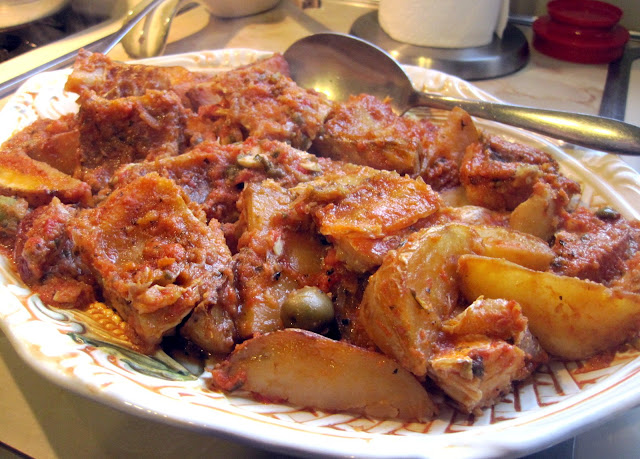
(photo: pesce stocco prepared with green olives, wedges of potatoes, and cod)

There are certain foods that stimulate the brain like a night in downtown Tokyo (with it's neon glitter and masses of humanity).  For us, stockfish or pesce stocco, the native Calabrian dish (specifically from the region around Cittanova) triggers tremendoud food memories of my grandmother Rosa and her basement kitchen in New Jersey.   

Pesce stocco, the dried not salted cod fish, is often confused with baccalà which is dried salted cod fish.  The Normans brought both variants of preserved cod fish to southern Italy by 1130 and they've remained popular food items to this day.

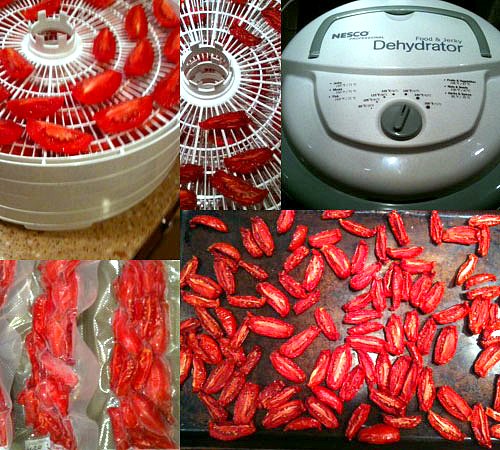
(photo: courtesy of Dr K., the home dehydrating process for tomatoes)

The following is a guest post from our friend and loyal fan, Dr. K.  Click here for all of Dr. K.'s guest posts.

You don't have to be an Italian or of Italian descent to recognize the heralded position that the tomato holds in the pantheon of Italian cuisine.  But without some careful planning, it is not possible for most Americans to enjoy fresh, high quality tomatoes year round if you're living in the United States.  Store bought tomatoes just don't make the grade (if you want to know more about what you're seeing in the grocery store in January, beware).
 
As we enter the waning days of summer and you've had your fill of tomato salad, Caprese salad, and fresh tomato sauce on your pastas and pizzas, you may be searching for a way to preserve some of nature's bounty so that you may enjoy that great tomato taste throughout the colder months.  Passato is an excellent way to enjoy the summer tomato crop in sauces, stews, soups, and braises year round, and you can find wonderfully detailed descriptions of how to can tomatoes here on Scordo.com.  Canning whole tomatoes is another popular way to enjoy tomatoes in the winter.  As a simpler alternative, you can also peel and freeze tomatoes whole, and thaw them out to use for cooking (these aren't eaten raw due to textural changes from the canning or freezing processes). 

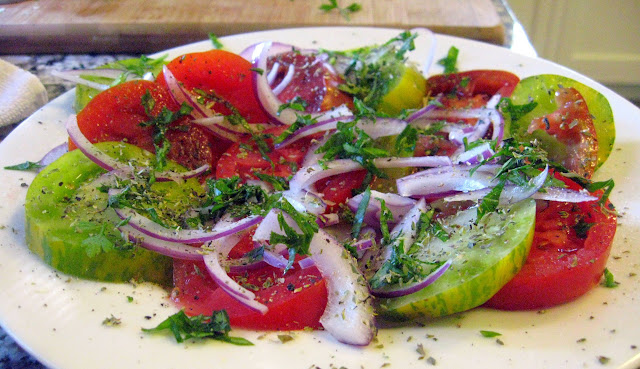
(photo: lovely friends are rare in life, lovely friends who give you heirloom tomatoes are the equivalent of Saints; thank you Dr. K.) 

One of the loveliest times of the year for individuals enamored with food here in the northeastern section of the United States is late August because, amongst other fruits and vegetables, the tomato crop is in full swing.  Here in New Jersey you can find excellent, high quality, heirloom tomatoes at small local markets, farmer's markets, and in the tiny backyards of local residents.  In fact, the tomatoes are so good in the New York metropolitan area that I'd venture to say they are one of the few food types found in the Unites States that are just as good, or even better, than their Italian counterparts.

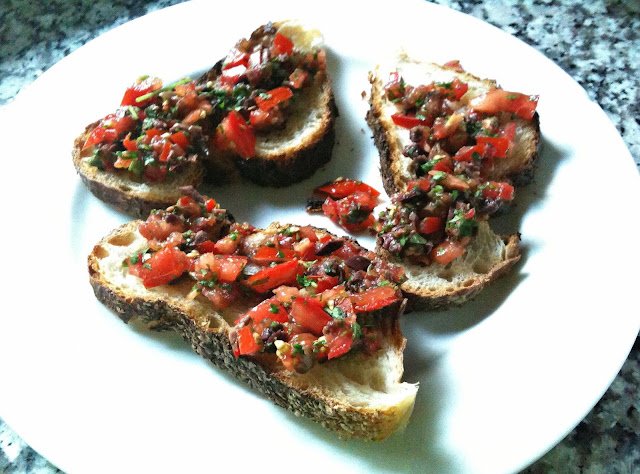
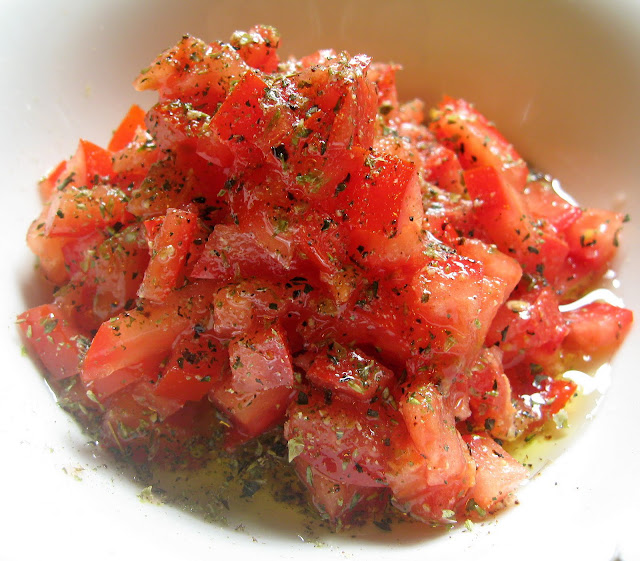
(photo: tomato bruschetta topping, minus the basil and red onion)

The simple tomato bruschetta is my go to dinner party appetizer because it's easy to prepare and universally accepted as tasting and looking good.  Our simply recipe includes finely diced ripe tomatoes (roma, plum, or San Marzano varieties) and red onion, as well as good extra virgin olive oil, Kosher salt, freshly cracked black pepper, dried oregano, and julienned basil.

Tomato bruschetta can make a great light Sunday dinner along with a piece of cheese, salumi, and olives.   

(photo: Our pizza sauce is quickly cooked with dried oregano, extra virgin olive oil, Kosher salt, and freshly ground black pepper).

I've always stuck to the claim that you can make pretty good pizza at home.  My critics argue that making "pizzeria" type pizza in a home environment is impossible given that a home stove cannot reach the 900+ degree Fahrenheit temperature a proper wood burning stove can and, moreover, impart the appropriate flavor and heat to pizza dough.  I think my critics are, in theory, correct but in a pragmatic sense entirely wrong.  That is to say, of course one can make fantastic pizza at home without a wood burning oven.    
(photo: mussels in spicy tomato wine sauce with parsley)

Mussels in red or white wine sauce is an Italian restaurant stand-by and one of my favorite seafood dishes.  The dish, however, can be easily ruined with foul seafood, thick sauces, and overcooking.  Mussels should not be rubbery, smell bad, or be covered in gelatinous "sauce."  Our version of mussels starts with the highest quality seafood you can find, so develop a relationship with a local shop and get to know the person serving you fish.  After the courting period, your fish person will reveal deep secrets about what you ought to buy and the meaning of life (and after a prolonged period of time you'll be an expert yourself and marry his first born female child).  In terms of the dish itself, keep the condiment or sauce very simple; for example, our sauce includes 6 ingredients (not including the mussels):

(photo: close up of a few Villa Cappelli sun dried tomatoes in olive oil)

One of the most important aspects of a product claiming to, in fact, be "sun dried tomatoes" is that the tomatoes are indeed dried by the sun.  We're so adamant about proper sun dried tomatoes because we produce our own variety cured in extra virgin olive oil.  The sun dried tomatoes hail from Pellegrina, Calabria and are dried by the intense Mediterranean sun.  Specifically, my grandmother lays out hundreds of hand quartered roma, plum or San Marzano tomatoes on large woven baskets with a bit of sea salt and lets mother nature do the rest.  The tomatoes dry in 2-3 days depending on the intensity of the sun.  

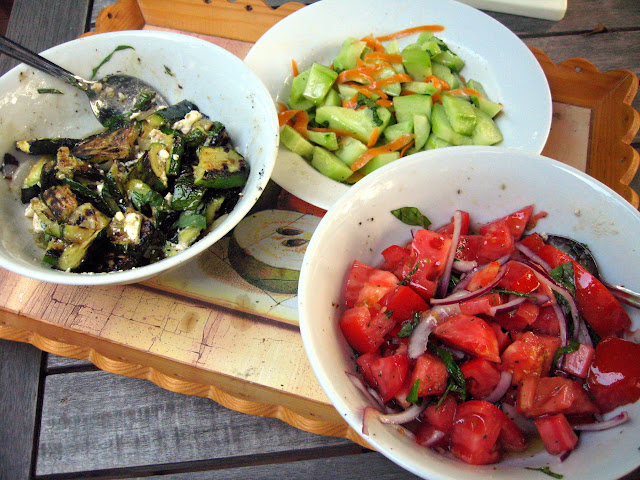
One of my favorite ways to consume olive oil is via the simple and humble tomato salad.  Our tomato salad is prepared with red onion, basil, dried oregano, Kosher salt, freshly ground black pepper and the best extra virgin olive oil we can get our hands on.  

Recently, we've fallen in love with two extra virgin olive oils that seem to have been made just for tomato salads (and, by association, whole milk mozzarella).  Specifically, we're talking about Pace da Poggio Etrusco and Laudemio Frescobaldi.  The Pace de Poggio Etrusco hails from Siena in Toscana and has a slightly sweet character along with floral and herbal notes.  The Laudemio Frescobaldi (first pressing, 2010) from Chianti Ruffina has peppery notes and reminds me of the many spring vegetables such as artichoke, asparagus, and peas.   


(photo: various food mills; ours is the top left above)

How many of you own a food mill?  Uh-oh, I only see a few hands and I'm getting some quizzical looks!   OK, let's jump out of the role play and get down to why I think everyone should own a food mill; after all, like a chef's knife and a cutting board, the food mill is one of those universal kitchen tools that you'll kick yourself for not owning earlier (here's our list of essential kitchen tools).
 
(photo: an Italian tuna sandwich with tomato salad prepared with Pace da Poggio Etrusco extra virgin olive oil) 

As many of you know we keep plenty of high quality tuna in olive oil in our Italian pantry at all times!  And we usually prepare our tuna in two ways: 1. as a stand alone salad to be consumed with olives, cheese, and salumi or 2. as a simple Italian tuna sandwich combined with high quality bread.  

Ingredients:

Process:
 
(photo: La Castellina extra virgin olive oil used to make handmade ravioli with tomato sauce)

Every once in a while a particular recipe I've made hundreds of times tastes like something completely different.  For example, my wife Erin (who secretly does much of the cooking behind Scordo.com!) made a batch of tomato sauce and I quickly proclaimed it "the best sauce ever!"  

Erin used a can of whole plum tomatoes (or pomodori pelati) from our canned tomato collection (as opposed to the passato di pomodoro we normally use).  The result was a fresh tasting tomato sauce with fabulous color and depth.  The olive oil we used also helped; in this case it was unfiltered extra virgin olive oil from La Castellina in Tuscana (La Castellina has a wonderful "brand" story).  The oil can be found at the Love From Italia web site.  

The ravioli pictured above were made by hand by my mother in law, Joyce, and were filled with ricotta and spinach.  
(photo: thanks to howtoeatlikeabird.com for providing the image)

Fresh fish requires very little manipulation and (quality) whole fish can be roasted in the oven with olive oil, Kosher salt, and freshly cracked pepper (you can stuff the cavity of the fish with parsley and lemon slices if you want to get fancy).  Firm fleshed fish like cod, red snapper, sole, halibut, and hake can also be steamed in a large pan with lemon juice, water, salt, and pepper. 

However, when I want to add a complimentary flavor to a firm white fish I almost invetibaly turn to tomatoes; specifically, a type of fresh passato that can be cooked with or separate from the fish.

Recently, I added tomato to a few pan seared scallops and the results were wonderful; namely, the contrast of sweet scallops with slightly acidic tomato tasted great.  Here's the quick recipe: 


The tomato mozzarella sandwich is so simple it hardly needs explaining, but it certainly should be prepared more often by home cooks (hence the post!).  


A good tomato mozzarella sandwich, like most Italian dishes and recipes, is dependent on great ingredients; therefore high quality tomatoes, whole or Buffalo milk mozzarella cheese, extra virgin olive oil, and bread are vital.  For my sandwich I'm using: 

I start by adding the extra virgin olive oil to both side of my bread, followed by a single layer of mozzarella and tomato.  I add salt, pepper, and oregano and a drizzle of olive oil.  If I had access to fresh basil I would include a few, bruised (to release the flavor), leaves as well.  Enjoy the sandwich with a glass of Ciro Librandi Bianco or crisp lager or IPA.
     

(photo: pan roasted eggplant with tomato sauce, prior to adding cheese and baking)


Back in August, I published a slightly unorthodox eggplant parmigiana recipe where I first roasted, mini or baby eggplant, (these are usually smaller versions of the generic eggplant found in most US supermarkets) and thereafter covered with tomato sauce, grated Parmigiano-Reggiano, and baked.  The result was outstanding but not as cheesy and decadent as the more classic, Italian American, version of eggplant parmigiana.  So, if you were asking, Vince, where's the melted mozzarella cheese, here you go:      

Ingredients:

- 2 large eggplant
- 2 cups of finely diced mozzarella (the fresh variant or the supermarket kind, whichever you have access to)
- 2-3 cloves of garlic
- dried red pepper flakes
- Kosher salt and freshly ground pepper


(photo: the first layer and prior to adding tomato sauce and cheese)

Process:

My version of the classic eggplant parmigiana starts by pan roasting two large eggplant that have been cubed into roughly 1.5 inch squares.  Pan roasting is simple but it does require a large pan, olive oil, salt and garlic, and bit of patience.  I usually add about 3-4 tablespoons of olive oil to a large pan and set my flame on medium low.  Thereafter, I add 2-3 cloves of roughly chopped garlic, a bit of red pepper flake, the cubed eggplant, and a healthy amount of Kosher salt (to draw the moisture out of the eggplant - the key to producing great eggplant). You'll want to slowly cook the eggplant over a 25-35 minutes process; stirring every 5 minutes or so.  You'll know your eggplant is cooked fully when you have nice color and a soft texture (like any recipe, taste the ingredients at every stage to ensure you get a great end result!). 


(photo: final layer with cheese <you can cube or thinly slice your cheese> prior to placing in oven)

Next, I take two small sized, and oven proof, ramekin and begin putting together layers of cubed eggplant, finely diced mozzarella, and 1-2 tablespoons of tomato sauce.  Most likely, you'll be able to build about 3 layers depending on the size of your cubed eggplant. Thereafter, you simply place the ramekins in your oven for 15-20 minutes.


(photo: final photo <taken with an iPhone> as my main camera battery died!) 

For another simple eggplant dish, see my roasted eggplant recipe.     
(photo: pizza Calabrese with multiple toppings)

I categorize pizza in the United States into two tidy compartments; namely, 1. the thin style "NY Pizzeria" pizza comprised of tomato sauce and some variation of mozzarella, made from water buffalo milk or the cow milk variant) and 2. "pizza Calabrese" which includes a minimal amount of cheese (that is to say, usually grated cheese post baking), a slightly thicker crust, possibly a bit of pomodori pelato, and multiple toppings (including mushrooms, olives, onions, etc.).

I enjoy both types of pizza styles, but when I make pizza at home I aim for pizza Calabrese.   
Here's our family pizza dough recipe from an earlier post, which includes pictures of my aunt's bakery / forno in Pellegrina, Calabria: 


Lazy, weekend, lunches are one of the small pleasure in life and I define a lazy lunch as a simple plate of food (with little to no manipulation), fresh, crunchy, bread, and a bottle of exquisite wine (psychologically, get an exquisite bottle of wine for under $20, there are fabulous wine deals out there if you stay away from California, northern Italy, Bordeaux, etc.).  The lunch should also be had outdoors and with someone you wouldn't mind spending your last waking hours with (just in case it's you last meal!).


I had such a "lazy lunch" yesterday including red and yellow tomatoes with red onion (from my mother's garden and the Purple Dragon Co-Op), thickly sliced pieces of, still warn, whole milk mozzarella (from the original, New Jersey, Cafasso's Fairway Market and not the large, uber, market that is lurching westward like a corporate giant), a French Baguette made about a mile away from our home at Balthazar's Bakery, and a can of oil cured sardines from Sicilia (the Scalia brand is my favorite)


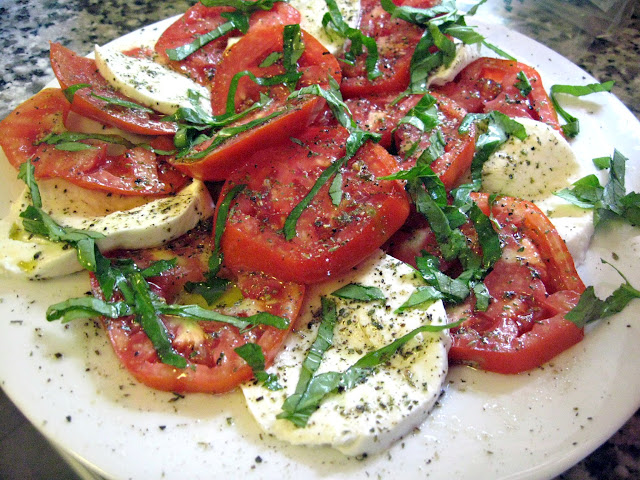
The tomatoes were simply sliced, as opposed to a formal tomato salad, and drizzled with extra virgin olive oil, kosher salt, dried oregano, freshly ground black pepper and topped with thinly sliced red onion and basil.  The mozzarella was prepared with extra virgin olive oil, black pepper, and dried oregano.  The sardines were simply emptied from the jar and set on the plate!  Click here for my guide to olive oil.

Do you have a favorite lazy weekend, and single plate, lunch combination?  
tomatoesplum
(photos: Jersey plum tomatoes washed and ready to be cut)

August is prime season for canning tomatoes and this year's Jersey plum tomatoes are outstanding!  The Scordo family purchased about five bushels of locally grown plum tomatoes and canned only passato (passato is essentially pureed tomato, in the past we canned a combination of passato and whole tomatoes).  As the site e-rcps.com points out:

Tomatoes are usually preserved in three different forms, each of which has its particular uses. First there are the ordinary tinned or bottled whole tomatoes, 1. pomodori pelati, which contain a high percentage of liquid and are best used for dishes that require a tomato base but need a long cooking time. Secondly there is the puree, 2. passato di pomodoro, which is a much thicker reduction of tomatoes, sometimes flavoured with celery, onion, carrot and basil, then called pomaruola or conserva. This is ideal for sauces which need a rich body of tomato. Thirdly there is the tomato concentrate, 3. concentrato di pomodoro, which is the tomato reduced to a very strong paste and flavour and is useful for colour and flavour in a dish where bulk tomato is not required. 

The advantage to canning passato is that when it comes time to make tomato sauce for dinner or lunch, there is no need to food mill whole tomatoes!

You can read my detailed article on how to can tomatoes here.   Enjoy the photos from our 2010 tomato canning extravaganza:

IMG_6356
(photos: cutting the plum tomatoes into sections and removing some of the seeds)

IMG_6354 
(photos: cooking cut tomatoes in large aluminum pots)   

IMG_6359
(photo: stirring the tomatoes)


IMG_6378 
(photo: almost ready for the large food mill)

 
IMG_6362 
(photo: Italian-made food mill being set up)
 

IMG_6364 
(photo: food mill set up)
 
IMG_6377
(photo: tomatoes being put through the food mill for passato)

IMG_6381
(photo: pure tomato passato!)

IMG_6384 
(photo: the food mill does a great job of removing the skins from the tomato, tomato skins are the enemy of a good tomato sauce)
  
IMG_6379 
(photo: preparing sterile mason jars with basil)
 
IMG_6380 
(photos: fresh garden basil)
 
IMG_6385 
(photo: moving passato into mason jars)
  
canning_tomatoes 
(photo: the tomato canning process is intense and very hands on, but the end result is terrific)
 
IMG_6390
(photo: future canning expert examining the end result" tomato bliss in a Mason jar!)

IMG_6361 
(photo: strainers help wash whole tomatoes)
  
IMG_6365
(photos: bushel crates, five in total for the Scordo family)
(photo: final product: layered Italian sun dried tomatoes, Kosher salt, basil, garlic, and olive oil)

One of my favorite, all purpose, condiments on this little planet is sun dried tomatoes preserved in olive oil.  Authentic sun dried tomatoes capture the essence of the tomato and can be enjoyed year round.  There is a difference between tomatoes that have been truly dried in the sun and dehydrated tomatoes (click here to learn how to dehydrate your own tomatoes).

As a young boy, one of my first vivid memory includes large outdoor tables lined with hundreds of thinly sliced tomatoes laying in the Calabrian sun.  My grandmother would dry the tomatoes outdoors for days until the slices turned a deep red color and shriveled beyond recognition.  The sun was of the southern Italian variety, of course, and the tomatoes heirloom and nurtured, by most standards, better than most small children.  The combination of dry/intense Mezzogiorno sun and superb tomatoes yielded a product that didn't need much sprucing, but leave it to Nonna Vincenzina to preserve the tomatoes and add even more flavor.

The following is Nonna Vincenzina's sun dried tomato recipe:

sundriedtom.jpg

Ingredients:

  • 3-4 cups of olive oil depending on the size of canning jar
  • Fresh basil (you'll need a good amount of leaves to include in each layer, more on this below)
  • 4-5 cloves of minced garlic
  • ½ cup of dried oregano 
  • Kosher salt 
  • 3-5 pounds of sun dried tomatoes (try and find the imported variety; here's a link to some organic sun dried tomatoes just in case you can't get them from Italy)
Process:

Start by finding a large, wide mouth, mason jar; pint size is fine, but if you can find larger jars they'll store more tomatoes.  Wash your mason jar very well and you can even go as far as sterilizing the jar.  Moreover, it's vital that your hands and any other tool used for the process are exceptionally clean.  Next, begin layering your unseasoned sun dried tomatoes in the jar in the following order:

  1. layer of tomatoes
  2. sprinkle of kosher salt
  3. pinch of garlic
  4. pinch of dried oregano
  5. and a layer of fresh basil leaves

Repeat the above layering process until you're nearly at the top of the jar (don't over stuff the jar because your last step includes filling the jar with olive oil).  When you're finished with each layer push down with a flat object to compress the ingredients.  Finally, fill the jar with olive oil, making sure that the tomatoes are completely submerged (note: the oil will need some time to settle so make sure all of the tomatoes are covered).  

Screw on the lid tightly and store the jar in a cool, dark, closet or cupboard.  You'll need to let the tomatoes sit 6-8 days before consuming them (the oil needs to soften the tomatoes and you also need to let the garlic, basel, and oregano do it's thing).

sundriedtom2.jpg

Some of my favorite uses for sun dried tomatoes include:

  • Lazy weekend lunch with sharp cheese, good bread, and wine
  • In any type of sandwich
  • As a side dish with roasted pork chops, grilled chicken, or simple white fish (e.g., flounder, cod, etc.)
Sun dried tomatoes go well with a crisp white wine to off-set the sweet and rich flavor of the cured tomato; try a nice Chenin Blanc from South Africa (yes, I know it's not a southern Italian wine, but, hey, it pairs nicely!)

Note and Disclaimer: It's vital when you cure vegetables in olive oil that you thoroughly clean the jar itself as well as all the ingredients and utensils used in the preparation.  My family has been curing and pickling vegetables (as well as tomatoes for tomato sauce) for well over 50 years and we haven't had any health issues.   Although our family has been doing this for many years without incident, there aren't good studies establishing this practice as safe.  Many food safety authorities advise against preserving tomatoes and garlic in oil due the risk of bacterial contamination and proliferation of spores, especially clostridium botulinum, which could be fatal.
scordo on twitter scordo.com on facebook become a fan stumble scordo rss feed for scordo

Scordo.com Free Newsletter - Sign Up Today
* indicates required

BECOME A FAN OF SCORDO ON FACEBOOK:


GOOD READING:


MORE ABOUT US:


FEATURED STORIES:


Homemade Sun Dried Tomatoes in Olive Oil Recipe
Don't settle for the canned varieties found at supermarkets; find out how to make your own [+]


How to Make Authentic Tomato Sauce
This is the authentic Scordo family recipe - straight from Calabria. You'll be amazed at how simple the recipe is to make [+]


Guide to Italian Extra Virgin Olive Oil
My grandfather produced his own extra virgin olive oil in Italy and I've put together an olive oil buying guide just for you [+]


How to Make Rice Balls or Arancini At Home
The ultimate Italian street food - these fried treats are great for the holidays or for any lunch or dinner; try them with your kids [+]


Guide to Making Espresso at Home
Making good espresso at home isn't easy but once you master a few easy tips you'll never settle for the junk served at most cafes in the US, including Starbucks [+]


Why You Should Not Eat Out
My argument on why eating out doesn't make sense [+]


Guide to Italian Meats: Salame, Capicola, Prosciutto, etc.
Learn all about the great "deli meats" and authentic cured specialties from Italy [+]


Scordo Pizza Recipe
Who doesn't love pizza, but did you know it's real easy to make at home [+]


English to Italian Translation Powered by
Grab this Widget


SPONSORS, AFFILIATES, SUPPORTERS:

Italian Food and Life Site


mymelange
Independent Budget Backpacking Travel Tips

Advertise with Scordo.com


DONATE AND HELP KEEP US GOING:


Feeling generous and want to help keep Scordo.com producing fresh and original content?


QUESTIONS, IDEAS, TIPS:


email scordo.com: blog at scordo.com


Note: The views expressed herein are solely my own and should not be attributed to my employer in any way. This site is not maintained utilizing my employer's resources or on company time.


RSS feed graphic for scordo.com Subscribe to Scordo.com via RSSBlog Flux Directory