
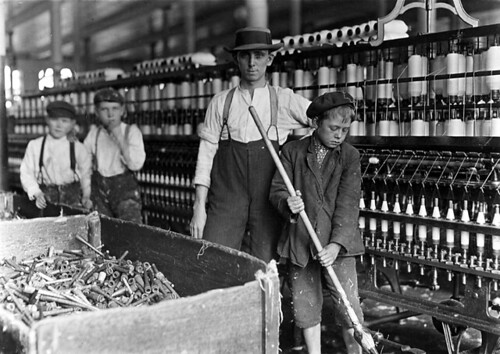
Continuing on the theme of offering parents practical tips, I ask the all important question: Do Your Children Hustle? 7 Tips for Parents For Ensuring a Strong Work Ethic
Teaching your kids to hustle or instilling a good work ethic is critical to raising children, in my view. And it seems many of today’s young children are spoiled and posses a sense of self entitlement, partly because of parenting style and cultural norms. I’m afraid that the old school mentality of not babying children may indeed be correct. I’m certainly not advocating that parents create a “sweat shop” (per the photo above) atmosphere at home, but parents must create an environment that consists of A., love, B., compassion, C., safety, and D., the idea that working hard is important.
Here are a few tips that may instill the “hustling” mentality in your young children:
1. Be a role model. Do you work hard around the house? Children are like little scientists who observe and thereafter run tests (specifically, they’re observing their parents and then mimicking what they see).
2.Talk about the value of work. Tell your children about what hard work means and what it can provide in the way of security and rewards. It’s often a good idea to reinforce what children observe with an explanation via a conversation.
3. Allow your child to fail, yet don’t allow them to not finish a given task or chore around the house. One of the most critical life lessons my parents taught me early on is that it’s ok to make mistakes, fail, or not do something well, but it’s never ok to be lazy or not complete a given project. In turn, I think they instilled stubbornness in me (for better or worse!). Is stubbornness a good life skill?
4. Teach your kids the value of money and that working hard can lead to acquiring money for savings and a good quality of life. I’ve heard from parenting experts who advise not to teach young kids about money, but rather wait for the appropriate time period (that is, once they reach a certain age). In my view, it’s never too early to begin talking about money with children (of course the conversation should scale with the your child’s age and cognitive ability, but generally the US produces young adults with a very poor personal finance IQ).
5. Point out examples of laziness or behavior that is not acceptable. It’s tough for young kids to understand theory, but they easily digest examples of bad behavior in the real world. Here I’m not advocating a boot camp type mentality but I do believe that discipline is a good thing when raising kids.
6. Try and instill patience and the idea that work will not be enjoyable or fun all the time. I had a hard time with acquiring the patience skill set as a child and I often wanted to finish up my homework, chores, meals, etc. in the quickest possible fashion. In my mind if I finished something quickly I could move on to the next thing whether it be playing outside or getting to school. Patience is a great skill set and it goes hand in hand with the idea of having perspective (or not sweating the small stuff).
7. Reward your child if they show positive behavior– including a small allowance, day at the park, a new book from the bookstore, etc. Children need motivation just like adults!
Update February, 2010: It’s interesting to look back at the above tips after having a child. Back in Jan of 2009 we were 6 months away from having our first child and I have to say that I wouldn’t change any of my recommendations.
What I will say, however, is that I can see why I compassionate parent would want to spoil their child. Like most good parents, you want to see your child happy and without worry, but it’s important to differentiate between a child’s long term happiness and the sort of quick hit happiness that comes about with spoiling your child on a day to day basis.


Hey Vin,
Great post! I most definitely agree that it is vitally important for kids to see their parents practicing what they preach. Its amazing how children mimic their parents early on, then tend to hate everything their parents do in adolescence, but find themselves doing those very same things as adults! For that reason, I think its important to work hard as a parent and demonstrate appropriate, respectful, honorable characteristics – hard work being one of them.
By the way, I love that picture. The poor kid looks miserable! (please note that we do not advocate forcing your kid to continue sweeping your sweat shop as you are smiling for a photo) 🙂
— Mike
Interesting thoughts Vin; I agree parents should try to teach responsibility and the importance of money to their children. I imagine that it is a challenge for parents to consider this and also to help their children take advantage of opportunities to be involved in education and programs for the youth, such as those I was very fortunate to be a part of as a child.
This is definitely true and have always respected my parents for the work ethics that they have instilled early on.
I will not allow my niece/nephew to sweep in a factory, however, until they are the legal age. There are laws now Vinny that we must follow!
Hi Mike,
I bet the adult in the photo is from Calabria! Thanks for the comment, raising kids is challenging, but why not try and instill the right characteristics from the very beginning!
Vin
Hi Simon,
Thanks for the comment. I think you can both raise a child to understand the value of hard work and also give him/her opportunities (such as music lessons, sports, cultural experiences, etc.). Like most things, I suppose raising children is all about balance.
Best,
Vin
How about work in an auto body shop; you know get underneath the car and change the oil?
: – )
Vin
It’s a balance for parents; ultimately, it’s about the parent understanding a given child and giving them what they need.
Vince
Benefiting From The Recession
For most Americans the recession seems to be, and to borrow a marketing term, top of mind. You hear stories of the successful, white collar, executive being downsized because his product is being eliminated from the US market or of…
Best Of / Top Posts
HOW-TO and TIPS:Best Tools For HomeownersRecent College Grad TipsHow Many Shoes Should A Man OwnTips on Cleaning Your Kitchen and HomeTips for First Time Home BuyersHow Stress is Preventing You From Leading a Happy LifeHow to Make Homemade Wine and…
Avoiding the Disease of Self Entitlement: 3 Symptoms and Cures
I see it all the time, twenty and thirty somethings ingrained with the idea that they deserve what they deem desirable, whether it be a new wardrobe, apartment in a trendy city, new luxury car, a monstrous new kitchen, the…