September 2010 Archives


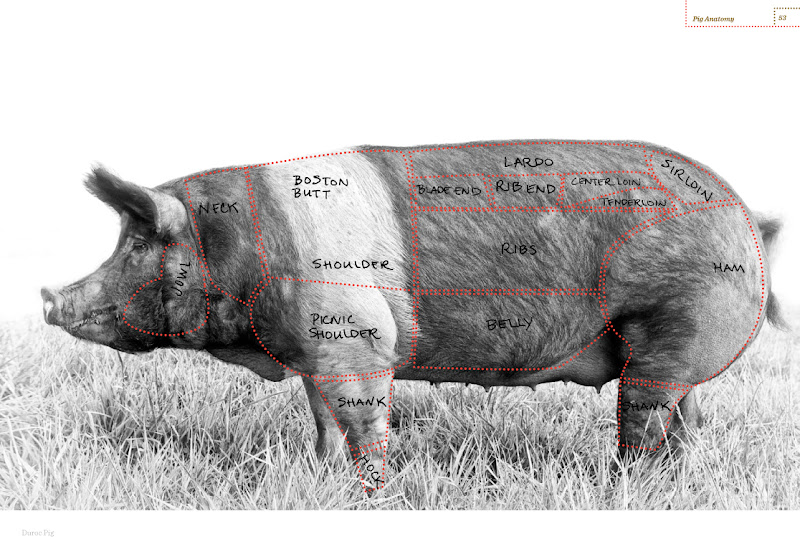
(photo: the varying parts of a pig, photo courtesy of Meat Salt Time by Tony Seichrist)

 I have to admit, I have an addiction.  Specifically, my addiction is centered on the mighty pig and it's cured off-spring, Salami!  

Salumi (the plural for salami) is made from either a single, whole, cut (e.g., Prosciutto) or ground parts of the pig.  All salumi (at times referred to as charcuterie) is cured, including some type of spice, and is aged for varying periods of time (for most Italians, cooked pork products, such as mortadella and prosciutto cotto, would also be considered salumi). 

Some of the more popular salumi in Italy include, Cotechino or Zampone, Guanciale, Lardo, Pancetta, Salame, Salame genovese di Sant'Olcese, Felino, 'Nduja, Soppressata, Ciauscolo, Prosciutto, Prosciutto di Parma, Prosciutto di San Daniele, Speck, Culatello (a personal favorite), Culaccia / Culatta, Prosciutto cotto, Capicola (another personal favorite), etc.  See my guide to salumi for more information. 

Scroll down for a chance to win a great book on how salami is made!

(photo: Salumi drying in cells and developing mold.  photo courtesy of Meat Salt Time by Tony Seichrist)

All great salami starts with a high quality pig, such as Duroc, Ossabaw, Mangalitsa, Pata Negra, etc.  And salumi such as Felino or Soppressata are made from different parts of the pig including the neck, belly, loin, jowl, etc.  The pig parts need to be ground before the spicing and stuffing process can begin. And as you probably guessed, both the lean and fatty parts of the pig are used during the grinding process (in fact, this is a key step because a good salumi needs a good ratio of fatty to lean meat).  Before the grinding takes place, most salumi makers coarsely chop their cuts of meat and thereafter it goes through a coarse grind plate.  Next, the meat is ready for salt and spice.  

The best salumi makers, such as Christiano Creminelli (who is the subject of a new book by Tony Seichrist entitled, "Meat Salt Time), use high quality sea salt and spices such as black pepper, garlic powder, nutmeg, dextrose or sugar, chili flakes, cloves, fennel seed, juniper berries, white pepper, etc.  The spices vary according to the type of salumi being produced, but most salumi are usually comprised of about 3% salt.  

(photo: Different Salumi spices, in this case the type of spices used by Creminelli.  photo courtesy of Meat Salt Time by Tony Seichrist)

After the spicing process, the salumi mixture is stuffed into a natural casing and tied and the critical fermentation process begins.  During the fermentation process, they key goal is to control temperature and humidity.  As Seichrist explains:

"The temperature and humidity are primed for bacterial growth, and the sugars in the recipe provide food for the growing culture.  As the bacteria begin to multiply and consume the sugars, there is a sudden drop in PH.  It is this sudden lowering of the pH that renders salumi completely safe to eat."  

The fermentation process also allows the salt in the meat to pull the water out of the salumi (this is what "drys the salumi and the high humidity during the process prevents the meat from drying out too much").  The ideal temperature at the beginning of the fermentation process is about 73-75 degrees with humidity close to 100 percent.  After about 10 hours, the humidity level needs to be dropped to 60 percent (for about 5 hours) with a gradual drop in temperature, as well.  After the 5 hours the humidity level is raised slowly (during a 4-5 day process) to about 75-85 percent with a temperature between 55-60 degrees.  The salumi stay in the aforementioned environmental conditions (usually in a curing cell when making large production batches) for about 17 days (during which critical mold and bacteria is created as well), in total.  

Are you interested in learning more about the salami making process and how high quality artisan producers such as Creminelli make their products?  If so, enter to win your very own copy of Meat Salt Time ; the book includes some of the best food photography I've seen(!):

- Only one entry per person please.

- The contest is open until 12 midnight on 10/4 and a single (1) random user will be picked via Random.org (sorry contest only open to folks from the US given shipping logistics).  The winner will be announced immediately on Twitter (so please follow me) and on Scordo.com by 8PM on Tuesday, 10/7.

- Requirements (both are needed): 1. Become a fan of Scordo.com on Facebook (if you're a fan already please "share" the page on your Facebook account) and 2. leave a comment here on your favorite food process, that is, something like making salami that you know well (e.g., making homemade pasta or fried chicken).  

- The book publisher will send out the book to a single contest winner during the week of 10/11.
  
(photo: Christiano monitoring the butchering process. photo courtesy of Meat Salt Time by Tony Seichrist)

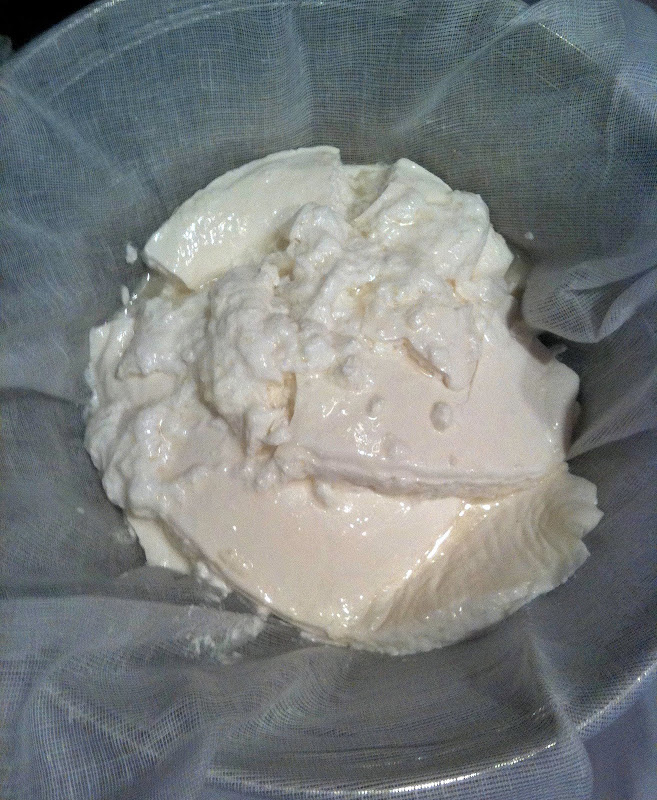
(photo: moist curds <ladled after 12 hours> before hanging to drain further, courtesy of Dr. K.)

Our good friend Dr. K has passed along his homemade chèvre (goat milk) cheese recipe and I'm excited to be able to share it with our loyal Scordo.com readers.   Goat cheese is made in Calabria, of course, and it's some of the best produced cheese on the planet.  In Aspromonte, close to our family's village in Pellegrina, you'll find Caprino dell'Aspromonte in either a soft or hard variety.  Click here for my homemade ricotta recipe and my guide to southern Italian cheeses.   

I was excited about Dr. K.'s recipe because of it's simplicity and the fact that buying chèvre from the store is expensive.  In turn, here's Dr. K.'s recipe:

Take a gallon of goat milk. Make sure it's not ultra-pasteurized. If it's raw, you can pasteurize it yourself on the stove. Heat it to 86 degrees, or cool to 86 after pasteurizing. Add 1 packet of chevre direct set culture. I get mine from the New England Cheesemaking Supply Company  - great resource for cheese making). Stir thoroughly. Cover with lid and let stand at room temp for 12 -20 hours or until firm. Ladle the curds into butter muslin (like a very tight woven cheesecloth, not the kind they sell in most stores) over a bowl or colander.  Hang the cheese in butter muslin and allow to drain 6 - 12 hours, depending on how thick you want it. Add salt and herbs if desired. I add Herbes de Provence.

(photo: draining the cheese for 6-12 hours, photo courtesy of Dr. K.)

The recipe yields at least a pound of cheese which would, as stated above, otherwise cost a ridiculous sum at the store.  Make the recipe at home, and the cost includes only the milk plus maybe a dollars for the culture.


(photo: the final product used with fresh tomatoes, courtesy of Dr. K.)

Here's another excellent recipe for goat Chèvre from the folks at the Humble Garden.  Click here for my homemade ricotta recipe and my guide to southern Italian cheeses
(photo: a family shot during World Cup 2006, a far better showing for the Azzurri!) 

The following post is a long time in the making.  For a few months now I've been wanting to share a list of some of the top, Italian-themed, sites and blogs on the web.

In turn, here's my, unofficial, alphabetically inspired, and unscientific list of top Italy sites (written in English).  If you're a dear, dear friend and I've failed to include you please send me a note.  I also encourage everyone to follow the folks below on Facebook and Twitter, if you want to be in the know on all things Italian.

1. Bleeding Espresso
An ex-pat, and former attorney, living in Calabria Michelle shares her experience about Calabrian culture, food, etc.

2. Blog From Italy
Alex runs this "general" news from Italy blog, including music, travel, and "good Italian things"

3. Calabria From Scratch
Authentic recipes from Calabria via an engineer turned cookbook author.


6. Ciao Amalfi
Laura is an American writer who now lives and writes exclusively about the Amalfi Coast.

7. Frutto Della Passione
Joanne's blog is all about Italian food.

8. Italofile
Melanie has a focus on travel and Italy.


10. Melange
Robin has some great food photos, as well wonderful content on traveling to Italy and France.

11. My Bella Vita
Cheryl focuses on life and travel in Southern Italy (from a woman originally from the American south!)

12. Ms. Adventures in Italy
Run by Sarah who has lived all over Italy.


14. Why Go ITaly
Travelling to Italy, then visit Jessica's comprehensive site.

15. Zoomata
Nicole writes about general Italian goings-on.

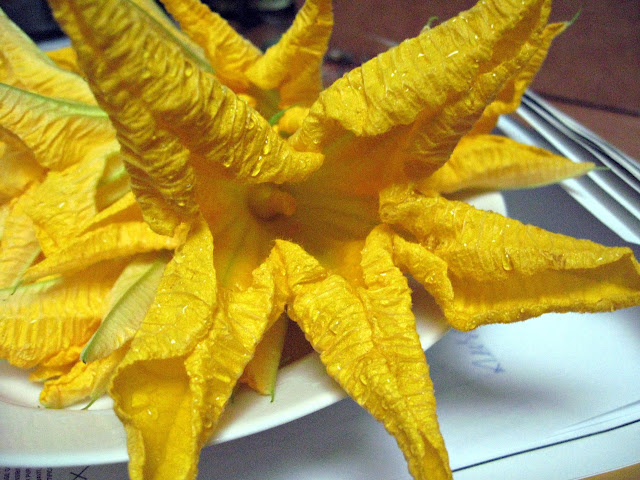
(photo: fresh frittelle di fiori di zucca, or zucchini fritterr; most Italians cosume this little treasures as a pre-dinner type of meal)

Michelle over at BleedingEspresso.com recently posted an excellent recipe for Fried Zucchini Flowers and it inspired me to look through my photo archive and post a few Frittelle photos.

Michelle's recipe is similar to the recipe my mother has been using for nearly 30 years here in the States, however my mother's version does include a few more ingredients (namely, grated Parmigiano-Reggiano and fresh parsley).  My mother's technique also includes "flattening" out the batter when it hits the hot oil so that thin frittelle are produced.  Note, you can also simply batter and fry a single, whole, zucchini flower (I prefer chopping the flowers to release more flavor).

For many Calabrians the zucchni flower is the best part of the vegetable (in fact, and to be perfectly honest, zucchini are often seen as "second rate" vegetables in Calabria, don't ask me to explain this view but I think it has something to do with the abundance of zucchini during the summer months and the same can be said about other fruits and vegetables in the region).

Here's my mother's recipe:

- 1-2 cups of roughly chopped zucchini flowers (with the stem removed and interior material removed)
- 1.5 cups of flour
- 2 tablespoons of baking powder
- 1 cup of milk
- 1 egg
- 3/4 tablespoons of salt
- 1 pinch of black pepper

Oil for frying (you can use olive oil but I think it's a big waste of a precious oil, try an oil with a higher smoking point that is less expensive like Canola, for example)

The technique is fairly simple: start by mixing the flour, baking powder and salt together. Grab another bowl and mix the milk, egg and zucchini flowers.  Combine the dry ingredients well and fry until crispy and golden (about 4 minutes if your oil is at the correct temperature). 
   

(photo: harvesting zucchini flowers outside of Bagnara Calabra in the village of Pellegrina, my parent's birthplace)

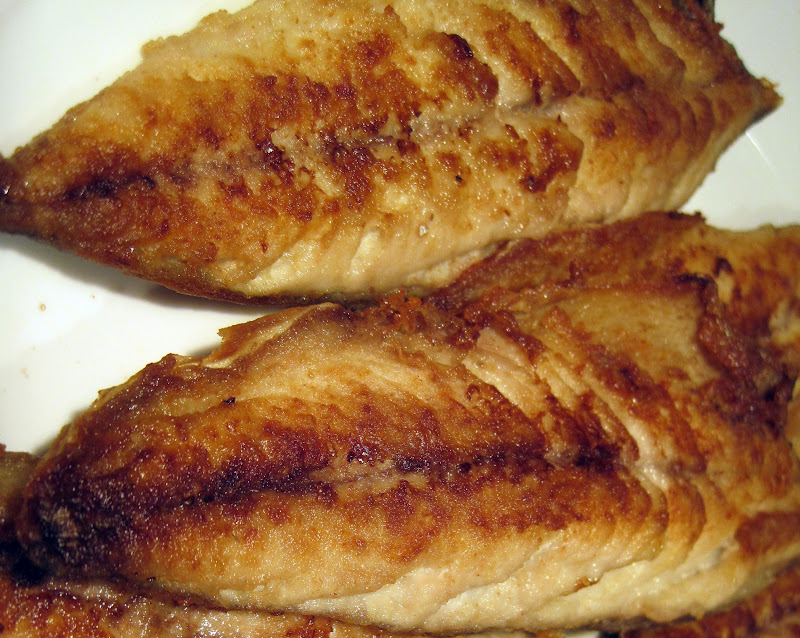
(photo: just out of the oven baked mackerel)

I've written about my love of fish on multiple occasions here on Scordo.com, expounding on sardines, smelts, tuna, branzino, and salmon.  Yet I was sad to discover that while I hold all of the aforementioned fish in high esteem, I've only written about fresh mackerel on one other occassion (leaving one of my favorite fish with a single entry!).


(photo: baked mackerel with olive oil, salt, and pepper)

Mackerel is an ideal fish, in my view, because it has a wonderful texture, oily composition, and includes a meaty flavor profile which is akin to good canned tuna in olive oil.  The fish has a firm flesh and is extremely high in vitamin B 12, Omega 3 (a type of fatty acid), and Phosphatidylserine (linked to positive brain function, especially in folks suffering from dementia, for example).  In fact, Mackerel has twice the amount of Omega 3 than Salmon.  Mackerel is also low in mercury and the Atlantic variety is in good shape (from an over-fishing perspective).

I recently prepared a baked version of mackerel with a vinegar based sauce comprising of fresh mint, salt, pepper, red wine vinegar, dryed oregano, and garlic.


(photo: Calabrian vinegar and mint sauce referred to as Sermoglio)

My mother refers to the sauce as "sermoglio" and is typical in Calabria and used with many fish dishes, including swordfish. 

I served the mackerel with a split pea soup and sauteed broccoli rabe.
 

(photo: split pea soup with carrots, garlic, and fresh parsely)


(photo: brocolli rabe)


(photo: freshly made croutons to accompany the split pea soup)


(photo: vinegar and mint sauce with baked mackerel) 


We'll be back soon because we're living the Italian way (that is to say, we're enjoying some time off). 

In the meantime, please see our top posts!


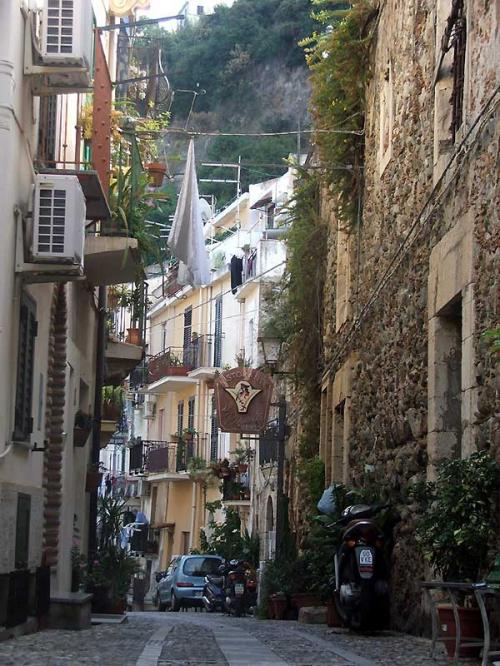
(photo: street scene in Bagnara Calabra, courtesy of myworldshots.com )

I'm going to make a statement that may upset serious cooks, but here goes: It's almost impossible to cook foods from other places in the world outside of their place of origin.  I'm not stating an absolute truth because you can get pretty damn close to replicating a pizza from Naples for example; maybe importing a wood burning stove (along with olive wood or some other exotic species to get the right temperature), specialty flour, San Marzano tomatoes, and bottled water from Italy, but at the end of the day it's just not going to taste the same as, say, a pizza made in Italy. 

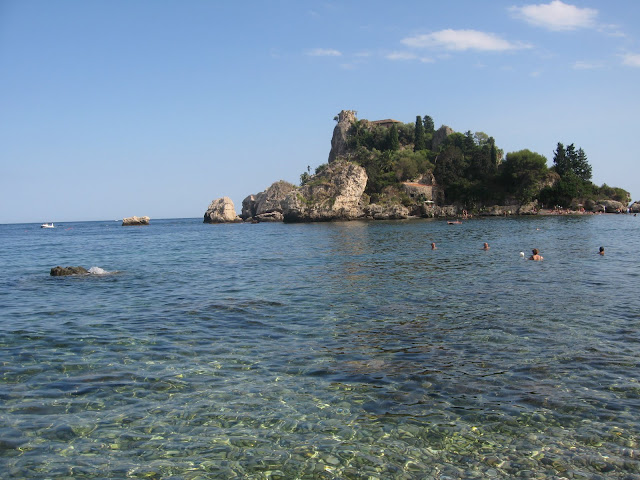
There are intangibles when experiencing a given food, including the physical environment, the person preparing the food item, and, of course, the psychological state the eater is in.  For example, if you're on vacation in August in Bagnara Calabra facing the Stretto di Messina in Southern Italy and you order a pizza and a cold beer at a local eatery, you're going to consume a pizza made with fresh mountain water, just harvested tomatoes, and first cold pressed olive oil from one of the surrounding villages.  You'll also be sun-burnt and famished because you've spent a few hours on Bagnara's famous Violet Coast.  In other words, that pizza will most likely be the best you've ever tasted. 


(photo: courtesy of Artisan Books)

My point above is not to discourage you from cooking Italian food in the US, but rather to make a subtle point that all Italian food made in the US is "Italian-American" food (this, to get fancy with a philosophical term, is an a priori truth <i.e., a truth independent of experience!>).  I cook Italian-American food, my mother cooks Italian-American food, and Mario Batali, for example, cooks Italian-American food. 


(photo: courtesy of Artisan Books)

Frank Falcinelli and Frank Castronovo cook classic Italian-American food (by way of their families) and they are both extremely proud of the cuisine they serve each and every night at their restaurant.   And, although, I have not eaten at their Carol Gardens, Brooklyn restaurant Frankies Spuntino, they rightly situate the "American" in the "Italian-American" food category (that is to say, their recipes and cooking style focus on the classics of Italian American cuisine, rather than to try and bring "authentic" Italian fare to it's customers which, to my point above, is impossible in the US!)

Falcinelli and Castronovo recently published their first cookbook entitled, "The Frankies Spuntino Kitchen Companion and Cooking Manual" and the book hits on a few terrific themes including bringing the classic dishes prepared in their Brooklyn restaurant into your home kitchen. 


The book, which is beautifully produced and leather-bound, has terrific illustrations and includes sections on cooking equipment and the Italian pantry, as well as a wonderful chapter on the philosophy of "Sunday Sauce." The same chapter has a brilliant timelines of how to go about constructing a traditional Italian meal on Sunday (this section would make any engineer proud!). 

Other recipes included in the cookbook (really a "cooking manual) are Linguine with Fava Beans, Garlic, Tomato and Bread Crumb, Sardine, Blood Orange, and Puntarelle Salad, Cipollini Onion Vinaigrette, Roasted Eggplant, Braised Pork Shank with Gigante Beans and Rosemary.  Falcinelli and Castronovo have produced an excellent, all around, cookbook and it may be the only Italian-American cookbook you'll ever need to use in your kitchen!   In fact, why don't you enter to win a chance to receive your very own copy the The Frankie Spuntino Kitchen Companion!  Here's what you need to do:

- Only one entry per person please.

- The contest is open until 12 midnight on 9/20 and a single (1) random user will be picked via Random.org (sorry contest only open to folks from the US given shipping logistics).  The winner will be announced immediately on Twitter (so please follow me) and on Scordo.com by 8PM on Friday, 9/21.

- Requirements (both are needed): 1. Become a fan of Scordo.com on Facebook (if you're a fan already please "share" the page on your Facebook account) and 2. leave a comment on an experience you've had where a dish/food item was incredible because of the location / atmosphere. 

- Artisan Books will send out the book to a single contest winner during the week of 9/27.

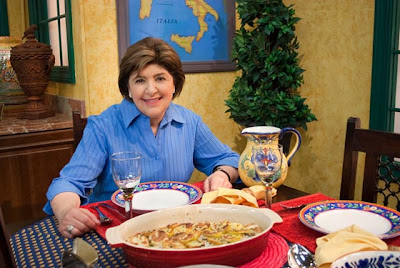
(Photo: Mary Ann Esposito, photo courtesy of NY Mag)

Every big idea or theory has an associated sound bite.  The French philosopher Rene Descartes is remembered for his famous line, "I think, therefore I am.", the chef Jacques Pepin loves to utter, "fast food my way", and the chef, turned uber capitalist Lidia Bastianich (see the mega Italian Mall, Eataly, just opened with Mario Batali and Lidia's son, Joe) loves to utter "Tutti a tavola a mangiare" (translated roughly as everyone come to the tables it's time to eat - kind of ordinary sounding in English!) after she prepares her TV meal.

If the Italian table had an associated sound bite it would be something like, "simple ingredients make outstanding food."  Give me a few days and I'll jazz up the tag line, but the idea of simple, great tasting, food made via fresh and seasonal ingredients is at the heart of what it means to eat or cook like an Italian

For PBS host and cookbook author Mary Ann Esposito she's taken the idea that the best Italian food is made via simple, and fresh, ingredients as a literal truth and just released her new cookbook, Ciao Italia: Five Ingredient Favorites.  Mary Ann's book includes recipes (from dinner to dessert) that are made with five ingredients or less (including salt and pepper).  Some of my favorites include pork chops with pistachio crust, Prosciutto di Parma and pine nut pizza, and chocolate, hazelnut and banana tartlets.


(Photo: Mushroom and celery salad from Ciao Italia Five ingredient Favorites by Mary Ann Esposito. St Martins Press, NY)

In honor of the new cookbook and the fact that I used to see Mary Ann Esposito on the campus of the University of New Hampshire (she tapped her PBS show Ciao Italia close to campus) during my undergraduate years (I never had the courage to introduce myself), I interviewed Mary Ann and asked her a series of questions about her Italian American experience and how she defines Italian cooking.


Moreover, Scordo.com has also partnered with Mary Ann to offer one lucky reader a chance to win a free copy of Ciao Italia: Five Ingredient Favorites!  Here's what you'll need to do to enter the contest:

- Become a fan (or encourage somone to fan) Scordo.com on Facebook and leave a comment on our wall on your favorite, simple, Italian recipe or food and 2. Become a fan of Mary Ann on Facebook.

- Only one entry per person please.

- The contest is open until 12 midnight on 9/9 and a single (1) random user will be picked via Random.org (sorry contest only open to folks from the US given shipping logistics).  The winner will be announced immediately on Twitter (so please follow me) and on Scordo.com by 8PM on Friday, 9/10.

- Please be sure to send me an email to let me know you've become a fan on Facebook (sorry, Facebook doesn't allow me to sort by new fans), email me at blog at scordo dot com

- Mary Ann's publisher will send out the book to a single contest winner during the week of 9/13.

Finally, here's my interview with Mary Ann, enjoy: 

Question One:
Tell us what it means to be an Italian-American and how you would best suggest to young Italian-Americans to keep our traditions alive and well (across food, lifestyle, and general living)?

Mary Ann's Answer:
"It means everything to me because the Italian culture has historically set the standard for so much of world achievements.  When you think of inventions, art, architecture, music, saints, science, religion, fashion, family and food, much of it has been attributed to the Italians. Young Italian Americans should involve themselves in organizations like the National Italian American Foundation, study Italian in school and on their own and above all talk to their family members about the history of the immigrants who made them who they are today. I try to do this through our web site ciaoitalia.com and Mary Ann Esposito Foundation which encourages would be chefs to study Italian regional cooking. You can learn more about the foundation on the web site."

Question Two:
What part of Italy did your family originate from?  What traditions do you (or your family) bring to the US from Italy?

Mary Ann's Answer:
My family is from the province of Avellino in the region of Campania and Caltanisetta in Sicily. My grandparents were very proud but poor people. First and foremost they brought strength and a fearless attitude. They brought strong religious faith. They brought their skills of tailoring and farming and olive culture. They made wine; we did the same. They cultivated gardens; we did the same. They made all their own food; we do the same. I try to emulate their traditions by recreating the foods I grew up via my books and my PBS series television, Ciao Italia now in its 21st year of broadcast. I also keep my family traditions alive through my blog.

Question Three:
How you define Italian cooking at home?

Mary Ann's Answer:
Fresh, in season ingredients, treated simply to keep the integrity of the food. All my cookbooks stress this.


(Photo: Pistachio pork chops from Ciao Italia Five Ingredient Favorites by Mary Ann Esposito. St Martins Press, NY)

Question Four:
You have a Masters Degree in history from the University of New Hampshire; has your knowledge of history impacted how you cook and see the world?

Mary Ann's Answer:
Absolutely. When I wrote my thesis on a Renaissance Italian cooking manuscript, I began my introduction by saying without food there is no history. Food and history are inseparable. Early foods like grains, legumes and puls allowed civilization to flourish and many wars were waged over whether there was food or not. In Italian culture, food is the cornerstone of everything. Take bread as an example. When I make it, I am reminded of how this simple staple from water and flour is still the staple food of third world and emerging nations. I see that waste not want not quality that my grandparents had who revered bread so much that not a bit was every wasted. To this day, I never throw away stale bread, using it instead for bread salads, as fillers for vegetables, to sprinkle over pasta dishes and as what has come to be very chic and in today, the bruschetta or crostino.

On Ciao Italia I give you not only a recipe but the story behind the recipe; where does it come from, why is it named so. The Mary Ann Esposito Foundation's goal is to keep the history and traditions surrounding Italian regional foods alive. I want the next generation of Italian Americans to take over where I leave off so we can preserve our heritage for generations to come.

Question Five:
What are some of your favorite recipes and food types outside of traditional pasta with tomato sauce, for example?

Mary Ann's Answer:
I love to make polenta and risotto as well as traditional breads and pizza. Once you start studying the regions of Italy and their local foods, you have a better understanding of why there really is no Italian food per se; there is only regional food. I love eels from the Veneto and from Sardinia; the bistecca of Florence and the porchetta of Umbria. Any eggplant dishes and rabbit stews are also favorites. I have so many that it would be impossible to mention them all here and that is why their importance has consumed me in my work.

Question Six:
What are the top five ingredients that you keep in your pantry at all times?

Mary Ann's Answer:
Extra virgin olive oils, imported semolina pastas, dried beans, arborio rice, San Marzano tomatoes. In fact my latest book is called Ciao Italia Five Ingredient Favorites and you would be surprised how much you can make with just 5 ingredients as opposed to a whole list!
scordo on twitter scordo.com on facebook become a fan stumble scordo rss feed for scordo

Scordo.com Free Newsletter - Sign Up Today
* indicates required

BECOME A FAN OF SCORDO ON FACEBOOK:


GOOD READING:


MORE ABOUT US:


FEATURED STORIES:


Homemade Sun Dried Tomatoes in Olive Oil Recipe
Don't settle for the canned varieties found at supermarkets; find out how to make your own [+]


How to Make Authentic Tomato Sauce
This is the authentic Scordo family recipe - straight from Calabria. You'll be amazed at how simple the recipe is to make [+]


Guide to Italian Extra Virgin Olive Oil
My grandfather produced his own extra virgin olive oil in Italy and I've put together an olive oil buying guide just for you [+]


How to Make Rice Balls or Arancini At Home
The ultimate Italian street food - these fried treats are great for the holidays or for any lunch or dinner; try them with your kids [+]


Guide to Making Espresso at Home
Making good espresso at home isn't easy but once you master a few easy tips you'll never settle for the junk served at most cafes in the US, including Starbucks [+]


Why You Should Not Eat Out
My argument on why eating out doesn't make sense [+]


Guide to Italian Meats: Salame, Capicola, Prosciutto, etc.
Learn all about the great "deli meats" and authentic cured specialties from Italy [+]


Scordo Pizza Recipe
Who doesn't love pizza, but did you know it's real easy to make at home [+]


English to Italian Translation Powered by
Grab this Widget


SPONSORS, AFFILIATES, SUPPORTERS:

Italian Food and Life Site


mymelange
Independent Budget Backpacking Travel Tips

Advertise with Scordo.com


DONATE AND HELP KEEP US GOING:


Feeling generous and want to help keep Scordo.com producing fresh and original content?


QUESTIONS, IDEAS, TIPS:


email scordo.com: blog at scordo.com


Note: The views expressed herein are solely my own and should not be attributed to my employer in any way. This site is not maintained utilizing my employer's resources or on company time.


RSS feed graphic for scordo.com Subscribe to Scordo.com via RSSBlog Flux Directory