
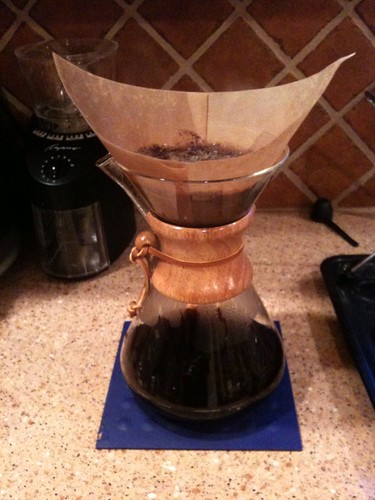
Chemex Coffee Maker
I was flipping through the latest issue of the New Yorker and an article by Malcom Gladwell caught my eye, as it usually does whenever I see his name in the table of contents. Gladwell writes clearly and as deeply as a popularizer of big ideas can so I look forward to his articles (you’ll never get all the details with writers like Pinker, Dennett, and Gladwell because they often write for a mass audience – this is just a small critique). Gladwell’s piece was on the drinking habits of two distinct people; the Cambra of Bolivia and the Italian-Americans of New Haven, CT (circa mid 1940’s). The reference to the latter group caught my eye and I read intently as Gladwell points out that for both the Bolivians and Italian – Americans a great deal of alcohol is consumed on a day-to-day basis, but unlike many other ethnic groups, the propensity for alcoholism is low (versus the Irish – American class in New Haven, CT of the same generation, for example). Gladwell attributes the idea of “drinking responsibly” to cultural norms in the aforementioned groups that don’t tell it’s members: “drink and get loud or violent”, “drink until you can’t stand up”, or “drink when you have a problem” as is the case for some college students, tailgating sports fans, or unhappy suburban dads.
The New Yorker got me thinking about other positive habits that Italians and Italian-Americans take part in on a daily basis (I’m not talking about watching the Jersey Shore on MTV). And like having a daily glass of wine or aperitif, many Italians begin their day with coffee (usually in the form of a single espresso or a cappuccino <if you want to stand out as a tourist in Italy just order a cappuccino after 10:30 AM; it’s not accepted for most natives>).
I witnessed the coffee ritual first hand growing up in NJ, as the first thing my parents did in the morning was reach for the Bialetti stovetop espresso maker. I should also say that the second thing they both did was kiss their kids (bad breath and all, sorry ma/papa’). For Italians in Europe the morning coffee ritual often takes place at the local bar (short for café) with customers ordering a short or single espresso and consuming it quickly (while standing) at the bar). The process is usually repeated again after lunch.
I’ve expressed my love for all types of coffee here on Scordo.com, including stovetop espresso, French press, handheld espresso, single cup Americano, etc. And all for good reason, I truly love coffee and I couldn’t imagine not taking part in my twice a day coffee ritual (either a latte or Americano in the AM and a single shot espresso after lunch; caffeine after 2PM doesn’t work for me). Recently, I’ve shared my love of coffee with Dr. K. from Philadelphia (Dr. K is married to my wife’s college roommate and we’ve gotten to know each other over the last couple of months). And one recent discussion centered on how difficult it’s been to find an easy to use, drip style, coffee maker for larger amounts of coffee (read more than a few cups). Being self described coffee aficionadas we shied away from plug in drip style machines (which are often expensive, yield bland brown liquid, and consume a ton of counter top space) and messy French press machines (which yield a good cup of coffee but often include sediment and are finicky with bean grind). Just as our quest for a simple drip style seemed futile, Dr. K. stumbled across the Chemex filter drip coffee maker from his favorite online shop Sweetmarias.com.

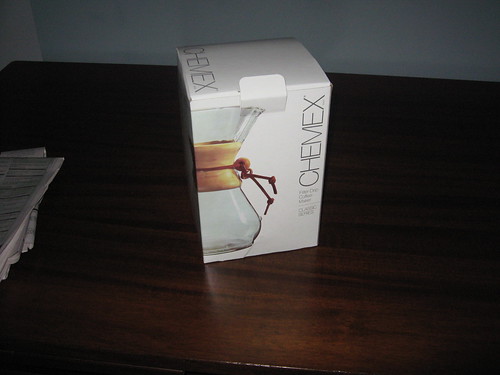
The Chemexis an elegant coffeemaker made out of glass and natural wood and has been produced for forty years (the product is made from International Housewares Corporation in Pittsfield, MA). The 10 cup model I used basically looked like an oversized science beaker (Chemex was started by a Chemist!) yet with a lot more style. The Chemex works with a proprietary bonded coffee filter (available in both natural, non dyed, brown and regular, bleached, white). The square shaped brown filters can be used in a compost and are relatively cheep ($7.50 for 100). At the heart of the Chemex is the aforementioned paper filter which according to the company is 20-30 percent heavier than standard filters. The Chemex filters brew coffee slower than most drip style machines but do not let any nasty sediment or paper taste come through. And brewing via a longer time period is something you want in a drip style machine, as the grinded coffee bean has more time to “sit with” the hot water and creative flavor.
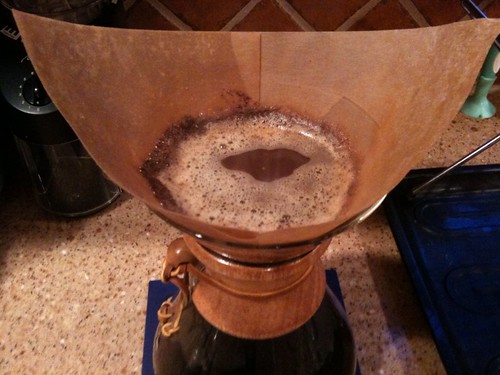
The process for brewing a pot of Coffee is fairly straightforward with the Chemex unit. You start with hot water at 200 degrees F. and thereafter place the custom paper filter over the opening of the unit. Next, you place one tbsp of coffee per 5 oz cup (grind it fresh please, preferably with a burr grinder, but if you have a traditional blade grinder the Chemex filter is pretty forgiving) – you can add more or less to suit your taste. The trick with the Chemex coffee maker is to add just enough hot water (with the first pour) to allow the coffee to “bloom” or develop that nice crema (you’ll see it when it happens). Thereafter, you keep on adding water and stop just before reaching the top (you’ll need to do this several times if you wan to brew the full 10 cups). That’s it for the process.
Here are my quick observations on the Chemex unit and the coffee it produces:
- It’s incredibly easy to use and clean upis quick (as you just throw away the filter with grinds and wash out the glass container and let dry).
- The coffee is very good and it does exhibit some nice complexity. The coffee flavor is, indeed, better than a standard drip style coffee maker, but I do find a French press or Aeropress cup of coffee to have more complexity and richer overall flavor. The coffee is incredibly “clean” with the Chemex; that is to say, there is no harshness or bitterness but it does lack a depth of flavor that I’ve found with other manual type machines. I may need to try adding more coffee grinds than the 5 oz per cup recommended by the company.
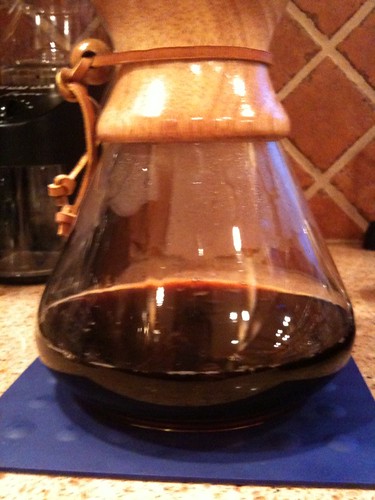
- The coffee does not remain hot for a long period of timeafter the brew period. As Dr. K recommends, it’s best to have a large stainless carafe ready so you can move the contents of the Chemex to an insulated container as quickly as possible.
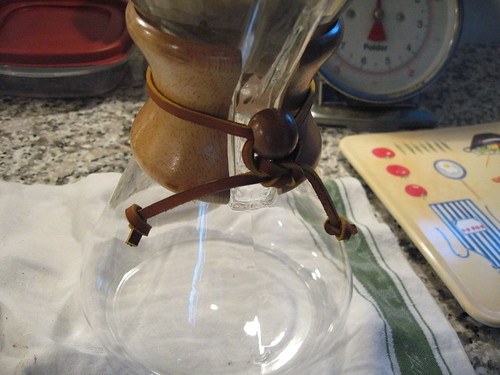
- From an industrial design perspective, The unit is well executed. The wood and leather used in the middle of the unit serves as a handle and from an ergonomic perspective is almost perfect (think of Oxo products without the plastic). The model I used was made with machined glass, but there are more expensive models made with hand blow glass.
- The unit is inexpensive and requires no electricity. The 10 cup (50 oz) model I tried retails for $37.50 at Sweetmarias.com
- Like any glass coffee maker you do need to be careful when washing / cleaning the unit. I have friends who have broken countless Bodum glass French press coffeemakers.
- The unit requires proprietary filters and is akin to a vehicle needing premium gasoline to run (yes, in some cases, an engine will yield more power or run more efficiently, but at a higher price point). The filters, as I said, are not expensive, but you need them in order for the unit to work the correct way (trust me, I tried using a regular paper coffee filter as a test)
- The unit is perfect for a large dinner party when you want to brew up a large batch of quality drip style coffee (just make sure you have an insulated carafe waiting and your guests will not be disappointed).


From Dr. K:
Very good point about keeping things hot. Fortunately, by preheating
the Chemex with the boiling water from the kettle (I combine this with
the prewetting of the filter as a single step), and pouring the coffee
I’m about to drink into a Bodum borosilicate glass double walled
thermal mug (shown below…about $10 at Crate and Barrel and well
worth every penny – keeps your drink hot for as long as it’s in there
and imparts no taste to the beverage), and the rest into an insulated
stainless steel thermos or carafe, I’m able to enjoy scorching hot
coffee for hours after brewing!
Regarding breakability, I think Bodum makes great products but
fragility is an issue. Sweet Marias stopped carrying some of their
brewers because 20% of then would break during shipping! The Chemex
seems pretty solid, and though drooping it on the floor would not be
recommended, I would take it head to head against any of the glass
carafes from drip machines or French presses that it would replace.
Regarding taste and complexity, I have to disagree with you! I’ve
found the body and complexity to be far superior to what I’ve gotten
wih the Aeropress. I’ve found the Aeropress to be a little dilutive
and mellow, missing out on some of the acidity and brightness that I
taste with the longer Chemex infusion time. The Aeropress does keep
out the bitter elements, but can make for a dull cup on occasion,
especially when brewing at the low temps they suggest. But I think
you astutely identified the cause of the difference. If you follow
the Chemex directions, you are not using enough coffee! The Aeropress
uses about the same amount of coffee for a single cup as the Chemex
instructions recommend for 5 cups. You actually need to use 2 level
tablespoons per 6 oz filtered water for all infusion techniques
(Specialty Coffee Association of America standard measure). Use the
right amount of coffee and you’ll get a better infusion as well as a
slower infusion time and that should dramatically improve your
results. I just use the standard scoop from Sweet Marias which is one
scoop per 6 oz water. Please retry if with sufficient coffee and
you’ll see the difference!
The major downside to the Chemex is that it’s not as good for smaller
brews (just as you wouldn’t want to brew two cups in a ten cup drip
coffee maker), and as you mentioned you have to buy their filters.
For a cup or two, I use that clever coffee dropper from Sweet Marias I
showed you the box for. I still use the Aeropress on occasion, which
makes a decent cup, but all the parts make cleaning a bit of a pain,
the temperature they recommend isn’t optimal for infusion brewing, and
it wastes a lot of coffee, which as a home roaster and cost-conscious
consumer is infuriating! But I don’t mind using it when I have some
beans that are reaching staleness (after a week from roasting), and I
may take it with me for travel some day as it’s fairly compact as
brewers go.
Try the Chemex again with more coffee (probably double what you were
using) and let me know how it goes!
Also, I couldn’t help but smile at your mention of your parents’
stovetop espresso maker, as my Bialetti just arrived today (photo
below)! Which was unfortunately the same day I read about a new study
showing deleterious effects of caffeinated espresso on coronary blood
flow.
Part II tips from Dr. K:
As a follow up to my previous email, here’s a link to the Sweet Marias
Chemex tip sheet. It’s a great starting point. Note the differences
from the Chemex manufacturer instructions with respect to the bloom,
prewetting, and most importantly coffee amount.
Every coffee scooper I’ve gotten in the past has been one tablespoon,
with instructions to use one scoop per 5 or 6 oz cup. Perhaps the
issue was that typical automatic drip extracting techniques were so
bitter that using the right amount of coffee resulted in a bitter
tasting cup!
I now use the standard SCAA size scoop which is the equivalent of two
rounded, not heaping, tablespoons. With good infusion techniques like
the Chemex, the clever coffee dripper, Aeropress; proper brewing temp,
and good fresh coffee, bitterness is not an issue even with a strong
cup. This is the recommended scoop measure for all infusion/drip
techniques. It may not suit everyone’s preferences but is probably
the correct starting point.
With the Chemex I typically use four level SCAA scoops (8 rounded
tablespoons) of coffee to brew 5 cups (up to the level of the button
on the Chemex glass bottom). This is almost twice what Chemex
recommends. And I get a very robust, strong but not bitter cup with
that (with less coffee than the Aeropress requires). Using the right
amount of coffee will also slow the infusion, which takes at least
five minutes, ensuring proper extraction. I use a medium grind on the
coarser side, as it stalled a little when I first tried a finer medium
grind.
As you can see from the photos I sent you before, which were from a
five cup brew, the grinds were creeping far up the sides of the
filter. Adjusting your coffee amount and ignoring the Chemex
manufacturer instructions should cure your flavor issues!
Also, it looked like your filter wasn’t oriented with the three-ply
side towards the spout in your photo as Chemex recommends. It was
hard to tell though, I may be seeing that wrong.
http://www.sweetmarias.com/Tip-Sheets_PDF_files/Tips-Chemex_SM.pdf
I have seen this beautiful object before and have wondered how it compared. I am not a fan of drip coffee but my husband is, this may be a good compromise and looks portable too. Thank you for the very thoughtful review.
Portable Espresso Take Three: MyPressi Twist Review
I was a big fan of the Sci-Fi series Battlestar Galactica. Battlestar, as it was known to series insiders, was serious science fiction that was elegantly produced with big ideas, a great script, and blissful (almost film noir) type…
What can I do with the left over coffee I have everyday? Does anyone have a recipe or an idea to use left over coffee? Maybe in a meal once a week or in a drink? Thanks.
You can store leftover coffee in your fridge and then move to the freezer for about an hour for great iced coffee in the summer (key is to add sugar before it gets cold).
I know many desserts that call for coffee.
Good question!
Vince
The product sounds great and I will give it a try. I have tried all types of coffee making devices and my favorite is, by far, the stove-top percolator. Most experts that I have spoken with don’t like the percolator and claim it makes an inferior brew. But I have been using it for over 15 years and would never switch. After measuring out your coffee (yes, grind it yourself with a burr grinder) and water (there are many recipes on the web-I simply fill a little less than half the pot with water, and a little more than half the canister with coffee). Bring the water to a boil. Once it boils, IMMEDIATELY reduce the flame to very low and cook for 6.5 to 7 minutes. Perfetto. By the way, I recently had dinner at LeBernadin in Manhattan. After tasting the excellent coffee that was served with desert, I asked the waiter whether the restaurant used a french press? He replied “No, never….we only use a percolator”. Trust me.
Website Design West Palm Beach | Graphic Design Photography 33401
Guide to Making Espresso At Home
Over the last few weeks or so I’ve been giving some serious thought to purchasing a semi automatic espresso machine. My rationale for buying a home machine (including a burr grinder) includes two premises: 1. it’s very hard to…
11 Last Minute Italian Gift Ideas
(photo: left to right, tarallini snacks, myPressi Twist espresso maker, extra virgin olive oil, Rustichella pasta, and Creminelli salame) If you’ve waited until now to buy your special somebody a gift for the holidays then you’re probably in a little…
This looks like a great product. I have never tried drip coffee but I might now. Great post by the way.
I’m a huge fan of the Chemex. In my opinion, there’s no more beautiful way to make drip coffee.
This post reminded me of an interesting, recent NY Times article: http://www.nytimes.com/2011/02/13/magazine/13Food-t-000.html?ref=dining