
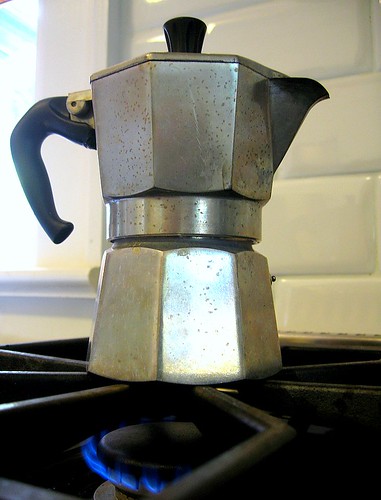
How to Make Great StoveTop Espresso or Moka at Home Like an Italian
In my view, espresso is the greatest representation of coffee on the planet. I do enjoy a cup of French Press coffee each and every day but when I crave pure coffee taste, I brew up a batch of stovetop espresso or at times referred to as Moka pot or stovetop percolator. True espresso aficionados head for a coffee bar or own their own equipment, but I can’t justify both the cost of a high end espresso machine nor the daily expense of buying from a bar or café. In turn, I’ve been using a 4 cup Bialetti stovetop espresso maker since my college days. The stovetop machine is inexpensive (about $25.00) and produces a good cup of espresso or cafe (it’s not a true representation of espresso but it’s just fine given time to brew, cost, and clean up).
In Italy, the stovetop espresso maker is in every home. Italians turn to their moka pot for their first morning cup and often make espresso after lunch and in the evening after dinner. You could argue that a homemade caffè is the lifeblood of the Italian household. Of course, not all stovetop espresso is created equally and we’ve created this quick how to manual on making outstanding moka espresso at home each and every time:
- Unscrew the top portion of the espresso maker from the bottom portion and remove the metal filter/coffee ground holder.
- Fill the bottom of the unit with fresh, filtered, water (to the top of the bolt on the inside of the base).
- Fill the metal filter with ground espresso, making sure not to pack the ground coffee but simply filling the filter with enough ground coffee where a small mound is produced.
- Insert the metal filter into the base and tightly screw the top unit to the bottom portion of the maker.
- Place the maker on your stovetop and set on a low burn (it’s important not to use a high flame as you don’t want to boil the coffee).
- You’ll begin to hear the espresso come up in about 8-12 minutes depending on the size of the Bialetti unit you’ve purchased. And you’ll know that the espresso is done when no more espresso is coming out of the top unit (simply open the hatch and have a look inside). I like to turn off the stove about 80 percent through the brew as the residual heat will finish bringing up the rest of the coffee; if you keep the flame on your pot you run the risk of over boiling / burning your coffee.
- Stir the espresso in the maker before serving.
A note on espresso beans: like any type of coffee preparation the fresher the bean the better tasting your coffee will be. So, you can buy beans and grind them per use, but it can be a labor intensive and messy affair (espresso beans need to be ground very fine). If you’re going to go the “grind every day method”, you’ll need a high end burr grinder. And remember there is no such thing as an espresso bean, just regular coffee beans that are dark roasted and ground very fine.
While we’re big advocates of home roasting and grinding prior to brewing coffee we do keep some pre-ground espresso from Illy or Kimbo in the house. After all, espresso is meant to be a “quick” cup of coffee and not a labor intensive process.





Starbucks Launches New Discount Breakfast: Make Coffee and Breakfast at Home
In yet another move away from its core business, and to curtail increasing losses, Starbucks introduced special breakfast pairings such as a tall latte with coffee cake and a tall coffee with a breakfast sandwich, all for $3.95.The move comes after…
The flavor of espresso does not mean more caffiene
Business Casual- Men’ s Clothing as a Young Professional Part 2- Shirts Maximizing Your Two Weeks: Travel Tips for the Frugal Traveler 19 Great Gift Ideas for Young Professionals 2 Days in 1: Get More Done Helicopter Parents: Taking Care of Business A …
Cool Products: Handheld Espresso Machine (no cord!) by MyPressi Twist
MyPressi Twist is taking pre-orders for a unique, hand-held, espresso machine that promises an outstanding cup without the need to plug in a bulky machine. The Twist uses pneumatic pressure, via re-chargeable Co2 cartridges, throughout the…
Portable Espresso Take Two: HandPresso Wild Domepod Review
At first glance it just doesn’t make any sense. That is to say, how could a shot of liquid gold (aka, fresh espresso) come out of a handheld device? Afterall, if you walk into your neighborhood café or Starbucks…
Portable Espresso Take Three: MyPressi Twist Review
I was a big fan of the Sci-Fi series Battlestar Galactica. Battlestar, as it was known to series insiders, was serious science fiction that was elegantly produced with big ideas, a great script, and blissful (almost film noir) type…
I bought one of these machines (Germans call them Moka) years ago and after some brief use it went into permanent basement storage. The problem? Absolutely no crema! My grandmother threw triple-ground espresso coffee into a (never washed) pan of boiling water, let it steep, and strained it into cups. This is identical to Cuban coffee, Turkish coffee, Arab coffee and Greek coffee. Some like it sweetened in the pan, but for good old paisano espresso (with crema), just treat it like machine-brewed espresso.
Hi Justine,
Yes, the stove top stuff is not true espresso (with crema). Rather, stovetop espresso is more akin to a stronger cup of drip style coffee.
Proper espresso can only be made with the right equipment, coffee bean and grind, etc.
Thanks,
Vince
Guide to Making Espresso At Home
Over the last few weeks or so I’ve been giving some serious thought to purchasing a semi automatic espresso machine. My rationale for buying a home machine (including a burr grinder) includes two premises: 1. it’s very hard to…
Easy Espresso at Home: MyPressi Twist Review
(photo: very good crema and taste profile, including notes of chocolate and hazelnut with very little bitterness) When it comes to making great food at home you have two options in my view; namely, 1. try and replicate the sam…
Do You Eat Your Oatmeal: Guide to the Italian Breakfast
(photo: Typical Italian breakfast, brioche with gelato. Image courtesy of THE MUESLI LOVER)Italians Love Coffee and Sweats for Breakfast!News break: if you’re Italian, you can have cookies for breakfast. Seriously, cake is a tradition…
Elegant and Sustainable Coffee: Chemex, Filter Drip, Coffee-Maker
(photo: thanks to Dr. K, Chemex in action during brewing process) I was flipping through the latest issue of the New Yorker and an article by Malcom Gladwell caught my eye, as it usually does whenever I see his name…
How to Make Iced Espresso or Cafe Shakerato Recipe
(photo: iced espresso made with stove top espresso, thanks to slowtrav.com for the photo on right)Growing up as an Italian America boy on the periphery of New York City iced espresso was a rite of passage, at least for the…
Low cost synthroid.
Synthroid court claims. Synthroid. Generic synthroid. Synthroid side effects. Synthroid without a prescription. Drug synthroid.