August 2010 Archives

(photo: a typical trip the market for some fresh ingredients for our kitchen, including bread, fruit, whole chicken, yogurt, etc.)

Hello Wisebread.com readers!

I've always equated good cooking with being prepared, just like a fine carpenter has the necessary tools to build a bookcase or a deck on hand at all times, a home cook should always have a well stocked pantry to prepare meals.  The following is a list of items that I always keep in my kitchen, in addition to the impromptu shopping I do for vegetables, fruit, meats, and fish throughout the week (here's my guide on how to buy fish, fruit, and vegetables).  Contrary to what you see in cookbooks and FoodTV, it's impossible to make grand meals every night and simple, high quality, meals made from good ingredients are often a reality of modern life (here's my view on cooking 30 minute meals).

Eating well, therefore, is about access to ingredients and if you keep the following items in your kitchen or pantry at all times you'll always be able to eat like a king!

1. Canned Tomatoes
Tomatoes serve as a base for all types of sauces (or condiments) for pastas, but canned tomatoes (either concentrato di pomodoro, passato, or pelati) can also be used in soups and roasted meat dishes, as well.

2. Canned Tuna, Sardines, and Anchovies 
I love, high quality, canned fish and in some instances they can be much better than mediocre fresh fish.  I always keep 4-5 cans of Italian tuna in olive oil (preferably from Sicilia) as well as a few sardines packed in oil and one large jar of anchovies, again packed in olive oil.  You get what you pay for with canned fish, so buy the best you can afford (same rule applies to buying shoes!). I like the Scalia brand. 

3. Homemade Breadcrumbs
Buying store breadcrumbs is the equivalent of buying water at your local market; that is to say, there's just no need to do it.  If you always have bread in your kitchen, then you'll always be able to make fresh breadcrumbs.

4. Fresh Bread
I aim to buy a fresh baguette every other day or so.  We tend to have a bit of bread with our meals when we're not starting with pasta and especially during the summer months when we consume a ton of tomatoes with olive oil and basil.  Good bread is crunchy on the outside and has airy interior texture that's not too dense.

5. Beans
Keep as many dry beans in your pantry as possible, as well as a few cans of ready to cook beans.  I keep garbanzo, kidney, black, cannellni, 

6. Olive Oil
Olive oil serves as a base for both simple meals and extraordinary dishes.  Buy a good quality  first cold pressed extra virgin olive oil for tomato salads, salad dressings, finishing pastas, etc. and buy a good, super market, olive oil for cooking.  For all olive oils, consume it quickly and store it in a dark and cool spot.  Here are some of my olive oil reviews.

7. Vinegar
I keep a high quality red wine vinegar and a decent bottle of balsamic vinegar.  Click here for a review of the brands I like.

8. Garlic
I keep 5-6 bulbs in the kitchen at all times.  Buy fresh garlic that is compressed tightly and doesn't have it's skin falling off at the market.  

9. Dry Pasta
I keep about 6 dry pastas in my pantry at all times (here's my guide to dry pasta).  3 short (penne, rigatoni, etc.) and 3 long (linguine fine, spaghetti, etc.).  De Cecco may be the only super market brand worth purchasing (Colavita isn't bad), while Barilla made a very good product up until about 5-7 years ago when I think they switched to an inferior flour or manufacturering process (whatever the case, the quality of the pasta has changed dramatically, in my humble view).  If you can stomach the price, Rustichella is a fine every day pasta.  You can certainly make your own pasta and store it, short term, in your freezer.    

10. Cheese and Salumi
I keep 2 quality cheeses in my fridge for a light Sunday or Summer meal and 3-4 large pieces of Parmigiano Reggiano or Grana Padano (a cheaper substitute with near, identical, flavor and texture) in my basement kitchen.  I only grate the hard cheeses before I consume them and store the pieces in my fridge in a vacuum sealed bag.  My fridge also includes pieces of either Cacciatore, Finocchiona, Crespone, Salami Secchi, and Sopressata (whatever I can find).  Here's my guide to salumi or salami, including a review of Creminelli and Columbus Artisan brands!

11. Sun Dried Tomatoes
It's very easy to make your own sun dried tomatoes and I primarily consume them with bread and cheese.  I know folks tend to cook with sun dried tomatoes but I'm not a big fan.  Click here to learn how to make your own! 

12. Whole Wheat Toasted Bread
I know I told you not to buy store made breadcrumbs, but I think it's nice to have a few packages of pre-made toast in your pantry for an impromptu meal or party.  I love the Grissin Bon Light brand and you can make a quick breakfast with them (with jam and butter) or add tomatoes and salt for a quick appetizer.


Lazy, weekend, lunches are one of the small pleasure in life and I define a lazy lunch as a simple plate of food (with little to no manipulation), fresh, crunchy, bread, and a bottle of exquisite wine (psychologically, get an exquisite bottle of wine for under $20, there are fabulous wine deals out there if you stay away from California, northern Italy, Bordeaux, etc.).  The lunch should also be had outdoors and with someone you wouldn't mind spending your last waking hours with (just in case it's you last meal!).


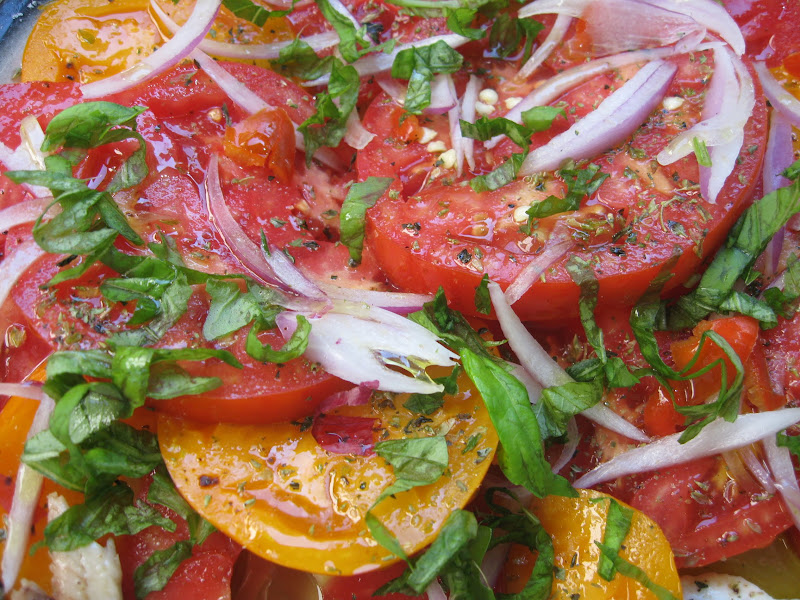
I had such a "lazy lunch" yesterday including red and yellow tomatoes with red onion (from my mother's garden and the Purple Dragon Co-Op), thickly sliced pieces of, still warn, whole milk mozzarella (from the original, New Jersey, Cafasso's Fairway Market and not the large, uber, market that is lurching westward like a corporate giant), a French Baguette made about a mile away from our home at Balthazar's Bakery, and a can of oil cured sardines from Sicilia (the Scalia brand is my favorite)


The tomatoes were simply sliced, as opposed to a formal tomato salad, and drizzled with extra virgin olive oil, kosher salt, dried oregano, freshly ground black pepper and topped with thinly sliced red onion and basil.  The mozzarella was prepared with extra virgin olive oil, black pepper, and dried oregano.  The sardines were simply emptied from the jar and set on the plate!  Click here for my guide to olive oil.

Do you have a favorite lazy weekend, and single plate, lunch combination?  
Hello everyone!  Just a simple post today with some items from our New Jersey garden:


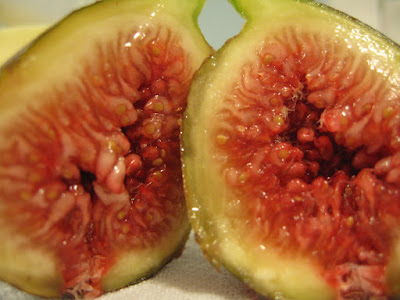
(photos: close up of a red, mission, fig)

 
(photo: red, mission, fig cut in half)  

(photo: the red fig)

 
(photo: cucumber)

(photo: eggplant)

(photo: basil)


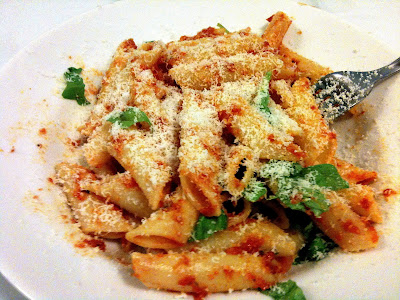
This week's Scordo Pasta Challenge was special to me, you see the Scordo family canned tomatoes this past weekend and the penne lisce we consumed included the first tomato sauce made from 2010 tomatoes!

"Penne Lisce", or smooth penne, is essentially the standard penne you can find in any supermarket and on most menus at restaurants.  The second, standard, penne variant is "Penne rigate" or penne with ridges.  While the penne is common, it's trully a superstar pasta that can be tossed with a fresh tomato sauce, pesto, or baked in the oven with cheese (click here to learn how to cook like an Italian).    Penne is a well designed pasta because it holds the condiment or sauce very well and it's jagged edge can also scoop up sauce!  I like the taste sensation penne lisce provides because of it's smooth surface.

I've now consumed 18 pasta shapes for the Scordo Pasta Challenge and suddenly the 150+ shapes do not seem like a daunting task!
IMG_6317
(photo: The Canonica Verde Umbrian Spice Blend including rosemary, sea salt, garlic, and red pepper flakes)

Click here for my other olive oil reviews!

As you've probably noticed, Olive Oil and Pasta are at the heart of Italian cuisine (both above and below the mezzogiorno, the geopolitical dividing line of Italy).  Specifically, my love for both products started in Nonna Scordo's New Jersey basement (we all lived in the same two family home for a few years before my parents purchased their own home).  As a small boy I was incredibly skinny and, as the legend goes (Italian mothers are tremendous storytellers with penchants for stretching empirical truths), I would not eat much.  One day, Nonna Scordo discovered I had a particular fondness for large rigatoni rigate with her blended olive / corn oil mixture (olive oil, athough still expensive today, was particular difficult to acquire in the mid 1970's through the mid 1980's, at least for folks in the lower to middle class ranks in the US), hence Nonna's move to stretch her olive oil.  Neverthless, rigatoni with oil and an abundance of mixed (again another "food stretch") Pecorino Romano and Pamigiano Reggiano cheese became my favorite meal (allowing me to reach puberty with some fat on my bones).  

IMG_6323
(photo: the Zitoni Cararecci - notice the length of this mammoth pasta shape!)

As a dish, pasta with olive oil is still one of my favorite simple pleasures in life and I, indeed, wax philosophical about my beloved Nonna Scordo every time I take a bit of rigatoni.  One such emotional moment came when I bit into a piece of Zitoni Casarecci from the producer Pastificio Vicidomini.  While I had the Zitoni with a chicken ragu, when I tried the pasta during the cooking process it had the same texture, mouth feel, and flavor of the rigatoni Nonna Scordo made in her kitchen.  More specifically, the Zitoni Casarecci had starchy and complex overtones, and while it didn't have the crunch and whole wheat flavor of Rustichella pasta, it certainly tasted and behaved (yes pasta must behave when cooked and tossed with the condiment) like a top flight Italian pasta.  Zitoni, as I mentioned in my last Scordo Pasta Challenge post, was a "special occasion" pasta in Italy.  As my mother describes, she would often be sent to the local shop near her Calabrian home to purchase a few kilos for Easter or Christmas lunch.   Because of the length of Zitoni Casarecci it is cut into pieces by the cook and the size can vary according to whichever pasta dish is being prepared.  

IMG_6395
(photo: the organic extra virgin olive oil from La Poderina from Grosseto)

On the olive oil side, I was fortunate to try two new olive oils from Italy this past week, including an organic oil from Grosseto La Poderina Toscana IGP, Seggianese monocultivar (made via a unique process called Sinolea) and a Tuscan variant, Rosselli del Turco DOP Chianti Classico.  Click here to read about the labels IGP, DOP, etc as they are applied to foods and wines in Italy.  

The Grosseto La Poderina is a solid extra virgin oil and can, indeed, be used as an everyday olive oil.  The relatively low acidity I found in the oil makes it a nice oil to try if you're new to consuming extra virgin olive oil.  I found the organic oil to be great with tomatoes, a salad of beet greens, and in salad dressings.  Color was outstanding with nice green/yellow contrast.  

IMG_6392
(photo: the super pungent Rosselli del Turco extra virgin olive oil)

The Rosselli del Turco was another beast entirely.  In fact, the smallish bottle that the oil is packaged in leads one to think automatically that Rosselli is a serious extra virgin.  So serious, in fact, that the shop carrying the product claims that it has one of the highest levels of polyphenols of any olive oil they've come across (think of polyphenols as tannins, like found in wine; the medical theory is that there's a correlation between the consumption of polyphenols and good health)!  Science aside, the oil was indeed pungent and overly peppery and bitter (I've had first cold pressed extra virgin olive oil straight from the press and the intensity didn't compare to the "attack" at the end of the palate the Rosselli produced; I actually coughed after tasting it).  In fact, on it's own (say with bread), I'd say it's a bit much for the American palette, but when drizzled on a piece of skirt stake with lots of black pepper it's quite good and can finish a dish that has complex flavors (maybe a piece of Bluefish or Swordfish for example).  The color of the oil was a neutral yellow.


IMG_6325 
(photo: lavish pizza made with the Umbrian Spice Blend)
 
IMG_6316

Finally, I sampled a spice packet containing an Umbrian blend (Canonica Verde Umbrian Spice Blend) of chili pepper, garlic, salt, parsley, and rosemary.  I was a bit hesitant to try a "blend of spices" because I'm accustomed to receiving herbs dryed in Italy from my family in individual containers (including oregano, red pepper flakes, rosemary, etc.) - the blending usually happens at home and for a given meal or dish.  Nevertheless, I sampled the packet on two dishes, first a lavash pizza with extra virgin olive oil, fresh basil, and provola and second a  roast chicken.  The spices proved to be a bit salty when used on the pizza, with only the sea salt and rosemary flavor components coming through.  However, when I rubbed the blend in a whole chicken and roasted the bird with a bit of olive oil, the spices blended together nicely and both the quality and flavor of the mix came though (including the chili peppers and garlic).

All the products above can be found in the wonderful online shop Olio2go.com.   
tomatoesplum
(photos: Jersey plum tomatoes washed and ready to be cut)

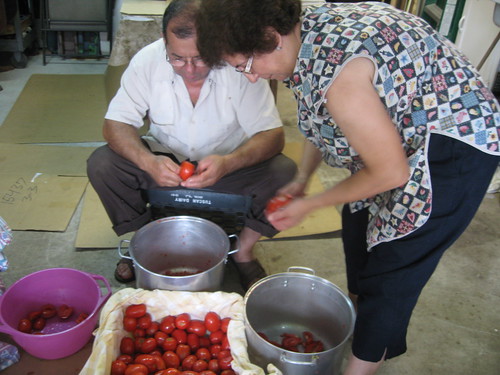
August is prime season for canning tomatoes and this year's Jersey plum tomatoes are outstanding!  The Scordo family purchased about five bushels of locally grown plum tomatoes and canned only passato (passato is essentially pureed tomato, in the past we canned a combination of passato and whole tomatoes).  As the site e-rcps.com points out:

Tomatoes are usually preserved in three different forms, each of which has its particular uses. First there are the ordinary tinned or bottled whole tomatoes, 1. pomodori pelati, which contain a high percentage of liquid and are best used for dishes that require a tomato base but need a long cooking time. Secondly there is the puree, 2. passato di pomodoro, which is a much thicker reduction of tomatoes, sometimes flavoured with celery, onion, carrot and basil, then called pomaruola or conserva. This is ideal for sauces which need a rich body of tomato. Thirdly there is the tomato concentrate, 3. concentrato di pomodoro, which is the tomato reduced to a very strong paste and flavour and is useful for colour and flavour in a dish where bulk tomato is not required. 

The advantage to canning passato is that when it comes time to make tomato sauce for dinner or lunch, there is no need to food mill whole tomatoes!

You can read my detailed article on how to can tomatoes here.   Enjoy the photos from our 2010 tomato canning extravaganza:

IMG_6356
(photos: cutting the plum tomatoes into sections and removing some of the seeds)

IMG_6354 
(photos: cooking cut tomatoes in large aluminum pots)   

IMG_6359
(photo: stirring the tomatoes)


IMG_6378 
(photo: almost ready for the large food mill)

 
IMG_6362 
(photo: Italian-made food mill being set up)
 

IMG_6364 
(photo: food mill set up)
 
IMG_6377
(photo: tomatoes being put through the food mill for passato)

IMG_6381
(photo: pure tomato passato!)

IMG_6384 
(photo: the food mill does a great job of removing the skins from the tomato, tomato skins are the enemy of a good tomato sauce)
  
IMG_6379 
(photo: preparing sterile mason jars with basil)
 
IMG_6380 
(photos: fresh garden basil)
 
IMG_6385 
(photo: moving passato into mason jars)
  
canning_tomatoes 
(photo: the tomato canning process is intense and very hands on, but the end result is terrific)
 
IMG_6390
(photo: future canning expert examining the end result" tomato bliss in a Mason jar!)

IMG_6361 
(photo: strainers help wash whole tomatoes)
  
IMG_6365
(photos: bushel crates, five in total for the Scordo family)
IMG_6231

One of the first things I learned to make from scratch was salad dressing.  Our family, of course, always made a simple red wine, olive oil, salt/pepper salad dressing, but the proportions and blending of the simple ingredients remained a mystery to me for a very long period of time.  In fact, it wasn't until I moved away to attend college that I learned to make salad dressing that wasn't too oily or too acidic.  My salad dressing epiphany occurred when I learned that while olive oil is the predominant ingredient in a standard dressing, vinegar is the true star!

When I began to see the power of the acid in salad dressings they began to come together in a more natural fashion.  I'd first add the vinegar and then the freshly ground pepper and kosher salt and, thereafter, whisk the items (to allow the vinegar to dissolve the salt and distribute the pepper flavor more evenly).  Next, I'd slowly add olive oil and whisk until I reached an emulsified state. 

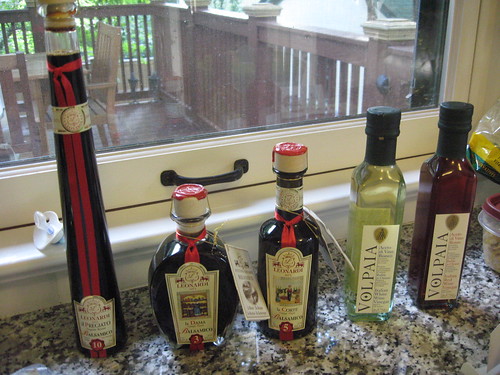
My salad dressing today comes more naturally and I stopped measuring ingredients a long time ago.  However, I do still recognize that the vinegar is king in a good salad dressing and, In turn, I was especially happy to try some outstanding vinegars this past month including the balsamic vinegar producer Acetaia Leonardi and the red and white vinegar producer Castello di Volpaia.  Let's start with the red wine vinegars!

vinegar_redwine_balsamic

Castello di Volpaia is produced in Siena and is actually home to a facility that is more famous for wine than vinegar!   In fact, by law, all vinegars made in Siena must be produced no less than 1 kilometer from the nearest wine cellar (in order to protect the wines from fermenting acids of the vinegar.  However, with the above said, both the red (aged 12 months) and the white (aged between 2-3 months) are some of the best aged wine vinegars I've ever tasted.  Volpaia's vinegars are made from Chianti wine and exhibit great floral notes (it has a wonderful aroma much like wine and unlike the mass market vinegars found in super markets).  The production process at Volpaia is fascinating I couldn't explain it better than the producer:

"After a great deal of research we decided to use a traditional artisan method to produce our vinegar. It's known as the "truciolo" or wood shavings system and it's great advantage is that it manages to maintain the original quality of the wine used.

Although only very good quality wine must be employed, an alcohol content of over 10% would interfere with the vinegar bacteria's action.

In order to preserve the wine's bouquet, for each new batch a specific bacterium has to be selected. Once chosen the bacteria are reproduced by gradually adding wine up to a maximum of 300 litres. This process takes from 20 to 30 days. At this point the vinegar is moved to a 2000 litre tank containing 3 stainless steel perforated baskets covered in freshly chopped shavings from well seasoned oak and chestnut.

A slowly rotating arm stirs the wine very slowly over the shavings where the vinegar bacteria develop. The wine percolates through the shavings and falls to the bottom of the tank. It is then pumped to the top to percolate again. This process is repeated until all the wine has fermented and turned into vinegar. The rate at which the transformation takes place is governed by the amount of air into which the bacteria come in contact and the temperature. The longer the process takes, the better the vinegar will be. And that is why we only allow very little air to enter the tank and keep the temperature constantly below 27°C. We take between 20 and 25 days to transform wine into vinegar, thus safeguarding both the original scent and that of the fermentation."


The red wine vinegar is terrific, of course, in salads, but my favorite use for red wine vinegar is as a condiment for fried fish such as sardines or smelts.  My vinegar fish sauce consists of fresh garlic and parsley that is heated through in a pan with the vinegar.  The white vinegar I sampled was a bit crisper than the red and was made from Trebbiano and Malvasia win.  I could see using the vinegar to wake up a sauce or maybe even in a marinade (but I preferred the red wine in my salad, for example).

Balsamic vinegar differs from standard red wine vinegar in that the former is aged for a longer period of time as well as made from the white, Trebbiano, grape.  Balsamic vinegars are generally more complex than their red wine vinegar counterparts and have a rich and sweet flavor component.  True balsamic vinegar must also be aged for a minimum of 12 years, with the world best aging as long as 90-100 years.  Cheaper, super market, balsamic vinegars are comprised of caramel and sugar as well as mixture of grape juice and standard vinegar.

. IMG_6233

I tried both 3, 5, and 10 year old, Acetaia Leonardi, balsamics and they all varied drastically in flavor and application (note: I'm assuming the numbers correspond to time aged, but please understand these vinegars are not Aceto Balsamico Tradizionale as defined by European standards).  I used the 3 year old vinegar mostly for salads and it had a rich, true, caramel flavor with some suggestion of other fruit (maybe dried fig, for example). The 5 and 10 year old vinegars were light years ahead of the 3 year old, especially the 10 year old which approached the flavor components of a fine wine (with lots of oak and varying levels of flavor).  Where the 5 year old shined was on it's fruit flavor component; I consumed the balsamic with a salad of freshly roasted beats, walnuts, and feta and the match was perfect.    

I like to keep both a good bottle of red wine vinegar and 3-5 year old aged balsamic in the house at all times (especially for salads where alternating vinegar use is a nice way to keep salads appealing).  Click here to find the products online
 
italy_father_brothers
(photo: my grandfather and his sons in mid 1960 Pellegrina <Bagnara Calabra> Calabria)

The year was 1997 and I was a college junior applying for a prestigious fellowship for first generation college students.  The fellowship provided funds and a mentor to guide and prepare students for graduate work in the humanities and sciences.  The fellowship had strict academic and social-economic requirements.  On the socio-economic side, students were expected to be first generation college students, fall on the lower end of the income scale, and come from an ethic group that were/are underrepresented at US graduate programs.

In my view, I was qualified for the above fellowship and was excited to apply.  The question as to whether I was from a distinct ethnic group (underrepresented in academic circles) was not an issue in  my mind (the last I checked most prestigious universities had faculties brimming with Waspy sounding last names and not surnames ending in vowels).  After all, I did not learn to speak English until I was 5 and thought the American side of my Italian-American moniker was just a way of acknowledging that we breathed the air in New Jersey and not Calabria; I spoke, ate, lived amongst, and thought like an Italian, so I was a true Italian.  

italy_wedding
(photo: typical Italian wedding in Pellegrina, <Bagnara Calabra> Calabria) 

When I got the call from the faculty advisor alerting me that I would not be selected for the summer fellowship program, my immediate reaction was rage.  Not because I had been denied, but rather because I had been denied for not being from an appropriate "ethnic group"; at least the groups that were currently in fashion as being minorities in the US and in turn at Academic institutions.  I pleaded my case with the advisor and asked, for example, how many of the students that had been selected spoke a second language or had been to the region/country that deemed them to be a minority, for example?  The answers that came back were disheartening and I felt betrayed.  

The incident made me think long and hard about what it means to be an Italian-American living in the United States today.  Unlike Geremio and his son Paul in Pietro DiDonato's classic novel Christ in Concrete, being an Italian American in New York at the turn of 20th century did not come with the added effort of proving one's status as an American with Italian ancestry.  After all, Geremio's son Paul was Italian, although born in New York (like the author who was born in West Hoboken).  No one at the turn of the 20th century would accuse Paul as being an American, rather he was an Italian who happened to be born to recent immigrants from Italy.  Suffice it to say, if such an academic fellowship existed in Paul's time, he would have surely qualified as being part of a true ethnic group.

italy2_greatgreat
(photo: my grandmother's family posing as though they were well off - they were not)

So, what has happened to the Italian-American in the 90+ years since DiDonato's seminal novel?  Has the Italian-American remained truly unique with strong ties to what it means to live like an Italian in a foreign country?  Or have the images of Sonny, Tony Soprano and the cast of Jersey Shore penetrated our media and fame driven society so deeply that to be Italian in America is solely about being involved in crime, putting gel in one's dark colored hair, and consuming tomato sauce?  

Again, what has happened to the attributes of the Italian American that were so pronounced and vivid in DiDonato's America yet so dull and mis-represented in our current epoch?   In my view, unadulterated assimilation has happened (some self induced and some pushed by the larger American society) of the negative kind that leaves the current Italian American in a state of watered down culture and misrepresentation (in short, what we have in the United States today are many pseudo Italian-Americans).

All is not lost for the modern Italian American, however, and there are glimpses of living the Italian way in America that are centered on practical living, working hard, eating well, and simply living the Italian way.  I see first and second generation Italian Americans shunning the popular, and myth driven, portrayals of the goofy, unintelligent, Tony Soprano (don't let the literary critics convince you he was a seminal and complex TV character; he was a mafioso with strong survival instincts) and argue that being Italian in America is just that; namely, living like a typical Italian that has been transplanted to North America (with a focus on food, family, friends, and enjoying deep and meaningful experiences every day).  

So, how do you live as an Italian in America today?

IMG_0220 
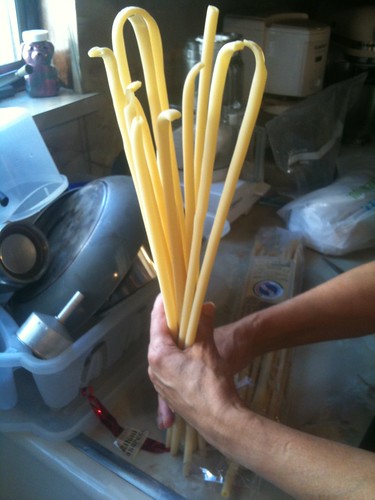
(photo: prior to breaking the pasta into smaller pieces, notice the length!)

I love impromptu meals; that is to say, one of the biggest thrills I experience in the kitchen is when one dish I have in mind turns into something completely different or helps inform a second dish.  For example, when starring at a few chicken legs in my refrigerator this evening I immediately thought of a stove simmered chicken dish (a type of chicken cacciatore).  The dish included garden zucchini, one whole onion, about 8 pieces of coarsely chopped garlic, parsley, and a 1/3rd of a bottle of Pinot Grigio from Venezia.  I simmered the ingredients on the stove top for about 1.5 hours and, this is where the "one dish informing another" comes into play, after producing a wonderful liquid in the pan infused with chicken, zucchini, garlic, and white wine flavors, I boiled 250 grams (enough for left overs) of Zitoni Casarecci from Pastificio Vicidomini and tossed with the wonderful impromptu sauce.  

zitoni_dry

chicken cacciatore with white wine
(photo: chicken legs with whie wine, onion, zucchini, and a bit of hot pepper)

Zitoni Casarecci is an extremely long pasta which is bent about halfway in length (it's about 4x the length of a typical strand of linguine).  The pasta has a large hole running the length of it's shape and holds sauce / condiment very well.  The short version of Casarecci goes well with a meat sauce and so does the Zitoni variant.  My Calabrian mother informed me that Zitoni Casarecci was often sold at her local pasta shape in Pellegrina (Bagnara Calabra) by the pound (dry of course, as fresh pasta is not often found in Calabria).  The pasta designated an important time and was only purchased a few times a year (due to cost).  Typically, the pasta is broken into short lengths before boiling.  I was especially excited about the quality of the Casarecci and I've been re-energized to continue the Scordo Pasta Challenge!
 
zitoni


zitonia
roastedeggplant

The PBS star Mary Ann Esposito recently caused a little bit of controversy over at the Huffington Post when she published a recipe entitled, "The Real Eggplant Parmigiano."  Amongst the comments on the post, some readers accused Mary Ann of pushing an Italian-American version of Eggplant Parmigiano and using an inauthentic cooking oil, like peanut oil (to say the least, the recipe got under the skin of certain individuals; I'm actually wondering why the Huffington Post is publishing articles on food and recipes <talk about being off-brand>).  One reader went on to state that Eggplant Parmigiano probably didn't exist in parts of Italy (especially Southern Italy) until the late 1970's when Parmigiano Reggiano started becoming readily available.

Nevertheless, I can only comment on the versions of eggplant parmigiano I'm accustomed to and neither of the recipes have a fried eggplant component which include flouring the eggplant slices prior to frying (per Mary Ann).
  
roastedeggplant2

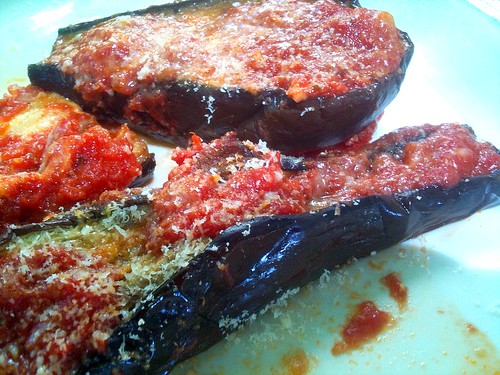
The first eggplant dish I would label "eggplant parmigiano" is made by simply grilling slices of eggplant and layering with the cooked slices with olive oil, chopped parsley, and grated Parmigiano Reggiano (no baking, frying, or tomato sauce) - click here for the full recipe.  The second dish is the focus of this post and is best made with "mini-eggplant" or small Italian eggplant (basically smaller versions of the large generic eggplant found in most markets).  The dish is fairly straightforward and begins by cutting the mini-eggplant in half (length wise) and roasting at 350 degrees Fahrenheit for about 20-35 or until the interior flesh of the eggplant is nice and soft.  Prior to placing the eggplant in the over, each length should be brushed with olive oil and sprinkled with plenty of kosher salt and black pepper.  After removing the eggplant from the oven, you can laddle a bit of tomato sauce over the halved lengths, along with grated Parmigiano Reggiano.  Thereafter, place the eggplant back in the oven for a few more minutes or until the cheese has melted and, presto, you have a simple baked eggplant or eggplant parmigiano dish (without any drying or masking of eggplant flavor).  
goat2
(photo: pan simmered baby goat or capretto with onion, tomato, garlic, and red wine)

Feasting on baby goat is a staple of our Italian American Easter and Christmas dinners.  My father's mother, Nonna Rosa Scordo, made a wonderful pan simmered capretto recipe and it includes braising a whole baby goat (which is processed at home or by the local butcher).  

Here's the recipe:
wheat_harvest_pellegrina 
(photo: various Scordo family members during the late summer wheat harvest in Pellegrina, Calabria) 

You can say, unequivocally, that Americans love their beef. Compared to their Mediterranean counterparts, American's are ranked third in the world (only behind Argentina and Uruguay) when it comes to choosing beef for their dinner table (Italy is ranked 9th, per 1999 statistics).  An educated guess as to why beef consumption has skyrocketed in the US, post WWII, is probably linked to access, price, and perceived nutritional value (if McDonald's sells a mediocre hamburger for less than $2.00 then why would the average US consumer spend, say, $2.99 per pound on organic peaches or $8.99 per pound on Wild Cod).  Moreover, given how quickly fast food establishments have scaled (from a franchise and business perspective) in the US since 1950, for example, it's probably easier for you to find a Burger King than a quality food market (you can blame capitalism and the subsidized food system for the proliferation of what I like to call, "big box crap food" <read Pollen's work for a more elegant explanation>).
meal
(photo: wild salmon, couscous, rainbow chard, and yogurt sauce)

There are some terrific fish on our little planet and while we are, indeed, overfishing our seas , I constantly marvel at how delicious certain varieties of aquatic vertebrates are, including mackerel, sardines, cod, swordfish, trout, branzino, striped bass, salmon, etc. (click on the links for a few fish recipes).  Much of the overfishing talk centers on Tuna, which is a large industry in Southern Italy, especially near Sicily (where the world's best tuna is caught and sold to the highest bidders).  The Mattanza (or spiritual fish harvest) take place in May and June and used to be centered on catching bluefin tuna with nets, but the tuna industry has become huge and the traditional manner of catching tuna has given way to massive harvests with modern techniques.   

rainbowchard
(photo: organic rainbow chard with garlic)

Salmon, of course, is not native to the waters surrounding Italy and consumption of salmon is low as opposed to other fish species in Italy, especially in relation to whitefish from the Mediterranean (e.g., seabass and seabream) to coldwater fish.  Salmon is consumed in some parts of northern Italy and in the larger cities (including smoked salmon on toast during the holiday months).

couscous
(photo: couscous with feta, cucumber, parsley, and lemon juice)

We consumed a 1 pound piece of wild salmon prepared with freshly ground pepper, kosher salt, olive oil, and lemon zest.  I baked the salmon at 350 degree for about 10-15 minutes.  I like to sear salmon to develop a crust and then place the fish in the oven to complete the cooking process, but who wants to spend time cleaning the stove (especially during the summer).

salmon
(photo: wild salmon with lemon zest)

I included a bowl of sautéed rainbow chard as well as a dish of couscous with garden cucumber, whole chickpeas, feta, and parsley.  The couscous was seasoned with fresh lemon juice, kosher salt, and freshly ground pepper.  We also had some Greek yogurt in the fridge so we made a quick sauce for fish with chopped basil, coriander, cummin, lime zest, sugar, Kosher salt, and freshly ground pepper.  Finally, we had some Jersey peaches which had been sitting in lemon juice. 

IMG_6314
(photo: Jersey peaches in lemon juice)

IMG_6311
(photo: a glass of white Lillet with ice, lime, and a piece of fresh Jersey peach)
dandellloins

I remember walking through the Calabrian countryside with my grandfather as a boy when he suddenly feel to his knees and plucked a few pieces of what I thought was simple green grass from the ground. I, of course, thought he was just being his usual pazzo (crazy) nonno, but what he found were dandelion greens, prized for their earthy, minerally, and zesty flavor.   

Like many prized goods in the food world, the best ingredients are often found in the wild and prepared without much manipulation.  Calabria is famous for wild mushrooms (click here to read my guide on finding wild mushrooms), chestnuts, asparagus, roasted wild boar, etc. and it's part of what makes the southern most province in Italy (along with Sicily) such a special region.  Hence my simple mantra: wild food is great food (let the French have their fancy manipulated fair).  

You can of course find wild dandelion in most suburban lawns here in the US, but the flavor component is not the same (trust me, I've sampled the fare both as a kid and an adult!).  I have, however, found some good "wild" dandelion greens at a local market during the Spring season.  You can sauté dandelions, but I like them in a simple salad with a good red wine vinegar/extra virgin olive oil dressing and thinly sliced red onion. You can also try a vinaigrette dressing (here's my recipe).   

beansalad

My kidney bean salad is comprised of 1 inch diced green beans, corn, red onion, parsley, carrot, kidney beans, extra virgin olive oil, fresh lemon juice, freshly ground black pepper, and kosher salt.

tunapesto

Pesto Tuna Salad is simply comprised of homemade pesto sauce and good quality Italian tuna packed in olive oil (the best is imported from Italy and canned in Sicily).  Here's my pesto recipe.  

The above meal goes well with a rustic homemade wine.  
orzosalad
(Photo: Orzo with zucchini, bits of tomato, and parsley)

With the arrival of August, our household starts the summer tradition of consuming copious amounts of fresh tomatoes (at times for both lunch and dinner) - see my entries on tomato salad, canning tomatoes, and tomato sauce.  Ripe, garden grown, tomatoes represent the ideal food type for me (blending subtle, earthy flavors, with beautiful texture and color; not to mention the nutritional benefits of raw tomato).   

tomatoesalad
(Photo: Tomatoes from the garden with red onion, basil, and a bit of fresh, hot, pepper)

My favorite tomato salad is comprised of red onion, basil, dried oregano, kosher salt, freshly ground pepper, and extra virgin olive oil (see my guide to olive oil).  I like to call our tomato dish the "universal salad" because it pairs well with meat (such as beef, lamb, or pork) or with a simple loaf of bread, cheese, and olives.  Recently, we paired the tomato salad above with roasted mackerel fillets and orzo with garden zucchini, parsley, and Parmigiano-Reggiano.    

IMG_6269
(Photo: Holy Wild Mackerel, Fishman!)

Total cost of the meal was under $19.00 ($7.99 for wild mackerel, .60 cents for 1/4 cup of orzo, $1.99 for Balthazar French baguette, and $7.99 for a bottle of sauvignon blanc from Chile; the rest of ingredients came from the garden or are staple products <such as olive oil, salt, etc.>).  Proving, again, high quality food does not have to be expensive or inaccessible (as some food snobs have argued - see my article on why good food is not expensive).   
 

IMG_6270
(Photo: French bread from Balthazar Bakery)

IMG_6271
(Photo: Sauvignon Blanc from Chile <great bargain versus Australia>) 
scordo on twitter scordo.com on facebook become a fan stumble scordo rss feed for scordo

Scordo.com Free Newsletter - Sign Up Today
* indicates required

BECOME A FAN OF SCORDO ON FACEBOOK:


GOOD READING:


MORE ABOUT US:


FEATURED STORIES:


Homemade Sun Dried Tomatoes in Olive Oil Recipe
Don't settle for the canned varieties found at supermarkets; find out how to make your own [+]


How to Make Authentic Tomato Sauce
This is the authentic Scordo family recipe - straight from Calabria. You'll be amazed at how simple the recipe is to make [+]


Guide to Italian Extra Virgin Olive Oil
My grandfather produced his own extra virgin olive oil in Italy and I've put together an olive oil buying guide just for you [+]


How to Make Rice Balls or Arancini At Home
The ultimate Italian street food - these fried treats are great for the holidays or for any lunch or dinner; try them with your kids [+]


Guide to Making Espresso at Home
Making good espresso at home isn't easy but once you master a few easy tips you'll never settle for the junk served at most cafes in the US, including Starbucks [+]


Why You Should Not Eat Out
My argument on why eating out doesn't make sense [+]


Guide to Italian Meats: Salame, Capicola, Prosciutto, etc.
Learn all about the great "deli meats" and authentic cured specialties from Italy [+]


Scordo Pizza Recipe
Who doesn't love pizza, but did you know it's real easy to make at home [+]


English to Italian Translation Powered by
Grab this Widget


SPONSORS, AFFILIATES, SUPPORTERS:

Italian Food and Life Site


mymelange
Independent Budget Backpacking Travel Tips

Advertise with Scordo.com


DONATE AND HELP KEEP US GOING:


Feeling generous and want to help keep Scordo.com producing fresh and original content?


QUESTIONS, IDEAS, TIPS:


email scordo.com: blog at scordo.com


Note: The views expressed herein are solely my own and should not be attributed to my employer in any way. This site is not maintained utilizing my employer's resources or on company time.


RSS feed graphic for scordo.com Subscribe to Scordo.com via RSSBlog Flux Directory