

The year was 1997 and I was a college junior applying for a prestigious fellowship for first generation college students. The fellowship provided funds and a mentor to guide and prepare students for graduate work in the humanities and sciences. The fellowship had strict academic and social-economic requirements. On the socio-economic side, students were expected to be first generation college students, fall on the lower end of the income scale, and come from an ethic group that were/are underrepresented at US graduate programs.
In my view, I was qualified for the above fellowship and was excited to apply. The question as to whether I was from a distinct ethnic group (underrepresented in academic circles) was not an issue in my mind (the last I checked most prestigious universities had faculties brimming with waspy sounding last names and not surnames ending in vowels). After all, I did not learn to speak English until I was 5 and thought the American side of my Italian-American moniker was just a way of acknowledging that we breathed the air in New Jersey and not Calabria; I spoke, ate, lived amongst, and thought like an Italian, so I was a true Italian.
When I got the call from the faculty advisor alerting me that I would not be selected for the summer fellowship program, my immediate reaction was rage. Not because I had been denied, but rather because I had been denied for not being from an appropriate “ethnic group”; at least the groups that were currently in fashion as being minorities in the US and in turn at Academic institutions. I pleaded my case with the advisor and asked, for example, how many of the students that had been selected spoke a second language or had been to the region/country that deemed them to be a minority, for example? The answers that came back were disheartening and I felt betrayed.
The incident made me think long and hard about what it means to be an Italian-American living in the United States today. Unlike Geremio and his son Paul in Pietro DiDonato’s classic novel Christ in Concrete, being an Italian American in New York at the turn of 20th century did not come with the added effort of proving one’s status as an American with Italian ancestry. After all, Geremio’s son Paul was Italian, although born in New York (like the author who was born in West Hoboken). No one at the turn of the 20th century would accuse Paul as being an American, rather he was an Italian who happened to be born to recent immigrants from Italy. Suffice it to say, if such an academic fellowship existed in Paul’s time, he would have surely qualified as being part of a true ethnic group.

So, what has happened to the Italian-American in the 90+ years since DiDonato’s seminal novel? Has the Italian-American remained truly unique with strong ties to what it means to live like an Italian in a foreign country? Or have the images of Sonny, Tony Soprano and the cast of Jersey Shore penetrated our media and fame driven society so deeply that to be Italian in America is solely about being involved in crime, putting gel in one’s dark colored hair, and consuming tomato sauce?
Again, what has happened to the attributes of the Italian American that were so pronounced and vivid in DiDonato’s America yet so dull and mis-represented in our current epoch? In my view, unadulterated assimilation has happened (some self induced and some pushed by the larger American society) of the negative kind that leaves the current Italian American in a state of watered down culture and misrepresentation (in short, what we have in the United States today are many pseudo Italian-Americans).
All is not lost for the modern Italian American, however, and there are glimpses of living the Italian way in America that are centered on practical living, working hard, eating well, and simply living the Italian way. I see first and second generation Italian Americans shunning the popular, and myth driven, portrayals of the goofy, unintelligent, Tony Soprano (don’t let the literary critics convince you he was a seminal and complex TV character; he was a mafioso with strong survival instincts) and argue that being Italian in America is just that; namely, living like a typical Italian that has been transplanted to North America (with a focus on food, family, friends, and enjoying deep and meaningful experiences every day).
So, how do you live as an Italian in America today?


I am a wife, mother of two, grandmother of two and one on the way, owner of Elisa’s Custom Creations, and an avid gardener. I am an Italian immigrant with strong work ethic – working hard, complaining little. My success is measured by my family happiness. I prefer the comforts of my home and the beauty of my garden and unlike the vast majority of retirees, I don’t worry about relocating to a warmer climate because I prefer to stay put close to family and friends.
Hey Vince—
DiDonato’s novel has been on my “to read” list for a long time. Thanks for the reminder to search for it once more. I know it has been heralded as a classic, and I look forward to reading it.
I’m still amused by how some people still think of the Italian American male (or female, for that matter) through the stereotype, because of its reinforcement within popular culture. The truth is, most of the men on my dad’s side of the family are/were quiet, thoughtful, reliable, hard working, and considerate of their families. Far from the stereotypical portrayals.
Many of those men are gone now though, and although I do what I can, it is difficult to keep from being more “Americanized” because of the dwindling influence of Italian mentors. You are right in the respect that we were really taught how to live by these great people that came before us.
The memories you have and the ability to keep tradition
is an important factor in passing along to the younger generation. Your blog is a reminder of that and one of the reasons that I read…
Salute!
Thanks for the nice words, Joe. I really like the idea you touched upon in your comment, namely the idea of the thoughtful/quiet Italian American. In fact, most of the Italians I grew up with in American were/are what I like to call “subtle” Italian – Americans (product of how they are but more concerned with leading a high quality of life through family, food, etc.)
Hi Elisa,
Yes, stating close to one’s family is a big quality of life thing and, in fact, when researchers measure happiness levels amongst a general population being near family and friends is on the top of the list (and not weather one relocated to Florida or Arizona).
Thought-provoking post, Vin. I think about this subject all the time. It scares me quite a bit, in a sense, because I realize that going forward, our Italian-American families will only become more and more American. We happen to be in that generation that is caught between two worlds, and it can be downright confusing and frustrating. At the same time, instead of being sad and focusing on the fact that our heritage will be watered down over time, I try to imagine how I want to continue to live my life with the best ideals instilled through my upbringing and our Italian culture. And I will be damned if I don’t live by those ideals each day in all that I do. And further, I will be damned if I don’t instill our philosophies, joy of food and family, the arts, and Italian traditions into my own family in the future. In a sense, that is the best we can do.
Hi Mike,
I was going to address 1st generation versus 2nd, 3rd, 4th, etc. generation, but I think it deserves its own topic which I’ll hopefully write about going forward.
Indeed, the best we can do is to simply live the way our family and ancestors live(ed) in Italy and try to take the best of American culture and blend it with out Italian background.
Vin
Have you read Blood of my Blood? A great book on Italian-Americans.
My Dad is 1st gen, but he married a non-Italian, but she kept all the Italian traditions alive. I only wish I have more relatives(just 1 brother) to share the traditions with.
When I have kids I plan on keeping all the traditions alive and not letting them fall by the wayside.
Lucas, thanks for sharing the book. I just recommended it our Facebook Fan Page (for Scordo), please head on over if you’re not a fan yet!
Keep up the traditions because as we get further away from the folks who first came to the US from Italy it gets harder and harder to be a true Italian!
Vince
Absolutely essential topic, and question, deserving of regular rethinking. As the son of a Calabrese immigrant (Cittanova, with family also in Bagnara), raised in the 50s/60s in an almost exclusively Italian Brooklyn, we did things because we were Italian. Today, we need to do things in order to become Italian. It’s what those things are, and how they’re understood and felt, that matters. No one in these posts has talked about what I feel are the basic responsibilities to our culture and history: knowing the language, knowing customs and the legacy of Italian literature and art; knowing the history (beyond ‘u paise, but also warmly embracing it), knowing the reals stories of immigration–those of anarchists, radicals, and race riots included. We also need to be active in sharing and deepening this knowledge. And able and willing to speak for and represent Italian life and culture in its diversity, complexity, and, yes, dark corners, including current Italy. May sound like work, and in some ways it is. But I think that without at least some of this commitment, this seriousness, it can be a pose, a series of gestures that will at some point fade forever and completely.
You are very right Robert. I’m 3rd generation Italian-american. Unfortunately, there was such a push in my families and during the 40’s and 50’s to become American that our language and a lot of our culture was lost. It is my sense, that a lot of 3rd generation Italians are trying to reconnect with our culture, but it is only bits and pieces. My brother and I refuse to give in to the dominant white culture and are disgusted when Italians forget their roots and promote extreme patriotism and bias against today’s immigrants. We must not forget that we were never considered white by the WASPs that were here before us and we were treated as such with Americanized last names, menial jobs, prejudice and deportation. Hell, they even wanted to round us up and put us in concentration camps during WW2, but they realized they could never round up all the Germans, Italians, and Japanese. So they settled on Japanese who were the smallest, most distinguishable, and concentrated group out of the three. I believe we can have pride without prejudice. Unless a culture is based on hate and violence towards other cultures I believe that all cultures should be celebrated
Relearning our culture is a tough and broad task. Crushing a culture’s language is one of the first steps in a decline of that culture. I’m in the process of trying to learn the Italian language. Robert mentioned anarchism and the part that it played amongst the arriving immigrants in the early 1900’s. I suggest people read Paul Avrich’s Sacco and Vanzetti: An Anarchist Backround. Reading is definitely key in this relearning process. Find out what region your family came from and find books or articles online about it. If possible, travel to Italy and see the region and people firsthand. Who knows, you may even still have relatives living there.
Robert, I agree and disagree simultaneously. My family comes from Alcamo and from Palermo, Sicily. For me to keep my responsibility to them would require instead that I learn Sicilian dialect, and in Chicago, good luck finding someone to teach me that! And though it may seem Sicilian is a special case, I’d argue that learning the regional dialect of one’s ancestors is somehow more in keeping with tradition than learning Tuscan/Florentine Italian (except in cases where that’s the family variety).But then, that limits one as well. Also, while Italian art and literature is important and well worth learning, my grandfathers and great grandparents knew little to nothing of it, outside of a few operas. They were working class immigrants here and peasants in Sicily. It was not a knowledge of art or of music that made them part of the group but their common experience. It was being. An act they had no choice in, which required no study, no research, simply breathing. What we can achieve in seeking the culture often seems more like putting on a mask or stepping on the stage (to me) than becoming/remaining/being Italian. I am willing to do these things, and relish them, actually, but I do not believe that the result is necessarily clear.
Robert,
Great, insightful, comment. It’s interesting that you state, “today we need to do things in order to become Italian” You are correct that there are, indeed, basic responsibilities to the culture like knowing the language, customs, history, etc. Frankly, it’s what the Jewish culture gets right and what the Italians leave to chance (viz., the idea of raising kids in a certain tradition with rituals, learning a language, history, etc.).
Vince
Interview with PBS Host Mary Ann Esposito and Ciao Italia: Five Ingredient Favorites Book Giveaway!
(Photo: Mary Ann Esposito, photo courtesy of NY Mag)Every big idea or theory has an associated sound bite. The French philosopher Rene Descartes is remembered for his famous line, “I think, therefore I am.”, the chef Jacques Pepin loves…
On the Italian Life and Consumerism: My Take on Eataly
(photo: the ideal Italian life represented in Pellegrina, Reggio Calabria) Italian Shopping on SteroidsYou’ll have to excuse me if I sound a bit crabby this morning, as I just finished reading a New York Times review of the mega…
Ciao Vince,
Great post, man. You (and everyone who has commented on it) have hit the nail on the head with where our culture stands in this day in age. My maternal grandparents came to Chicago from Sicily in the 1950s, and my father’s grandparents from the Mezzogiorno in the ’20s, and even though I am at most 2nd generation I was raised very close to my grandparents and my parents made sure in raising us that my siblings and I held our heritage as dearly as they do. I am currently studying anthropology in college and drawing from my studies and family experiences I’ve come to believe that the concept of race in this country is a primary hindrance on our culture. Because we as Italians are now considered to be “White” or Caucasian in American society, which wasn’t so in the past, it’s okay for the media and other cultural influences to patronize and even mock our culture without being “racist”. This is what allows negative stereotypes of Italo-Americans to continue to be commonplace in mainstream society. At the same time however I also believe that there’s not enough being done by Italian-Americans to stop these stereotypes, and that includes what everyone has mentioned about passing down traditions and actively participating in aspects of our heritage, because then these watered down pseudo-Italian Americans (as you nicely put it) who do not know our actual culture latch onto and intentionally continue to perpetuate the negative stereotypes that we proud and humble paesani loathe.
Anyway I’m glad to see there’s other (especially young) people thinking critically about the subject, and I hope I wasn’t ranting too much.
Saluti!
Thanks for the comment, Giancarlo! Anthropology is a great field. You raise some good points and you weren’t ranting at all (glad you like Scordo.com and please share the site with family and friends)!
Vince
Great article. I think perhaps we’ve even moved into a dialect of the dialect here in the USA. Vince you and I are both Calabrese so our dialect is as raw as it gets.. and adding the Italian American tri-state-ism to it has significantly changed the dynamic of the Italian American slang.
I will guarantee scholars in the years to come will begin to study the evolution of the dialect as it arrived here in the USA and then analyze its characteristics as a newer Italian American slang.
A great example of the language evolution is: take Joe Avati, an Italian Australian, his comedic routine content consists of him acting and speaking like his family; saying certain words like (ooo– car-u) which is car but even an Italian Australian has managed to slang up and create a dialect for the dialect and he’s a world away. Just interesting how language is changed but has it Italian derivatives. Joe Avati by the way is also from Calabria. This topic is definitely one for more conversation. Visit my site for more Italian American stories and live chats.
http://www.italianamericangirl.com
-Margaret
My father was a 1st generation Italian American along with one of his brothers. My father married a non-Italian but we grew up with as much Italian influence as was possible until my grandparents passed away when I was 13. My dad continued to carry on some of the same family traditions until he passed away 6 years ago. He did teach all of his children, 4 of us, how to cook the family sauce recipe and more.
I miss the closeness of my large family while growing up. We do not live close to each other so that makes having family gathering a bit harder. I am now a grandmother to 5 young children and I am starting the same traditions for them that my grandparents did for us.
My kids are also learning of my Italian heritage and roots and I hope to visit Italy in the next few years to connect with relatives there. We are from the Molise region.
Michelle, I admire you for starting up the Italian traditions you find important! Good luck and I hope the site can help you continue your traditions!
Vince
The Italian Life and Culture: Photos of Life in Calabria
(photo: by Piero Morello. Children in Calabrian classroom.) One of the great appeals of living in a country like Italy is that daily life is truly enjoyed. That is to say, a stroll by the sea, a day hunting…
Vince,
What a great article about such an important topic..
I’ve felt for a long time that the Italian community was not as cohesive as it could have been… I think historically Italians have been the group to embrace assimilation a little too gingerly at the cost of real ethnic identity and a sharp distinction from other ethnic groups who were more genuinely rooted int their communities and cultures.I remember deabting this point and someone told me it was becuase we could speak English better than other groups…okkaaaay… Anyway, I appreciate your insight. IBeing a WASP wanna-be does not ensure success, and it’s offensive to our real roots, we are after all the original Latins…(“tu vo fa’ l’americano” rings true here) I came here when I was 18 and I feel like I am evenly bi-cultural ( Italian/American) though I was not raised in the US…But I see some much backlash with phenomenoms like Jersey Shore (which my daughter loves!) and the Sopranos.
Grazie and keep up the great work with the recipies!
Lucia
Sir, the word “gingerly” means “with caution; without real enthusiasm”. I don’t think you used it correctly to support what you’re clearly saying in your entry.
You mean embrace assimilation with great alacrity or a little to much enthusiasm!
The Wine Press: On The Importance of Italian American Traditions
With the passing of my grandparents, my father and his uncles have moved to sell the first Scordo home here in the United States. The house is full of memories as I spent my first 5 years living in…
An Italian American Easter and Happiness
(photos: discovered on a town street during an Easter walk with our son) One of the cocktail party fun facts I often recite is that burgeoning field of “happiness studies” correlates being satisfied with life via a few simple items,…
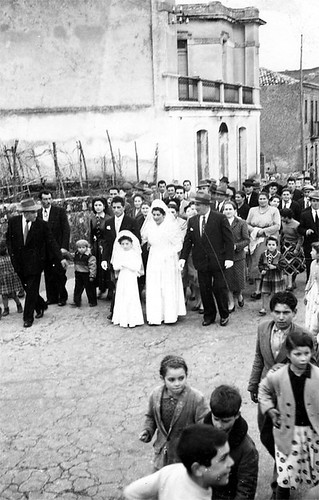
My some of my family is from pelligrina what year was that wedding photo taken
probably around 1950 or so
Vincent,
You mention everything in your article except the most important, and that is: speaking italian. I don’t see how ‘living as an Italian’ in the US can be separated by speaking the language, which is paramount to the survival of a culture. You might have been more precise if you had stated “living as an Italian American” rather than leaving as an Italian. Italian and Italian american are two very different things, a bit like being African and African American, or Irish and Irish American. Let’s not confuse the two.
Hi Luca,
We do mention language: “I pleaded my case with the advisor and asked, for example, how many of the students that had been selected spoke a second language or had been to the region/country that deemed them to be a minority, for example?”
Moreover, I don’t necessarily agree with you that language and culture are tied to each other; this is a form of linguistic relativism that had been debated in academic circles. A language is comprised of syntax and it’s an operating system for a given culture and I don’t think it’s responsible for how a given culture evolves/survives.
I agree with you about the distinction between an Italian American and an Italian (but don’t forget about Italians living in America, such as my parents).
What was NOT not spoken was your denial was in fact because you are WHITE and this gov’t thinks it can co-opt language and DEFINE peoples according to THEIR criteria . . terms “Hispanic,” “latinos” are misnomers and INVENTED governmentese . . .they are not accurate; didn’t you know the “white” caucasians are the privileged class and to be DENIED such financial rewards ? You ARE a minority in the true sense of the word but NOT in the “racial” sense;the reverse racism is palpable and drives most of these type of financial scholarships . . . which is why we have degraded because SOCIAL promotion has overtaken merit. I agree with you we Italians/ Sicilians ARE STILL a minority and need assistance as much as any so-called government declared, “minority” . .
there are shades of gray because cultures are shaped and molded mostly by the geographic location in which they exist. Geography determines EVERYTHING and of course there is more to a culture than only the language;think how far one would get in the USA with poor English skills ?
location and historic circumstances shaped us and molded us . .the farther geographically one moves, the more changes take place . . . how can one live a pure italian existence in a new environment ? There would be great alienation and stagnation . . . “hybridized” Italian enclaves are everywhere: Argentina,. Australia, Canada, one can hang on to one’s traditions, customs, language for only so long but the power of the ENVIRONMENT/LOCATION will impose itself unconsciously/subconsciously on the people and shape them; assimilation is a natural outcome of location,and impossible to overcome
This is a very interesting article. Please keep in mind that there were a lot of second greneration young men who joined the military and fought for this Country. My Father was a prisoner of that war, and I can tell you, his whole crew knew he was Italian, and glad of it! It was my Grandmother who was sending them food packages all the time through the Red Cross! My Grandparents settled in Utah! Madonne! The group of Italians here are small in number, but big on Italian traditions! I have only seen two Italian priests in my life, and one of them was my Uncle! Just keep In mind, my Grandmother would always say, “you can’t have good food if you don’t start with good food”!
I was born in New Jersey, but I have lived all over the USA. For almost 10 years I’ve been in the Southwestern United States. Simplistic attitudes about Italians are pervasive here and it doesn’t even pay to try to change anybody’s mind or sensitize them about it. I think the attitudes are harmless though. In many cases they’re just trying to be nice or funny with Mafia jokes or fake Italian accents. They just don’t know many Italians apart from TV-Italians. Most “Anglos,” I’ve met here really don’t identify with their family heritage at all though. They feel “Not Spanish,” or “Not Native American,” but I never hear them talking about their family history. On some level, I feel more comfortable with the Spanish and Native peoples here than any “Anglo,” because they have not lost their “culture,” and they’re more sensitive and appreciative of differences in culture. The longer I stay in the Southwest though, the more I feel like being back East or even going to Italy to the birthplace of my ancestors. I love my friends here and especially the land, but being apart from the culture I grew up in has made me yearn for people who have a common experience and understanding that is generally not available here.