
Guide to Cured Italian Meats: Salami, Salame, or Salumi salame salumi salami cacciatore prosciutto prosciutto cotto, finocchiona, capocollo, soppressata, culatello, mortadella
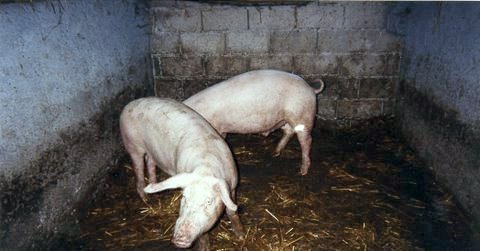
One of the highlights of my summer trips to Calabria as a small child included spending time on my grandfather’s working farm. Nonno Vincenzo’s farm was a 10 minute drive north of the small village of Pellegrina on Via Nazionale. Nonno would wake me up early in the morning and we’d jump into his white Fiat 500. While sitting in the passenger seat I anticipated a ride on his red tractor, visiting with the many roaming goats, and running through the olive tree orchards. However, I was secretly looking forward to one thing above all else: lunch! Lunch included the typical pasta starter, green, roasted meat, and tons of figs, peaches, wild berries, and cactus pears, but it was the cured meats that we ate before lunch that I enjoyed most. You see, Nonno was an expert salumi maker and he kept his best products hidden the entire year for his American grandkids to enjoy (at least that’s what he told me, though my Italian cousins Vice, Maria, Vincenzo, and Giuseppe all had that “salumi glow” about them!). Hence our Guide to Cured Italian Meats: Salami, Salame, or Salumi
Nonno produced wonderful cacciatore, capocollo, salt pork, and soppressata. The cured meats represented the ideal combination of salt, red pepper, herbs, wine, and intoxicating flavor and I often filled up on the meat and homemade bread and had no use for lunch. Salumi antipasto equaled lunch for me and a bit of frustration for my grandmother who didn’t appreciate the fact that nonno tempted his grandson with “vile” salted pork!
My love of cured meats continues to this day, but nonno has stopped running his farm and there are no pigs left to make capicollo, so we’re left to buying our cured meats from a salumeria (an insult and something that is looked down upon in rural Italy).
It’s even harder to find good salumi in the US, but the situation is changing with many local, artisan, salami makers sprouting up in places like California (see my recommended online shops below). It’s also technically illegal to import Italian cured meats into the US, so outside of Prosciutto di Parma (which is allowed) finding good Italian cured meats can be a challenge outside of large, ethnic, cities like New York, Boston, Chicago, etc.
What follows are my personal favorites in terms of salumi and a small description of how to consume and enjoy the cured meats. Looking for a more detailed review on specific salumi makers in US, here’s my recent review/article on Columbus Artisan and Creminelli (both companies are making excellent, artisan, salami). If you’re looking to produce your own salumi then start with Rhulman’s excellent book called Charcuterie: The Craft of Salting, Smoking, and Curing or the newer book Salumi by the same authors.
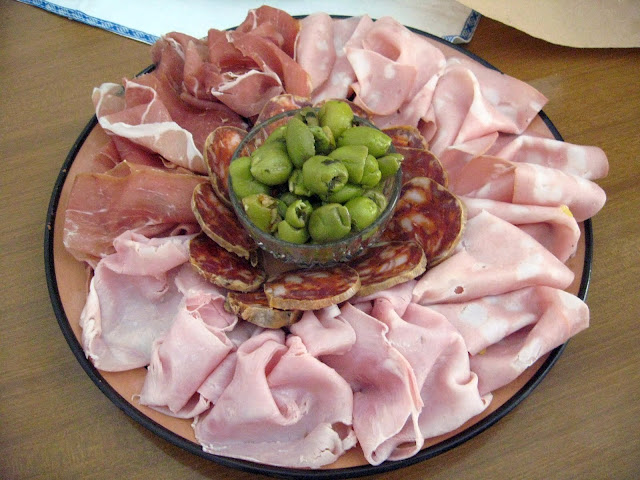
There are eight basic, cured/smoked, pork products made throughout Italy, including, but not limited, to:
Coppa (and/or Capicola / Capocollo)
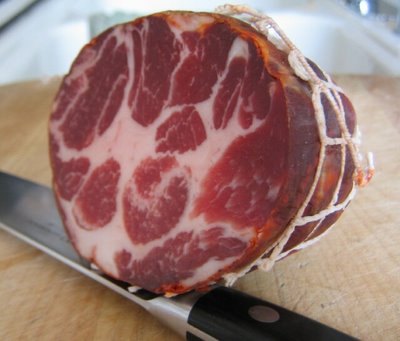
My all time favorite cured meat and apparently Tony Soprano enjoyed it as well (though his pronunciation of the delicacy wasn’t exactly grammatically correct). Capo means head or neck in Italian and the capicola is made from the neck or shoulder of a pig. Capicola has a tender texture and usually smoked and prepared with a variety of spices, herbs, and sometimes wine. I enjoy capicola in a sandwich made from fresh baguette. I usually don’t include any condiment or cheese as I don’t want to mess with the flavor of the meat.
Cacciatore (salami or dried sausage made from ground pork)
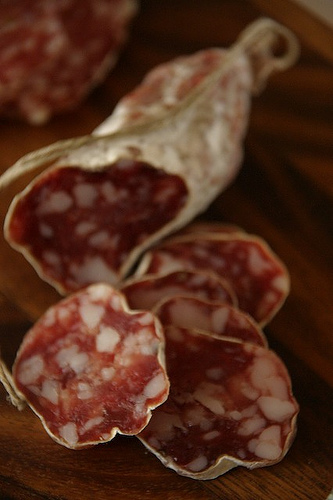
Literally means hunter and the folklore states that hunters used to carry this small salami in their pack and eat several pieces for sustenance during the hunt. Cacciatore is usually 6-7 inches in length and cured with the usual spices, wine, and herbs. Cacciatore tends to be a bit tougher than Capicola or Prosciutto. I love cacciatore with sharp Provolone and good bread. You could use the meat for a sandwich but the small pieces aren’t ideal.
Soppressata (salami or dried sausage made from ground pork)
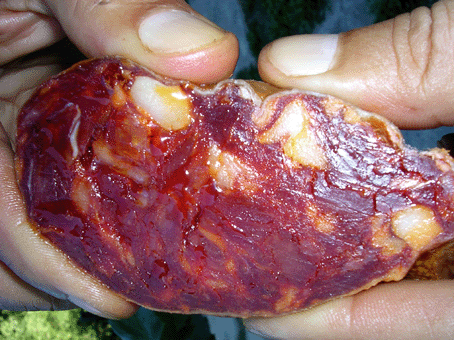
Like cacciatore, Soppressota is made from pressed pork belly, tongue, stomach and other parts of the pig. Again, spices and herbs vary by region and preference. Soppressota can be spicy and is an excellent meat for sandwiches. If you want to try and make your own see Michael Rhulman’s recipe on his exceptional food blog. Soppressata is less chewy and compacted than cacciatore and has the consistency of sausage. Generally speaking it’s important to note that most salumi are either categorized into products made from ground pig parts or from whole sections of the pig (for example, sopresseta versus prosciutto).
Guanciale
Made from the pig’s jowl.
Prosciutto
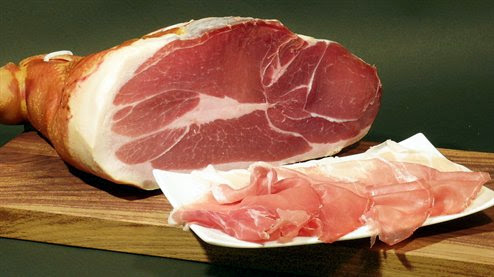
Prosciutto (made from the back leg of the pig) or dry cured ham comes in two different styles: prosciutto crudo (uncooked) or prosciutto cotto (cooked). Prosciutto di Parma or San Daniele (from Friuli and Emilia) are examples of prosciutto crudo.
Salt Pork
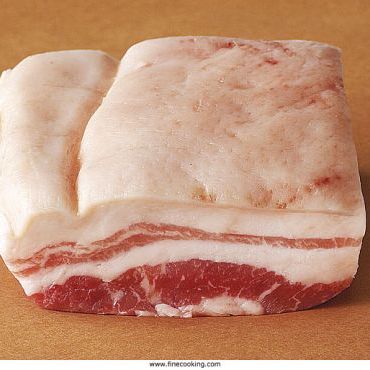
Most salumi affeciondads have a love hate relationship with salt pork; I happen to love this fatty, bacon like, salumi but it tends to be very salty. Moreover, I don’t particularly like cooking with salt pork, thought most folks use it as a fat for sautéing. I enjoy salt pork cut very thin with chunks of parmiggiano reggiano and a glass of homemade wine (I think the juxtaposition of the complex and creamy parmiggiano goes will with the simple, salty, and earthy flavors of homemade wine and salt pork). Salt pork is made from the pig’s belly and is not smoked.
Spalla
From the Academia Barilla web site, “Spalla is made from a large pork shoulder (preferably 46 to 48 lbs), including the coppa (a specific cut of pork neck and shoulder). After having remove the excess meat and rolled up the spalla, it is left to cure in a mixture of salt, pepper, cinnamon, garlic and nutmeg. It is places in a cold room, salted a second time and left for a couple of weeks. Then it is tied up, placed in a bladder casing and bound again from the bottom up. It is left in a cold environment for one to two months before consumption. It can be eaten raw, if well aged, or cooked, its more common form. The preparation, which follows very specific rules passed down through the centuries, calls for cooking the spalla in hot but not boiling water (160-175° F), seasoned with wine and bay leaves.”
Lardo
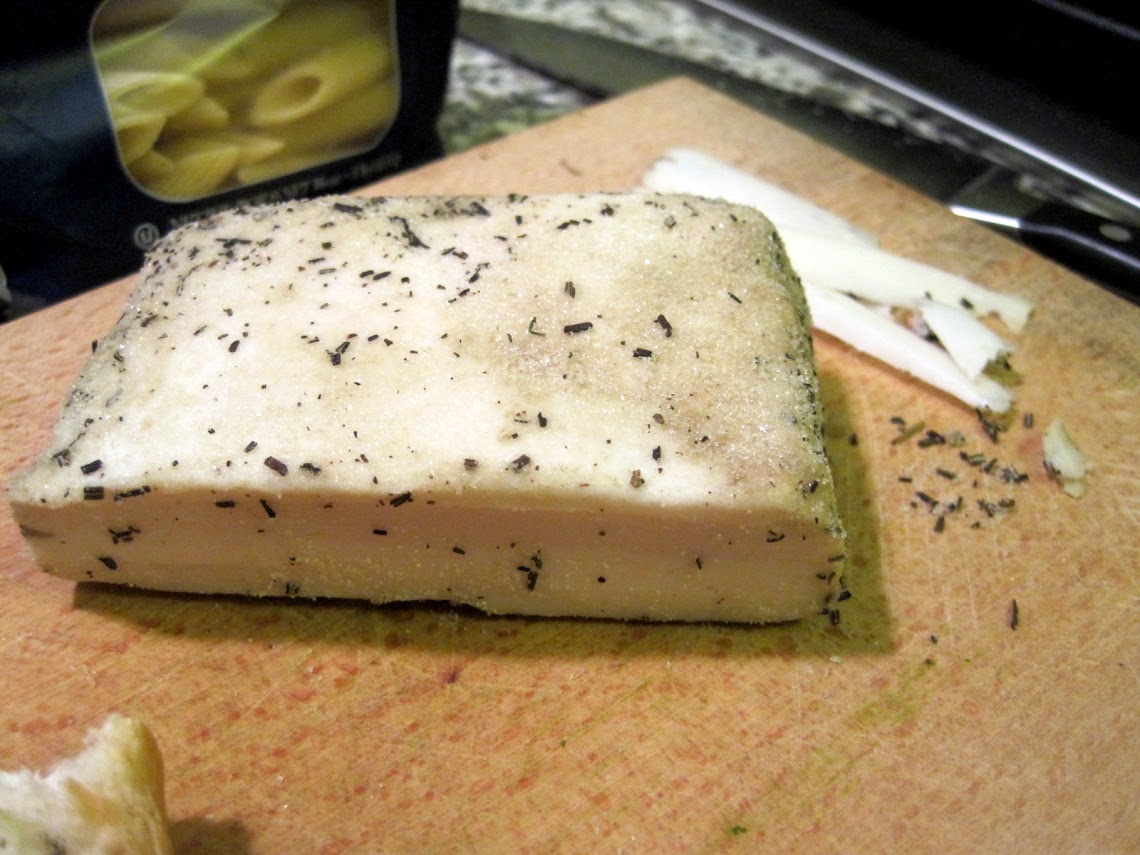
Lardo is produced from back fat and usually cured with rosemary. The most prized lardo is produced in the city of Carrara in northern Italy and usually consumed with a glass of white wine for a wonderful anitpasto.
Pancetta
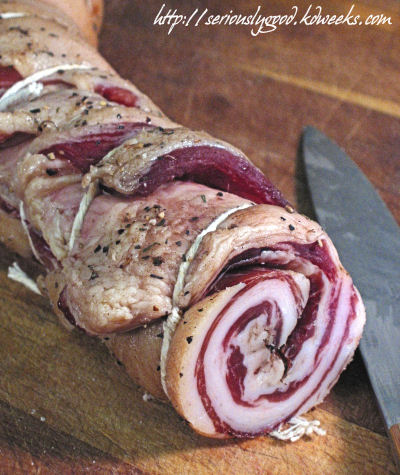
As you probably guessed, Pancetta is another salt cured and spiced salumi made from the belly of the pig. Most folks know pancetta and fry it to use in varied dishes. Pancetta when done is small batches is usually produced in a flat manner with the fat located on one side (unlike the rolled kind you will find in most shops in US). I’ve had both varities and it’s not one of my favorites. See Rhulman’s recipe if you want to try and make pancetta at home:
Speck
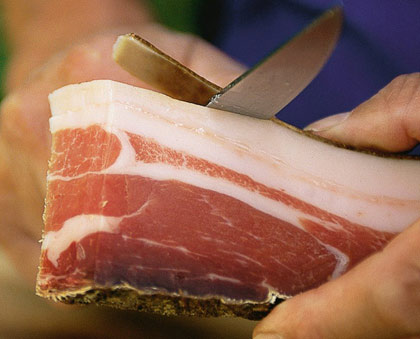
Speck is a type of Prosciutto made with the hind leg of a pig, however the bone is usually removed with this kind of salumi. Speck is usually cut thin and served with bread. The flavor is robust and the texture a bit chewy. Speck is also a smoked product. I’m not a big consumer of this cured meat, but it is tasty.
Culatello
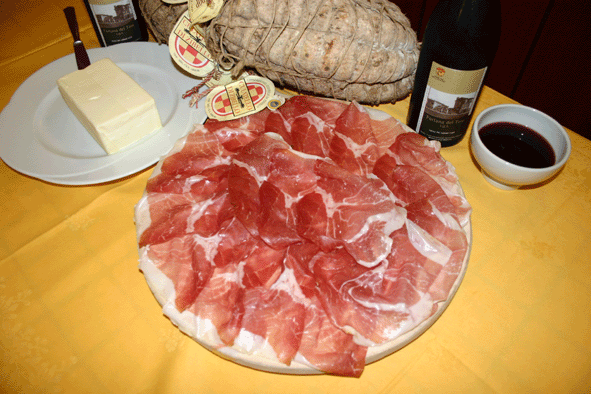
Culatello is a special type of Prosciutto made via larger pigs. Culatello is a prized cured meat and extremely flavorful. Here’s a nice write up on Culatello as I don’t have too much experience with the product (it’s a bit expensive).
Also, see La Cucina Italiana’s salumi FAQ as well as their Oct, 2009 article on artisinal salumi makers in the US. There’s an almost infinite variation of salumi produced in Italy and to catalog each and every variety would be on the scale of trying to catalog every variation of pasta shape.
Finally, here’s a list of where to purchase artisanal meats online:


I enjoy your blogs. I wish that they would ‘arrive’ more frequently!
Thanks, Susan! See today’s article on finding wild mushrooms! It’s a challenge to write every day, but my goal is a post per day (and with a new child it’s difficult at times).
Best and keep reading!
Vince
You had mentioned it being difficult finding good places to buy Italian meats. You should try http://www.volpifoods.com. Volpi Foods is a producer of salamis and other great specialty Italian meats. They are based out of St. Louis, MO. They have a great website and you can purchase everything online!
great specialty Italian meats at Volpi’s??? lol !!!!!!!!!
Hi Kelley,
Thanks for the Volpi reference; I think most folks in large metro areas can find good quality salumi.
Best,
Vince
Recipe: Grilled Veal Rib Chops with Chinese Eggplant and Feta and Tomato Salad
Many personal finance gurus will tell you to head to your local food market with only certain items in mind and shop only by price. Moreover, the penny pinching crowd would argue that the purpose of buying, and in…
John Volpi’s prosciutto is the only one mentioned as a worthy domestic product by Marcella in her “Classic Italian Cooking”. Volpi is the premier salumeria in the Midwest and is located on “The Hill”, the old Italian quarter of St. Louis. In these pricey times, their prices are reasonable. They ship through D’Italia and Sons (www.ditalia.com)and a standard FedEx delivery only takes one day to arrive in my corner of Illinois. Every Christmas I send a care package to family including, according to preference, prosciutto (half), pancetta, hot sopressata, and cacciatore.
My only criticism is that they have just about abandoned natural casings, claiming that regulations have made it too difficult to keep up a supply. I see that natural casing cacciatore are only made by one or two super-artisanal salumeria at astronomical prices.
I saw http://www.ditalia.com shop online and he has a lot of fake cheese and salumi….
Interview with PBS Host Mary Ann Esposito and Ciao Italia: Five Ingredient Favorites Book Giveaway!
(Photo: Mary Ann Esposito, photo courtesy of NY Mag)Every big idea or theory has an associated sound bite. The French philosopher Rene Descartes is remembered for his famous line, “I think, therefore I am.”, the chef Jacques Pepin loves…
How Salami is Made: Meat, Salt, and Time
(photo: the varying parts of a pig, photo courtesy of Meat Salt Time by Tony Seichrist) I have to admit, I have an addiction. Specifically, my addiction is centered on the mighty pig and it’s cured off-spring, Salami! Salumi (the…
On the Italian Life and Consumerism: My Take on Eataly
(photo: the ideal Italian life represented in Pellegrina, Reggio Calabria) Italian Shopping on SteroidsYou’ll have to excuse me if I sound a bit crabby this morning, as I just finished reading a New York Times review of the mega…
National Sandwhich Day: Two Sandwich Recipes, Roasted Peppers, and My Guide to Italian Meats
In honor of National Sandwich Day here are two of my favorite egg sandwiches as well as a guide to Italian cured meats and how to make your own roasted peppers. Enjoy the day and make a sandwich for dinner…
What is Fennel and How to Consume It
Young Scordo’s First Experience with Fennel Like most foods I love today, my first introduction to fennel was a catastrophe. My mother recalls in Christmas Eve dinner back in 1981 when a young Scordo erupted in a temper tantrum…
Guide to Antipasto: Italian Appetizers that Come Before the Meal
(photo: varied olives and cheeses) What is Antipasto and What Does it Include?Antipasto literally means “before the meal” and varies from province to province in Italy. Similar to French hors d’oeuvres or Spanish tapas, antipasto is a combin…
Best of Scordo.com 2010: Italian Recipes, Food, Products, and Advice,
(photo: The Scordo.com World Cup flag; unfortunately, we didn’t have a reason to bring it out this past World Cup)I wanted to wish our loyal Scordo.com readers a Happy New Year and Buon Anno! and also list our top ten…
Pancetta, Bacon, and Cured Pork Perfection
By now, you’ve read my countless references to salame, prosciutto, capicola, cured pork, etc. and you may be thinking: what’s wrong with this guy, does he have a thing for pigs or something? The short answer is yes and…
Crostini, Bruschetta, or Italian Toast Guide and Recipes
(photo: crostini with cannellini bean spread and roasted peppers)Crostini literally means “little toasts” in Italian and they are Italian appetizers or tapas consisting of flavorful toppings. Crostini are usually made from Italian baguette,…
Duck Prosciutto, Happiness and The Charcutiere Movement in the US
I’m a big believer in chasing happiness in life and not the 30 minute kind that’s associated with a new car, electronic device, or a bigger house (sorry all you hedge fund managers and Goldman employees). Happiness, after all …
Pennsylvania Salami Makers: Homemade Soppressata or “Soupie”
(Photo “Soupie” or Soppressata during the “first hanging.” The meat is already starting to shrink and change color; the meat hangs in this manner for one week. Courtesy of Matt Scicchitano) In Calabria, the salumi sopressata (…
Villa Cappelli Sun-Dried Tomatoes Cured in Extra Virgin Olive Oil
(photo: close up of a few Villa Cappelli sun dried tomatoes in olive oil)One of the most important aspects of a product claiming to, in fact, be “sun dried tomatoes” is that the tomatoes are indeed dried by the sun….
Tomato, Gorgonzola, and Hot Sopressata Panino, Plus a Columbus Salame Giveaway
Peperoncini and SalumiIf there’s one food item that the southern province of Calabria is famous for it would be peperoncini (or red chili peppers). Peperoncini are used in pasta dishes (Penne all’Arrabbiata, for example), cured meats and vegetables (i…
Organic Adriatic Fig Spread
Any time a fruit boasts a history dating back to 9200 BC it deserves both your attention and inclusion in your diet. Moreover, if that same fruit is grown all over our planet, including Iran, Pakistan, the Mediterranean, India,…
Colatura di Alici or Italian, Anchovy, Fish Sauce
(photo: note the wonderful golden brown color of the Colatura di Alici)What takes 12 months to age and is extracted during an age old curing process, hint it’s not a pork product (cue the Jeopardy music). The answer is Colatura di…
It is said that sopressata originates in Calabria. Where does capicola originate?
Hi Tom
Good question. Just like Italian dialects salumi is a varied and very subtle topic. Every region makes a special type of salumi and some are variations of standards while others are trully unique. Capicola is made, in a general, way across much of southern Italy, including Calabria. Our family has been making Calabria for decades, for example.
Vince
Soppressata originates from Basilicata not from Calabria.
Capocollo better know as Coppa is probaly from Puglia.
I’m from italy
i love the variety of meats shown here, but Im looking for a step-by-step how to guide because I am dying to make some of my own. Can you help me with some instructions?
I made cacciatore once. It was summer and they needed to cure for a week at 65 degrees, but the only AC I had was in my bedroom. They hung over the bed dripping on newspaper. They turned out pretty well, but resembled Landjaeger more than Cacciatore. My advice? Take up bread making, find a good salumeria and pay him to make your salumi.
I am searching for a trade mark Senffer or Sönfer established in Alto Adige region some years ago. Do you have some knowledge about this firm?
http://www.amazon.com/b?_encoding=UTF8&site-redirect=&node=172282&tag=tabbooingcom-20&linkCode=ur2&camp=1789&creative=9325
The old Italian district in St. Louis is “The Hill”. The Salumeria there is Volpi, who makes a complete range of salumi, including a fine proscuitto mentioned favorably in Marcella Hazan’s “Classic Italian Cooking”. I have purchased mail order salumi from them for about 40 years now, but their retail is now handled by a neighbor, Ditalia. See http://www.ditalia.com/category/italian-cured-meat-specialties
From my part of Western Illinois near the Iowa and Missouri borders, delivery from Ditalia is overnight for regular UPS shipping charges, which is free for orders of $100 or more.