

(photo: via the Italian Farmer’s Table, rye bread)
(UPDATE 1/10/09: Contest is closed. The winner is SimplyForties! Thanks to everyone for participating.)
If you’ve read any of my articles focused on Italian living and lifestyle over the last 6 months, then you’ve probably come to the conclusion that my Italian roots (and those of my parent’s) are firmly situated in the mezzogiorno (the word mezzogirono references the southern region of Italy, including the regions of Basilicata, Campania, Calabria, Apulia, Molise, Abruzzo and the islands of Sicily and Sardinia ). In turn, I often shy away from writing about northern Italy because I’m both unfamiliar with the region and also because so much has been documented and said about areas/cities such as Toscana, Roma, Sienna, Genoa, etc. But when a good friend forwarded me an article from a local newspaper in Connecticut I know I stumbled upon something special, namely, a new book by husband and wife team Matthew Scialabba and Melissa Pellegrino entitled, The Italian Farmer’s Table, Authentic Recipes and Local Lore from Northern Italy (see the accompanying website here!).
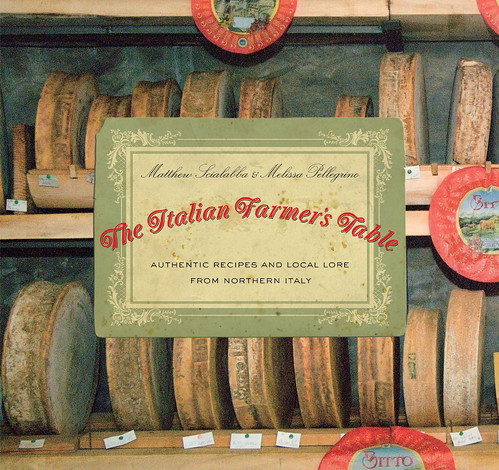
(photo: via the Italian Farmer’s Table, cover photo)
Like the movie Julie and Julia, Matt and Melissa ate, worked, and lived their way through every region of northern Italy by way of agriturismi (subsidized, working, family farms that provide lodging and meals to travelers). The couple also documented 150 northern Italian recipes from the farms, including many dishes I’ve never read or encountered in Italian cuisine. The 150 recipes are translated with great care and they can, for the most part, be easily adapted for the American kitchen. In addition to the recipes, the book also include tidbits on local traditions, events, and, of course, food items (for example, in the the chapter on the Casa Al Campo farm we learn about the Dolomite Mountains and the hunting rituals surrounding deer and chamois). The Italian Farmer’s Table also features great photography, especially photos taken with the farm owners and their local products.
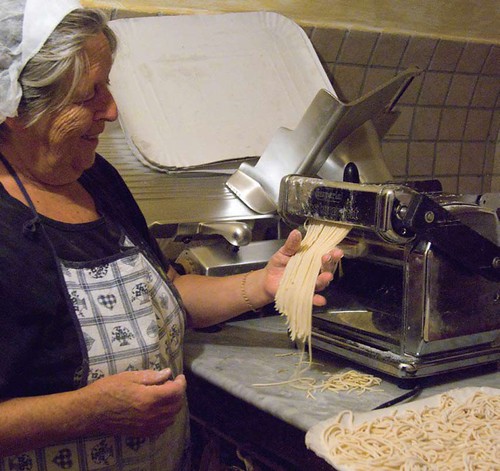
(photo: via the Italian Farmer’s Table, making pasta)
I loved the Italian Farmer’s Table so much that I asked Matt and Melissa if they were willing to offer a free copy of their book to a lucky Scordo.com reader and, echoing the generous spirit of the Northern Italian farmers referenced in the book, they agreed! Here’s how you can enter to win a free copy of The Italian Farmer’s Table:
– Prize Giveaway includes one (1) copy of the The Italian Farmer’s Table
– What you need to do to enter: 1. leave a comment under this post on your favorite Italian region or city that you’ve visited (if you haven’t been to Italy which region would you like to visit?) and 2. sign up for the Scordo.com What’s New Newsletter here.
– Only one entry per person please.
– The contest is open until 12 midnight on 1/10 and a single random user will be picked via Random.org (sorry contest only open to folks from the US given shipping logistics). The winner will be announced immediately on Twitter (so please follow me) and on Scordo.com by 5PM on Monday, 1/11.
– Please use a valid email address when leaving a comment so I can contact you just in case you’re the lucky winner (I’ll need your shipping address).
– Globe Pequot Press will send out the book during the week of 1/11.
Finally, Matt and Melissa were also nice enough to answer a few of my questions on local versus organic food, the agriturismo industry, why Italians place so much emphasis on eating well, etc. You can find the full interview below and also purchase the book via Amazon.
1. What inspired you pick up and leave the US and live in a foreign country. Was it difficult to adjust and handle the practical elements of living a foreign country.
We had been toying with the idea to write a cookbook about the Italian agriturismo for about six years. After numerous rejection letters from publishers, we decided to do the trip ourselves. We knew that the whole agriturismo system was practically unknown to the American tourist and that as the farm to table mantra began to pick up steam here in America, the timing was right for a book of this nature. We had both lived in Italy before so being there again was not that big of an adjustment. I think the hardest part was living out of a suitcase for four months and changing farms every 5th day.
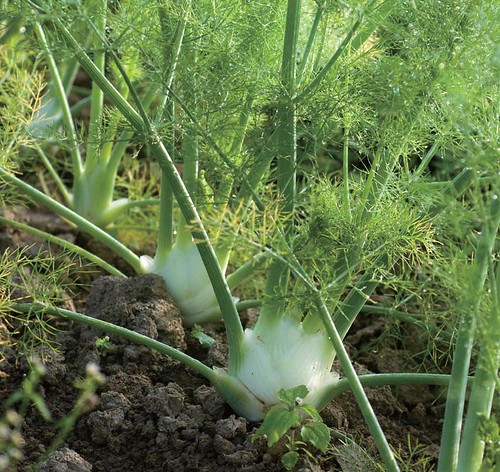
(photo: via the Italian Farmer’s Table, fennel)
2. There’s been lots of talk in the media surrounding organic and local foods. Should shoppers concentrate on buying local versus organic?
Hopefully if it’s local, it’s also seasonal and not shipped across the country or from another country. While we commend organically grown food we are not that big on its status symbol and government approved stamp. There is nothing better than eating ingredients that are in peak season and harvested close to where they are sold. Many of the farms we visited considered themselves “independently” organic, farming naturally without pesticides or chemicals, but perhaps lacking an official organically grown certificate. Hopefully, most locally grown food available to consumers are adopting a similar philosophy.
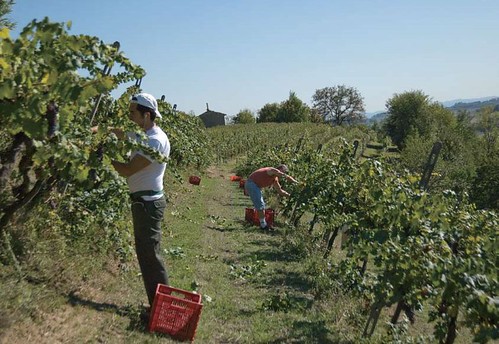
(photo: via the Italian Farmer’s Table, harvesting grapes)
3. How do Italian shop for food and is there a big emphasis on organic or local foods?
Italians shop for the day, often going to the markets every day to seek out what’s fresh and looks the best. Kitchens often have much smaller refrigerators than we have in the US and they eat far less processed foods and snack food.
4. What’s an agriturismo?
An agriturismo, is a working farms with accommodations and restaurants, where everything grown and raised on the farm are served to guests. The system was formed in the eighties to help preserve small family farms. By allowing them to open their doors to overnight guests, farms were able to supplement their incomes by providing food and lodging. They have experienced tremendous success, and there has been a huge movement throughout the country as crumbling farms are being renovated and revitalized. There really is no better way to experience rural Italy than to stay at an agriturismo and soak in some local culture and eat and drink like a real Italian.
5. What makes local Italian food taste so good and is it really possible to recreate the dishes in your book here in the US?
Prime ingredients that haven’t traveled hundreds of miles. We have adapted all recipes for the American home cook
6. What’s your favorite northern Italian region?
Too difficult a question – each region has its own personality and charm
7. You mention the “Italian countryside lifestyle” – what exactly is this?
Living sustainably and with the seasons consuming what one can grow and raise locally.

(photo: via the Italian Farmer’s Table, fresh ricotta)
8. Why do Italians put so much emphasis on eating well and how does good food contribute to such a high quality of life in Italy?
Eating well means everything to Italians. Eating means so much more than consumption, but rather, a time to be with friends and family and to sit down and enjoy company and conversation united by food. This all contributes to a high quality of life focused on more intrinsic values with less emphasis on material objects.
9. What’s your favorite, local, Italian dish to prepare in the US?
For us, in CT, we love linguine with clams. Fresh local little necks, garlic, hot pepper, white wine, and lots of parsley. Summer or winter, the briney salty flavor is a classic Italian (southern) favorite.
10. How is local farming set up in Italy and how can this system of food production feed a large western country and is it possible to replicate this system in the US?
The Italian agriturismo can prove to be a model example of how small farms can succeed and operate. As more and more Americans are shopping at farmer’s markets and becoming interested in learning about where their food comes from, smaller, family run farms have begun to experience success and economic sustainability. While we are moving in the right direction, there is still much to change about American’s eating habits. The White House’s first garden is symbolic of more awareness about the importance of eating well, and there’s hope on the horizon for a better and healthier American diet.


I spent 8 days in Lucca in Tuscany at a cooking school a couple of summers ago – absolutely fabulous! I love Italy.
I haven’t been yet, but it is one of my long term goals
(5 year) to get there. My family is from Calabria and
Sicily, but if we don’t go south first, I’d love to visit Rome. I have relatives there, and I’m sure the trip would be sensational with the art, architecture, and of course, the outstanding food!
Florence! The food was out of this world and the people loved to stuff me silly. I had one of the most amazing dishes of my life—fluffy light gnocchi with pesto sauce. I had a foodgasm right there are the table!
I’ve always wanted to visit Florence. Alas, I now have 3 small children and my traveling is over for quite a few years. In the meantime, I am learning to cook authentic dishes!
I love Venice! Simple city cuisine with history…
I loved Venice such a cliche I know. I didn’t expect to because generally I am a contrarian. The gelato was so very delicious. I also remember staying in a dorm in a convent on Murano.
Definitely Bologna where the cuisine had me dreaming for months after.
Three years ago we spent two weeks in Le Marches and Umbria only staying at agriturismi. I cannot say how wonderful and totally Italian the experience was. For a very authentic trip I would suggest that travelers go off the beaten path and visit the less traveled regions.
Spent 10 days in Rome – fabulous city! Though my best day of the trip was the cooking class we took in the medieval hilltop village of Toffia, which is located in Central Italy in Sabina.
Toffia and the surrounding villages are self-supporting, growing and sharing their wonderful food within their communities. We cooked with only local ingredients and some of the best olive oil I have ever tasted. We prepared Spaghetti alla Carbonara, Agnello alla Cacciatora, and a wonderful dessert recipe – Torta di Mele – that had been handed down through our host’s family for generations.
It was a wonderful day and a delicious meal shared with very kind, welcoming people. I can’t wait to go back!
Lombardia and Piemonte by far! I loved the small towns in these two regions, and we started off the experience by staying at la Torrazzetta near Milano. Very welcoming family and workers; they make their own wine.
Venice. Actually, I’d just love to go to Italy period. This books looks lovely!
We’re going to Emilia-Romagna in April (for the my first time in Italy), and this book seems like it will be a great way to whet our appetites!
Abruzzi. It’s where my family is from 🙂
I haven’t visited a lot of places in Italy, but had unbelievable food in Rome, and Venice. I would love to do much more traveling and eating!
I recently spent two weeks in Italy with my husband and another couple…loved it all. We stayed in Rome, Positano, Venice, Florence and Sienna. Picking my favorite is very hard. But I think I would have to choose Sienna. The entire Tuscany region is amazingly beautiful, the people so friendly and the food and wine amazing! You live in a wonderful country and I look forward to going back there someday!!
I recently spent two weeks in Italy with my husband and another couple…loved it all. We stayed in Rome, Positano, Venice, Florence and Sienna. Picking my favorite is very hard. But I think I would have to choose Sienna. The entire Tuscany region is amazingly beautiful, the people so friendly and the food and wine amazing! You live in a wonderful country and I look forward to going back there someday!!
I would love to visit Italy, and it would be SO fun to tour the wine country!
My dad was born in the Veneto region and his entire family is still there. I have visited several times, but I think my favorite is being anywhere in the alps. Thanks for the wonderful giveaway opportunity and good luck to everyone.
My dad was born in the Veneto region and his entire family is still there. I have visited several times, but I think my favorite is being anywhere in the alps. Thanks for the wonderful giveaway opportunity and good luck to everyone.
I once read an article about the “Cinque Terre” area, a series of five villages along the Ligurian coast, and put it into my “dream travel destinations” file. But really, any place in Italy will do!
The book looks gorgeous, and thanks for the opportunity to win a copy!
Rome blew me away with it’s history and architecture. The food throughout Italy was wonderful – the research for writing this book must have been incredible!
My favorite region is, of course, Calabria…where I’ve been living since 2002 🙂 But I *do* have a US shipping address and I’ve signed up for the newsletter, so hopefully I’m eligible to win this fabulous book!
My girlfriend and I planned our first trip to Europe last May. We planned to spend 10 days in Italy. 2 days in Venice, 2 days in Florence / Bologna, 2 days in Rome and ending with 3 days in Positano. We were both looking forward to the trip more than anything, but had to cancel due to extenuating circumstances. We will be rescheduling this trip very soon and cannot wait to come!!
I’ve really only been to the Rome area, but am dying to see Calabria!
I spent a week in Italy about 10 years ago, and while I loved it all, I would have to say Vernazza (part of Cinque Terre) was my favorite. I would love to go back there. I’d also love to win a free copy of what appears to be a great book.
We moved to Florence, Italy in December 2001 from New Jersey. Big change but there is a beauty that is released when you see the Duomo and other architectural buildings. We go to the Tuscan country house, where we have olive trees that make wonderful oil every year. We have also planted many crops of different kinds of vegetables with competition from the slugs, porcupines and wild bores. When the summer heat hits big highs in Florence, we trek to the Dolomites. Nothing beats the beauty and tranquility of the Alps.
Please delete this post and the one above. thanks
I would love to visit the Sigurrta Botanical Park in Valeggio which is between
the Lombardy and Veneto regions of northern Italy! What a dream trip!
I’ve enjoyed your blog for a long time now, always glad to see new postings.
Thanks for the chance to win the book!
I spent about a week in Italy 10 years ago. I loved it all, but I’d have to say Vernazza, in Cinque Terre, was my favorite spot.
I’ve signed up for the newsletter!
I’ve been to Italy twice for archaeological work, so I spent my time in Rome. I got to visit Naples and Florence as well and though I loved them both, Rome is where my heart is. The food, the history, the art… and hearing the language everywhere is so beautiful.
I cannot win, as I live in the UK but I love to places….Lake Como and the area, so beautiful…and Liguria…Favourite?? I think I would have to go for Liguria, hard choice, but you can get to France to, and all the wonderful little towns on the italian riveria coastline.
Michelle,
Me. Me. Me. Me. Send the book to me. I need it bad. I am a terrible cook of our beloved Italian foods and for me Campania is right on target.
You should see how my “Frittella” comes out…..e tutto brutto!!!!! Poor little flowers died in vain….
I love love love both north and south Italian….how can I choose. Ah the wisdom of Solomon; “..I will eat everything!”
Love and Light,
richard
My grandfather was from Ascoli Piceno, and while most of my immediate family have visited Italy, I have not managed the trip. However, I’m the only one who know’s how to make my grandfather’s sauce taste exactly like his. I would love to win this book & learn more.
The authors talk of Linguinne w/ clam sauce. I’ll never forget my first trip tp Rome. We went to a small restraunt and asked for the specialty of the house. They served that dish. When it was time for dessert they asked what I would like and I asked for clams and linguinne again. Oh so good!!!!!!!!!!!
Basaldella di Vivaro. Small town just northeast of Venice. This is where my dad is from and there are still many family members there. It’s been a LONG time since I’ve been but hope to get back there in 2010. Of course, anywhere in Italy would make me happy! Someday…..someday….maybe I will get to see it all! The book would be a great start!
I love Italy so much I started an Italian Specialty Food Store (even though it isn’t my heritage)! I love any small town in Italy, one of my favorites is Greve in Chianti, the meat shop & other little shops on the square are great.
My absolute favorite area is the Chianti region of Tuscany. I don’t think I have ever enjoyed being anywhere more than there…it’s beautiful, the food and wine is wonderful, the people are energetic and friendly…I just love it.
My sister and I are looking forward to traveling to Rome this spring for the first time.
I recently visited Rome and loved it all! But I am anxious to visit Tuscany and Lombardy as soon as possible!
Thanks for great comments thus far! My favorite region of Italy is Calabria of course; however Sicily is close second! My parents were born just outside of Reggio Calabria in a small mountainside village called Pellegrina (a 10 minute drive from the sea and Bagnara Calabra). The southern part of Italy has some undiscovered gems both from a culture and food perspective!
Best,
Vince Scordo
My favorite part of Italy is Rome–that’s where I learned to be happy.
My comment is not for winning the book, but rather to thank you for this post. A lovely write up with beautiful images. This is a wonderful way to introduce your fans to a wonderful resource and two amazing people.
BTW – Venice
Hi Elaine,
Thanks for the kind words; indeed I hope my fans open their eyes to a great book and two great writers/people.
Vince Scordo
This is a tough one. Having been to several cities in Italy, I would say that Siena and Rome were among the favorites. My greatest memory of the Siena area was a tour of a small winery in Montalcino. And Rome had a great combination of history, hipness and solid food (if you have a good guide to help you find the little gems).
My daughter and I were enchanted by and “consumed” Vernazza, enjoying the indigenous and seasonal foods, wonderful pastas, fresh seafood, simple presentation and best of all, sitting on the Mediterranean, toasting our great meals with fabulous local wines!
Rome was my favorite- I loved the hustle and bustle. It was ,magical. Thank you!
My favorite city is Ascoli Piceno, a gorgeous, unknown place that I was blessed to call home for nearly three years. My favorite region is Basilicata, where my roots lie on a mountainside in that beautiful, rugged land.
sounds beautiful, Valerie! Do they make Aglianico in Basilicata?
Vince Scordo
Thanks for posting, sounds yummy. I’ve lived in the Region for 10 years and I love reading about anything related to my new place of residence. I discover something different about the area every day.
What We’re Reading – New Cookbooks, Tuna Massacre, Artist Cook, the Manhattan, Pasta Science
(photo: courtesy of the documentary: “La Mattanza – The Tuna Hunt in Sicily” See below for a description of the yearly event) Eater.com – Eater previews new, 2012, spring cookbooks and “food books.” The preview includes a blurb on The…
Vincent, Here is my comment; I already subscribe to your newsletter. And just so you know, we think the agriturismo way of traveling is wonderful … and just perfect for families!
oops. contest closed. i guess i’ll just head on over to amazon to purchase the book:))
So sorry, Maria!