Recently in cheese Category

 
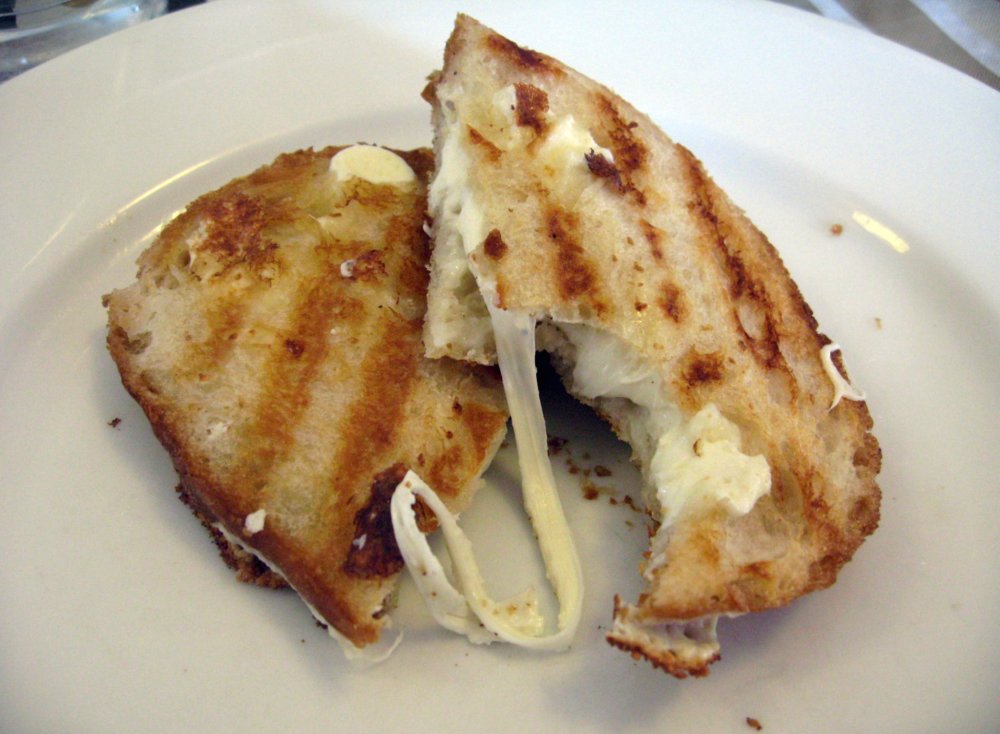
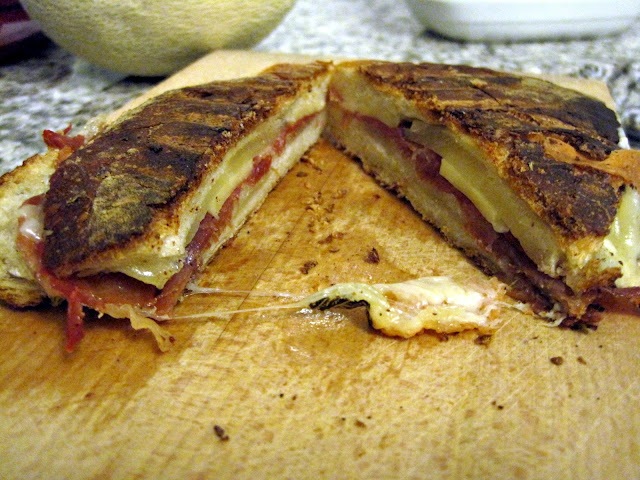
(photo: Pane in Cassetta <Grilled or Toasted Panino> with Prosciutto di Parma, Cheese, and Pane Pugliese; notice the charred bread and melted cheese)

One of the most ubiquitous panini (plural for sandwich) in all of the Italy is prosciutto and cheese.  In fact, I made so many of the aforementioned panini in Italy one summer (helping Zia Teresa in her small shop) I thought all Italians survived on prosciutto (or prosciutto cotto <steam cooked Parma ham>) and cheese alone.     

Italian's fascination with panini are easily understand and well placed when you begin to think about the quality of ingredients; viz., superb prosciutto made with the most well cared for (and regulated) pigs on the planet, cheeses that are seemingly sent directly from the Gods and protected by the Italian government, and bread that is both exquisite and ephemeral.  The end result is the perfect marriage of meat, cheese, and bread; that is to say, quite possibly the best recipe / food type on the planet. 

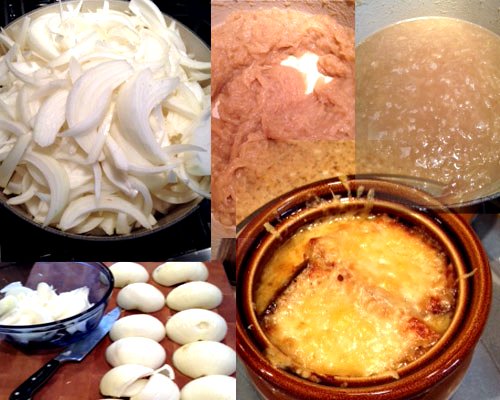
(photo: courtesy of Dr. K.; from a clockwise position: raw onions, reduced onions, water added to reduced onions, onions prior to cooking, and finished product).

When our die hard fan Dr. K. mentioned he tried a new recipe from Michael Ruhlman's excellent new cookbook Twenty I was eager to hear which dish he attempted.  And when Dr. K. sent us photos of Ruhlman's French Onion Soup recipe (the dish he choose) I become intent on adding an Italian bent to the recipe so that we could post the recipe on Scordo.com (after all, any dyed-in-the-wool Italian food snob wouldn't dare post a French recipe).  

You have to love any establishment that sells over 200,000 pounds of Italian cheese in a given week, in turn we've fallen deeply in love with the Pittsburgh based, Pennsylvania Macaroni Company.  The Italian food store was started in 1902 by Sicilian immigrants from Trabia and they now carry well over 5,000 Italian specialty items, including an online business that will slice imported salumi and cheese for you and ship it anywhere in the United States!
 
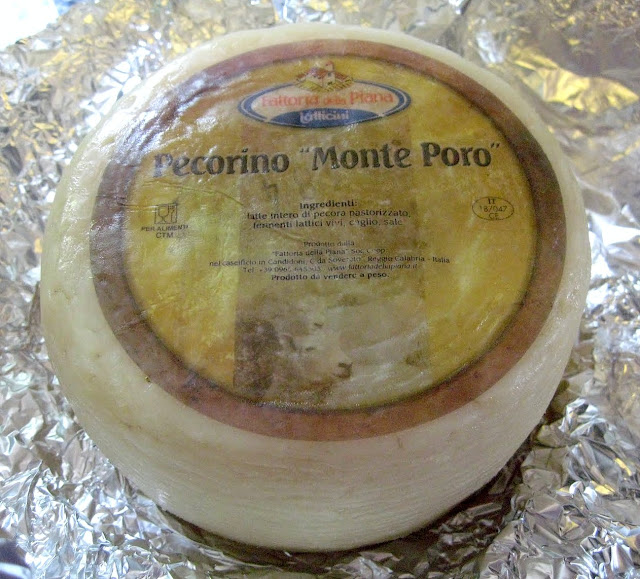
(photo: small block of Pecorino "Monte Poro" from Calabria)

Sit down for a meal at any restaurant or home in Calabria and you'll most likely encounter some variation of sheep's milk cheese; specifically, Pecorino.  During our recent trip to Calabria, for example, we ate Pecorino 4-5x per week and often mixed in a platter with local salumi and olives.
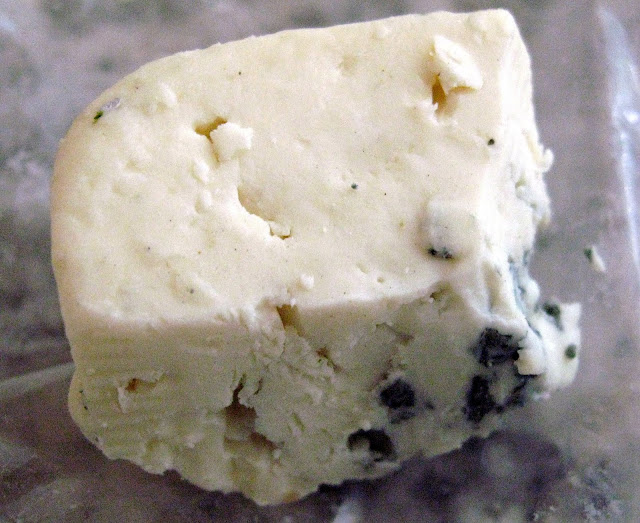
(photo: a piece of Italian Gorgonzola or blue cheese that I used with our basic salad dressing recipe)


Condition Yourself to Love the Foods You Hate

I'm always surprised when folks tell me they don't like a particular food or ingredient such as cilantro, baby goat, rabbit, blue cheese or Gorgonzola, etc.  When I ask folks why they don't like a given food the answer always centers on flavor; specifically that it's too strong.  My response is you're not always going to love a particular food or ingredient on your first tasting and that multiple exposures may be needed in order for your mouth to hit that "like" moment (think Facebook, ok).  For example, I'd probably need to rid my entire pantry and fridge if I hadn't been persistent about learning to like foods after initially being repulsed by items such as dried cod or bacala, salt pork, runny egg yolks, lentil soup (yes!), fried sardines, etc. 

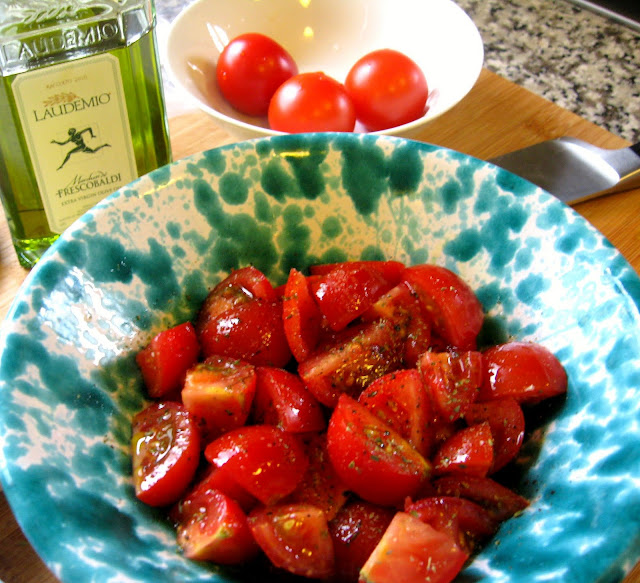
One of my favorite ways to consume olive oil is via the simple and humble tomato salad.  Our tomato salad is prepared with red onion, basil, dried oregano, Kosher salt, freshly ground black pepper and the best extra virgin olive oil we can get our hands on.  

Recently, we've fallen in love with two extra virgin olive oils that seem to have been made just for tomato salads (and, by association, whole milk mozzarella).  Specifically, we're talking about Pace da Poggio Etrusco and Laudemio Frescobaldi.  The Pace de Poggio Etrusco hails from Siena in Toscana and has a slightly sweet character along with floral and herbal notes.  The Laudemio Frescobaldi (first pressing, 2010) from Chianti Ruffina has peppery notes and reminds me of the many spring vegetables such as artichoke, asparagus, and peas.   


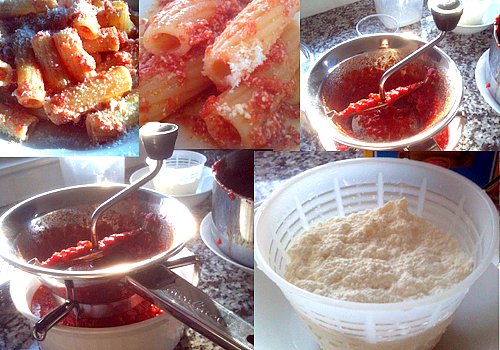
I talk a lot about pasta here on Scordo.com and I like to think for good reason!  One of my go to pasta recipes for any occasion is tomato sauce, ricotta, and grated Parmigiano Reggiano.  The ricotta is usually homemade (see our recipe) and the tomato sauce comes by way of our canned tomatoes.  Combine the cheese and tomato sauce with a pasta shape like tortiglioni and you have one of the most ideal representations of pasta and condiment on the planet!  The Tortiglioni was from De Cecco. 

(photo: Capezzana Olio Nuovo 2010 with fresh whole milk mozzarella dried oregano, Kosher salt, and freshly ground black pepper)

About 25 minutes northwest of Florence in the small wine growing region of Carmignano you'll find the estate of Tenuta di Capezzana - an estate that has been producing olive oil since the year 980.  I was lucky enough to sample the 2010 Capezzana November harvest and was immediately taken by it's mind bending color; a neon green slap in the face that is especially vibrant against whole milk mozzarella.  The color is partly due to the fact that Capezzana picks their olives when they are still green.
 
(photo: a cheese festival in Modena Italy.  thanks to wikivisual for the photo)

Part of the negative aspects of the industrial food system in America are the disassociations between "real food" and "synthetic food."   Take, for example, the cheese associated with pasta, specifically what you would put on a bowl of penne rigate with tomato sauce.  For many of us in the United States, we associate grated cheese with a green container from Kraft labeled as "Parmesan" - an imitation cheese.

Of course, what Kraft is aiming to imitate or associate with is Parmigiano-Reggiano and/or Grana Padano.  Both cheeses are produced in northern Italy with Parmigiano-Reggiano specifically being made in:

"...Parma, Reggio Emilia, Modena, and Bologna all south of the Po River in Emilia-Romagna as well as in the Mantova area in Lombardia north of the Po River.  Parmigiano referring to the city of Parma and Reggiano of course references Reggio Emilia."
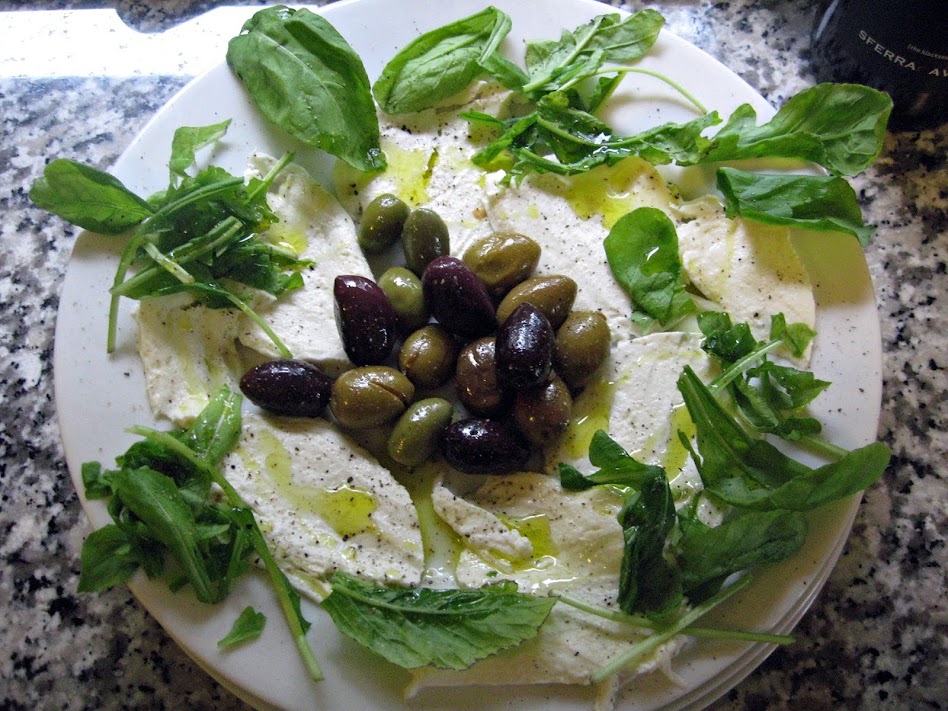
(photo: varied olives and cheeses)

What is Antipasto and What Does it Include?

Antipasto literally means "before the meal" and varies from province to province in Italy.  Similar to French hors d'oeuvres or Spanish tapas, antipasto is a combination of small bites of tasty food, usually accompanied by wine (see our wine basics guide) or beer and meant to stimulate the appetite before sitting for the main meal.
 
(photo: finished pizza with fresh mozzarella, homemade tomato sauce, grated Parmigiano-Reggiano, basil, and extra virgin olive oil) 

I recently had a wonderful email exchange with Dr. K, an avid home cook, supporter of local foods, and Scordo.com reader.  Dr. K was moved by our article on cracked Calabrian olive salad because of the suggestion that making food with others is truly a special, and uniquely human, activity.  I couldn't agree more with him and in turn wanted to share some recent photos of our pizza making session at home (I swear my family is in the background helping with the preparation!).  

You can find both our pizza dough recipe and pizza making process below.  If you're looking for a quick pizza to make at home try our lavash pizza recipe (which doesn't require you make dough). 


The tomato mozzarella sandwich is so simple it hardly needs explaining, but it certainly should be prepared more often by home cooks (hence the post!).  


A good tomato mozzarella sandwich, like most Italian dishes and recipes, is dependent on great ingredients; therefore high quality tomatoes, whole or Buffalo milk mozzarella cheese, extra virgin olive oil, and bread are vital.  For my sandwich I'm using: 

I start by adding the extra virgin olive oil to both side of my bread, followed by a single layer of mozzarella and tomato.  I add salt, pepper, and oregano and a drizzle of olive oil.  If I had access to fresh basil I would include a few, bruised (to release the flavor), leaves as well.  Enjoy the sandwich with a glass of Ciro Librandi Bianco or crisp lager or IPA.
     

(photo: Columbus Artisan line seasonal cacciatore)

I've written about Columbus' Artisan salumi line in the past (including their hot sopressata, cacciatore, finocchiona, crespone, salami secchi, and standard Sopressata) and their high-end line is outstanding as it's made with a higher grade of pork, allowed to age 21-90 days, hand tied and stuffed, and made with natural casings.  Click here if you're interested in learning more about how salumi is made.   


(photo: Artisan truffle cacciatore before hand slicing)

Columbus recently released a new line of holiday salame aimed at a larger, mass market, audience; namely, "wine salame"  The salame collection includes: Cabernet Sauvignon (with juniper berries), Pinot Noir (with pink peppercorns), and Pinot Grigio (with lemon zest).  The salame is aged minimally and has no natural casing. Columbus also recently introduced a seasonal, artisan, line of cacciatore made with both porcini and truffles.


(photo: wine salame on left and cacciatore on right; the photo doesn't do justice to the differences in exterior mold and composition of the meat itself)


(photo: wine salame and aged Italian provolone platter)

Our family sampled both types of salumi during the Thanksgiving holiday and we were impressed, as in the past, with the Columbus artisan line.  The porcini cacciatore, specifically, had a deep, woodsy, flavor component with a good combination of fat and meat (I would have liked to have seen a little less fat in the pork mixture but with all handmade salumi it varies from batch to batch).  Both the porcini and truffle salumi had nicely aged natural casings with good mold development (this is the white component on the exterior of the salame and does many things including help the meat maintain good moisture as well as impart flavor).  The wine salame we sampled was an entirely different experience and more akin to a US deli type of salame.  The wine components in each of the three salumi were minor with very little of distinct wine characteristics coming through.  I would aim to use the wine salami, cut very thin, as a sandwich ingredient, where as one should experience the Artisan cacciatore with nothing more than a piece of crunchy bread and a few olives.


(photo: one of my favorite cheeses, Reggianito, great with all types of salumi)

(photo: pan roasted eggplant with tomato sauce, prior to adding cheese and baking)


Back in August, I published a slightly unorthodox eggplant parmigiana recipe where I first roasted, mini or baby eggplant, (these are usually smaller versions of the generic eggplant found in most US supermarkets) and thereafter covered with tomato sauce, grated Parmigiano-Reggiano, and baked.  The result was outstanding but not as cheesy and decadent as the more classic, Italian American, version of eggplant parmigiana.  So, if you were asking, Vince, where's the melted mozzarella cheese, here you go:      

Ingredients:

- 2 large eggplant
- 2 cups of finely diced mozzarella (the fresh variant or the supermarket kind, whichever you have access to)
- 2-3 cloves of garlic
- dried red pepper flakes
- Kosher salt and freshly ground pepper


(photo: the first layer and prior to adding tomato sauce and cheese)

Process:

My version of the classic eggplant parmigiana starts by pan roasting two large eggplant that have been cubed into roughly 1.5 inch squares.  Pan roasting is simple but it does require a large pan, olive oil, salt and garlic, and bit of patience.  I usually add about 3-4 tablespoons of olive oil to a large pan and set my flame on medium low.  Thereafter, I add 2-3 cloves of roughly chopped garlic, a bit of red pepper flake, the cubed eggplant, and a healthy amount of Kosher salt (to draw the moisture out of the eggplant - the key to producing great eggplant). You'll want to slowly cook the eggplant over a 25-35 minutes process; stirring every 5 minutes or so.  You'll know your eggplant is cooked fully when you have nice color and a soft texture (like any recipe, taste the ingredients at every stage to ensure you get a great end result!). 


(photo: final layer with cheese <you can cube or thinly slice your cheese> prior to placing in oven)

Next, I take two small sized, and oven proof, ramekin and begin putting together layers of cubed eggplant, finely diced mozzarella, and 1-2 tablespoons of tomato sauce.  Most likely, you'll be able to build about 3 layers depending on the size of your cubed eggplant. Thereafter, you simply place the ramekins in your oven for 15-20 minutes.


(photo: final photo <taken with an iPhone> as my main camera battery died!) 

For another simple eggplant dish, see my roasted eggplant recipe.     
(photo: moist curds <ladled after 12 hours> before hanging to drain further, courtesy of Dr. K.)

Our good friend Dr. K has passed along his homemade chèvre (goat milk) cheese recipe and I'm excited to be able to share it with our loyal Scordo.com readers.   Goat cheese is made in Calabria, of course, and it's some of the best produced cheese on the planet.  In Aspromonte, close to our family's village in Pellegrina, you'll find Caprino dell'Aspromonte in either a soft or hard variety.  Click here for my homemade ricotta recipe and my guide to southern Italian cheeses.   

I was excited about Dr. K.'s recipe because of it's simplicity and the fact that buying chèvre from the store is expensive.  In turn, here's Dr. K.'s recipe:

Take a gallon of goat milk. Make sure it's not ultra-pasteurized. If it's raw, you can pasteurize it yourself on the stove. Heat it to 86 degrees, or cool to 86 after pasteurizing. Add 1 packet of chevre direct set culture. I get mine from the New England Cheesemaking Supply Company  - great resource for cheese making). Stir thoroughly. Cover with lid and let stand at room temp for 12 -20 hours or until firm. Ladle the curds into butter muslin (like a very tight woven cheesecloth, not the kind they sell in most stores) over a bowl or colander.  Hang the cheese in butter muslin and allow to drain 6 - 12 hours, depending on how thick you want it. Add salt and herbs if desired. I add Herbes de Provence.

(photo: draining the cheese for 6-12 hours, photo courtesy of Dr. K.)

The recipe yields at least a pound of cheese which would, as stated above, otherwise cost a ridiculous sum at the store.  Make the recipe at home, and the cost includes only the milk plus maybe a dollars for the culture.


(photo: the final product used with fresh tomatoes, courtesy of Dr. K.)

Here's another excellent recipe for goat Chèvre from the folks at the Humble Garden.  Click here for my homemade ricotta recipe and my guide to southern Italian cheeses
egg2  

Back in April, I posted about one of my favorite egg sandwiches made with a simple fried egg, fresh humus, and slices of ripe tomato on a whole wheat Ciabatta.  Sandwiches prepared with a perfectly fried egg (with a warm runny yoke) are ideal because the egg provides both the protein (white) and the dressing (yoke).  For me, the combination of silky yoke with tender egg white on a fresh piece of bread is sandwich nirvana.  

eggsandwich

Recently, I prepared a simple egg sandwich with lots of freshly ground black pepper and Kosher salt and a single, hand cut, slice of Provola.  I made the sandwich on surprisingly good Chiabata from the in-house bakery at our local Whole Foods.  I also included a side of basmati rice sautéed with mushrooms (cremini) and lots of fresh parsley.  I enjoyed the sandwich with a cold glass of Leffe Blonde.   
IMG_5995[1]

Strozzapreti is translated as "priest choker."  The legend has it that the priests of  Emilia-Romagna and surrounding regions enjoyed the long pasta so much that they choked while eating it.  I can certainly understand eating Strozzapreti quickly as it is, indeed, a delicous pasta.

IMG_5996[1]

I prepared our 500 grams of Rustichella Strozzapreti with tomato sauce and then added some finely chopped mozzarella.  I didn't bake the dish, but rather stirred the ingredients in our serving dish (this is a nice alternative to baked pasta).  

IMG_5998[1]

The pasta served as a primo, followed by some Niman Ranch sausage sautéed with lots of onions and parsley and a romaine salad with some locally made Greek Feta cheese.
  
IMG_5999[1]
(photo: homemade ricotta in a basket)

My first memory of ricotta wasn't pleasant.  I remember thinking that the cheese was tasteless and had a consistency of something akin to white mud rather than some wonderful food concoction.  Fast forward about 20 years and I'm in love with ricotta and value its subtle flavor profile and creamy texture (not to mention it's versatility).  Note to parents: introduce as many foods to your young kids as possible!  

(photo: Pecorino from Aspromonte, Calabria <one of the few DOC foods in Calabria>)

Unlike other parts of the world, Italy is blessed with varied micro-environments.  The micro-environments help preserve the varied culture, foods, and traditions of the 107 provinces or regions of Italy.  

Cheese is an ideal example of how each Italian region produces it's own version of a basic food commodity.  The region of Calabria, and the birthplace of my parents, produces some great cheeses, as do the many other provinces of Southern Italy.  Here are our top 12 southern Italian cheeses:

  1. Pecorino.  Pecorino is the king of Southern Italian cheeses (specifically, Calabria).  Pecorino is made from sheep's milk and some varieties are aged (such as the type used for grating).  My grandafather produced a version of Pecorino with his 20 or so sheep.  Most folks know Percorino Romano which can be sharp and tangy. 

  2. Provolone.  Another Calabrian favorite, Provolone can be eaten young or, like Pecorino, it can age and become more flavorful.  Provolone is readily available in the US and can be used in sandwiches and antipasti.

  3. Caciocavallo.  The horse cheese - don't ask me why.  Caciocavallo is a cross between provolone and gouda.  Caciocavallo goes well with fruit or can be grated.  The pic above is of Caciocavallo.

  4. Incanestrato.  This is the cheese you see hanging in a basket at Italian specialty shops.  Incanestrato is a spicy cheese and can be grateed (when aged) or eaten fresh.

  5. Mozzarella.  The best Mozzarella in the world comes from Naples (sorry, Calabria).  Mozzarella is a semi-soft cheese made from water buffalo milk.  If you can find imported Mozzarella from Italy, it is a grand treat (especially when eaten raw with extra virgin olive oil, a ripe tomato, and some basel).  Fresh mozzarella can be found in the US and the quality has become quite good (but note the cheese is made with cow's milk).  Provola is similar to mozzarella, but is a bit firmer.

  6. Ricotta.  Ricotta is one of my favorite cheeses. Ricotta means "cooked twice" or re-cook.  Ricotta is made with cow's milk and is very creamy and smooth.  Ricotta can be used as is with a drizzle of olive and spread on toast or you can combine linguine, olive oil, and freshly grated Parmigiano Reggiano to make one of the loveliest pasta dishes on the planet.  I don't recommend buying the supermarket variety (as it is tasteless and often lacks consistency and texture), rather go to a local Italian speciality shop and ask for the fresh variety.  My mother makes a version of Ricotta in her New Jersey kitchen.
     

  7. (photo: thanks to deliziedicalabria.biz for the photo of Pecorino)

  8. Scamorza.  A cow's milk cheese shaped like a pear with a dark yellow exterior. Scamorza is a soft cheese and is usually eaten on its own.

  9. Caprino d'Aspromonte.  A goat's milk cheese made into a soft or hard variant.  This is made in the beautfiful Aspromonte mountain region of Calabria and is relatively near my parent's village of Pellegrina.  Traditionaly a fresh or seasoned version of the cheese has been produced.  Caprino derives from the word Capra meaning goat.  

  10. Burrata is made in Puglia and is a fresh Italian cheese (made via mozzarella and cream). The outer skin is mozzarella while the inside is a cream like substance.  Burrata means "buttered" in Italian.  This cheese is becoming popular in the US.

  11. Piacentino or Piacintinu is made in Sicilia from sheep's milk and is cented with saffron and studded with black peppercorns.  It's a firm and sharp cheese.

  12. Ragusano is a cow's milk cheese made in Sicilia.  The cheese has a smooth, thin skin, no rind, and creamy color.  It's often grilled when you and as it ages it becomes better suited for grating.

  13. Vastedda della Valle del Belice is a DOP sheep's milk cheese from Sicilia which has wonderful melting characteristics. 

    (photo: thanks to Italiannotebook.com for the photo of burrata)
scordo on twitter scordo.com on facebook become a fan stumble scordo rss feed for scordo

Scordo.com Free Newsletter - Sign Up Today
* indicates required

BECOME A FAN OF SCORDO ON FACEBOOK:


GOOD READING:


MORE ABOUT US:


FEATURED STORIES:


Homemade Sun Dried Tomatoes in Olive Oil Recipe
Don't settle for the canned varieties found at supermarkets; find out how to make your own [+]


How to Make Authentic Tomato Sauce
This is the authentic Scordo family recipe - straight from Calabria. You'll be amazed at how simple the recipe is to make [+]


Guide to Italian Extra Virgin Olive Oil
My grandfather produced his own extra virgin olive oil in Italy and I've put together an olive oil buying guide just for you [+]


How to Make Rice Balls or Arancini At Home
The ultimate Italian street food - these fried treats are great for the holidays or for any lunch or dinner; try them with your kids [+]


Guide to Making Espresso at Home
Making good espresso at home isn't easy but once you master a few easy tips you'll never settle for the junk served at most cafes in the US, including Starbucks [+]


Why You Should Not Eat Out
My argument on why eating out doesn't make sense [+]


Guide to Italian Meats: Salame, Capicola, Prosciutto, etc.
Learn all about the great "deli meats" and authentic cured specialties from Italy [+]


Scordo Pizza Recipe
Who doesn't love pizza, but did you know it's real easy to make at home [+]


English to Italian Translation Powered by
Grab this Widget


SPONSORS, AFFILIATES, SUPPORTERS:

Italian Food and Life Site


mymelange
Independent Budget Backpacking Travel Tips

Advertise with Scordo.com


DONATE AND HELP KEEP US GOING:


Feeling generous and want to help keep Scordo.com producing fresh and original content?


QUESTIONS, IDEAS, TIPS:


email scordo.com: blog at scordo.com


Note: The views expressed herein are solely my own and should not be attributed to my employer in any way. This site is not maintained utilizing my employer's resources or on company time.


RSS feed graphic for scordo.com Subscribe to Scordo.com via RSSBlog Flux Directory