Recently in garden Category


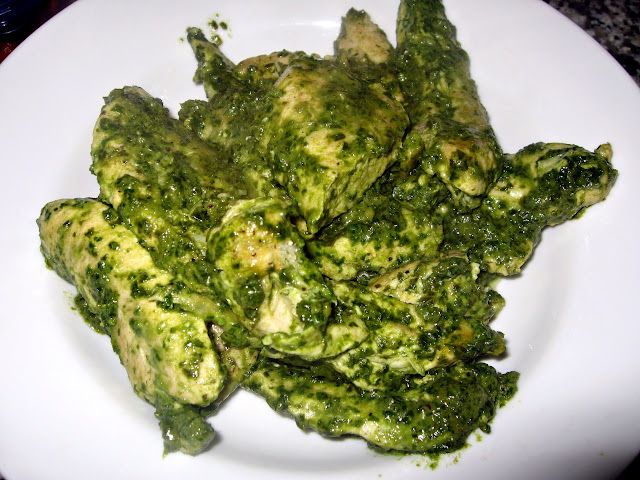
(photo: simple chicken breast and pesto sauce)

I generally like the Fall season and welcome the change in climate, but I always mourn the loss of my second favorite herb on the planet (parsley is number one in my book) come this time of the year; namely, basil. 

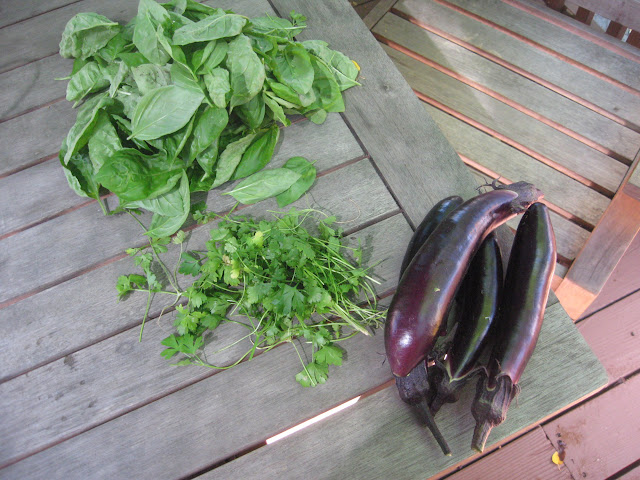
(photo: basil, parsley, and Japanese eggplant from our Italian garden in New Jersey)

Back in August of last year we posted some photos of our Italian American garden and we thought we'd share an updated series of photos from our current garden.  We recently harvested Japanese eggplant, flat green beans, basil, parsley, arugula, and chili peppers.    

With the basil and parsley we made our first pesto sauce of the season and our flat green beans and chilies went into a dish comprised of fried potatoes, tomato paste, herbs, and extra virgin olive oil.

(photo: a white fig tree near my mother in law's house in New Jersey; this tree goes uncovered in the winter)

We recently put up a quick survey on our Facebook fan page and asked readers if they own a fig tree and we had well over 30 readers respond positively!  The survey not only put a smile on my face but also re-assured me I wasn't the only child who grew up with live Mediterranean fruit in their New Jersey backyard.  

Fig trees dominate the landscape back in Italy, especially in the southern regions of Campania, Sicilia, Calabria, Puglia, etc.  In our Calabrian village of Pellegrina (part of Bagnara Calabra) fig trees littered the countryside and were served in large baskets as post lunch dessert.  The few trees my father kept in his New Jersey backyard produced limited fruit but were still light years ahead of any store bought figs and/or fig spread or dried figs.  An added bonus for me as a child was the trees doubled as tackling dummies during the winter month, as my father wrapped the trees in burlap, plastic, and insulation to guard against freezing temperatures, snow, and wind (Lawrence Taylor had nothing on little Vincenzo Scordo).  I'm currently in the process of scouting a location in our backyard for our potted fig tree plant and I'm hoping our son Tommaso doesn't use the tree as practice for an NFL career.
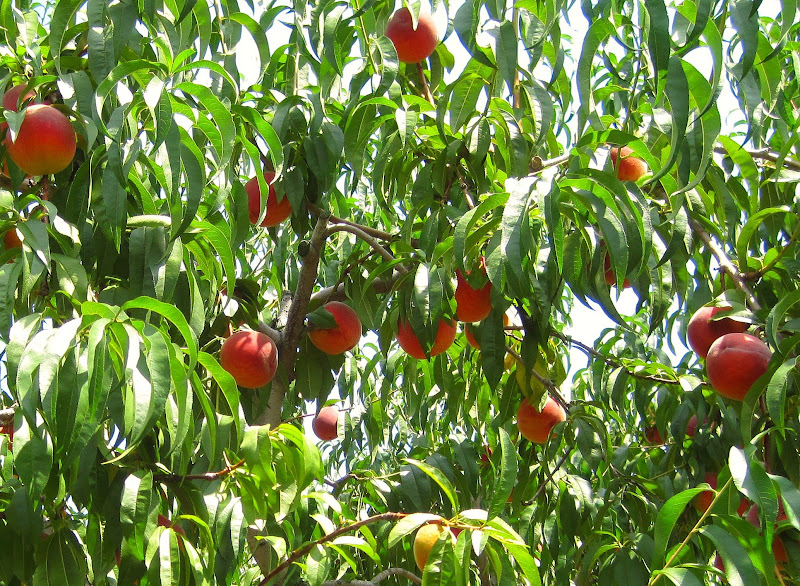
(photo: peaches in Calabria, Italy on the grounds of Zia's farm)

I almost hugged our TV last night.  Well, I didn't exactly get up off the couch to embrace our electronic box because I was under a fleece blanket and several layers of wool and cotton and getting up would have meant losing the precious body heat trapped in my vicinity.  What prompted the urge to hug our TV was the 4th round of the Australian Open tennis tournament underway in Melbourne, Australia.  The lovely, and liquid crystal induced, images comprised of sunny weather and tan spectators made me yearn for our summer here in the Western hemisphere.  And while the first day of Spring is several months away my Mediterranean blood desires warm days now.  

Alas, I don't have magical abilities when it comes to controlling the vicinity of the sun in relation to our small planet, so barring a move to Australia I'll patiently wait for the warm weather to arrive here in the United States.  If the wait is too much for you to bare, then have a look at some of our food photos from last summer which should help with your mental state; I can't help with the physical, sorry:

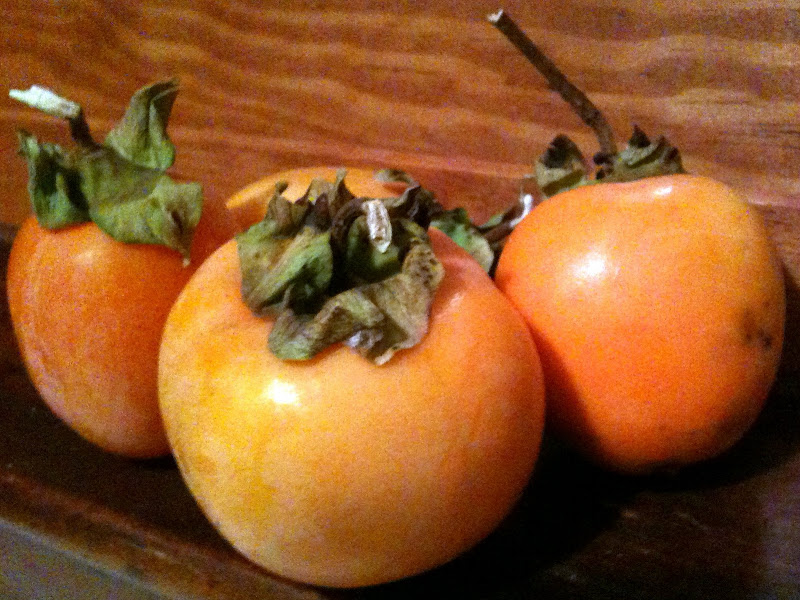
(photo: via iPhone, local persimmons)


(photo: via iPhone: sage drying in NJ basement)

I snapped these two photos with my iPhone earlier in the week and I really liked the deep Fall colors in the orange persimmon and green sage. 

The persimmons are courtesy of my mother who can grow almost anything in her tiny New Jersey garden, including a few fig and lemon trees (both trees need to be moved indoors during the winter months).  The drying sage comes via my mother-in-law who was especially excited to show me her collection drying in the basement (the aroma was wonderful!). 

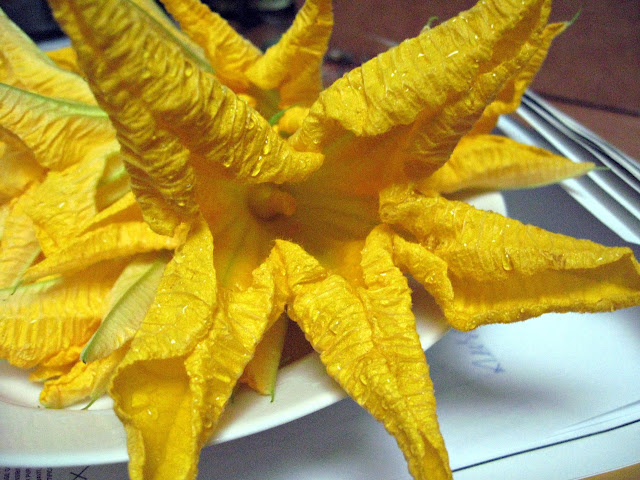
(photo: fresh frittelle di fiori di zucca, or zucchini fritterr; most Italians cosume this little treasures as a pre-dinner type of meal)

Michelle over at BleedingEspresso.com recently posted an excellent recipe for Fried Zucchini Flowers and it inspired me to look through my photo archive and post a few Frittelle photos.

Michelle's recipe is similar to the recipe my mother has been using for nearly 30 years here in the States, however my mother's version does include a few more ingredients (namely, grated Parmigiano-Reggiano and fresh parsley).  My mother's technique also includes "flattening" out the batter when it hits the hot oil so that thin frittelle are produced.  Note, you can also simply batter and fry a single, whole, zucchini flower (I prefer chopping the flowers to release more flavor).

For many Calabrians the zucchni flower is the best part of the vegetable (in fact, and to be perfectly honest, zucchini are often seen as "second rate" vegetables in Calabria, don't ask me to explain this view but I think it has something to do with the abundance of zucchini during the summer months and the same can be said about other fruits and vegetables in the region).

Here's my mother's recipe:

- 1-2 cups of roughly chopped zucchini flowers (with the stem removed and interior material removed)
- 1.5 cups of flour
- 2 tablespoons of baking powder
- 1 cup of milk
- 1 egg
- 3/4 tablespoons of salt
- 1 pinch of black pepper

Oil for frying (you can use olive oil but I think it's a big waste of a precious oil, try an oil with a higher smoking point that is less expensive like Canola, for example)

The technique is fairly simple: start by mixing the flour, baking powder and salt together. Grab another bowl and mix the milk, egg and zucchini flowers.  Combine the dry ingredients well and fry until crispy and golden (about 4 minutes if your oil is at the correct temperature). 
   

(photo: harvesting zucchini flowers outside of Bagnara Calabra in the village of Pellegrina, my parent's birthplace)
Hello everyone!  Just a simple post today with some items from our New Jersey garden:


(photos: close up of a red, mission, fig)

 
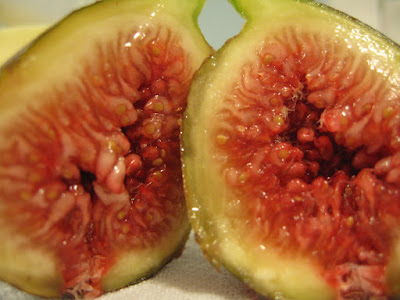
(photo: red, mission, fig cut in half)  

(photo: the red fig)

 
(photo: cucumber)

(photo: eggplant)

(photo: basil)
dandellloins

I remember walking through the Calabrian countryside with my grandfather as a boy when he suddenly feel to his knees and plucked a few pieces of what I thought was simple green grass from the ground. I, of course, thought he was just being his usual pazzo (crazy) nonno, but what he found were dandelion greens, prized for their earthy, minerally, and zesty flavor.   

Like many prized goods in the food world, the best ingredients are often found in the wild and prepared without much manipulation.  Calabria is famous for wild mushrooms (click here to read my guide on finding wild mushrooms), chestnuts, asparagus, roasted wild boar, etc. and it's part of what makes the southern most province in Italy (along with Sicily) such a special region.  Hence my simple mantra: wild food is great food (let the French have their fancy manipulated fair).  

You can of course find wild dandelion in most suburban lawns here in the US, but the flavor component is not the same (trust me, I've sampled the fare both as a kid and an adult!).  I have, however, found some good "wild" dandelion greens at a local market during the Spring season.  You can sauté dandelions, but I like them in a simple salad with a good red wine vinegar/extra virgin olive oil dressing and thinly sliced red onion. You can also try a vinaigrette dressing (here's my recipe).   

beansalad

My kidney bean salad is comprised of 1 inch diced green beans, corn, red onion, parsley, carrot, kidney beans, extra virgin olive oil, fresh lemon juice, freshly ground black pepper, and kosher salt.

tunapesto

Pesto Tuna Salad is simply comprised of homemade pesto sauce and good quality Italian tuna packed in olive oil (the best is imported from Italy and canned in Sicily).  Here's my pesto recipe.  

The above meal goes well with a rustic homemade wine.  
orzosalad
(Photo: Orzo with zucchini, bits of tomato, and parsley)

With the arrival of August, our household starts the summer tradition of consuming copious amounts of fresh tomatoes (at times for both lunch and dinner) - see my entries on tomato salad, canning tomatoes, and tomato sauce.  Ripe, garden grown, tomatoes represent the ideal food type for me (blending subtle, earthy flavors, with beautiful texture and color; not to mention the nutritional benefits of raw tomato).   

tomatoesalad
(Photo: Tomatoes from the garden with red onion, basil, and a bit of fresh, hot, pepper)

My favorite tomato salad is comprised of red onion, basil, dried oregano, kosher salt, freshly ground pepper, and extra virgin olive oil (see my guide to olive oil).  I like to call our tomato dish the "universal salad" because it pairs well with meat (such as beef, lamb, or pork) or with a simple loaf of bread, cheese, and olives.  Recently, we paired the tomato salad above with roasted mackerel fillets and orzo with garden zucchini, parsley, and Parmigiano-Reggiano.    

IMG_6269
(Photo: Holy Wild Mackerel, Fishman!)

Total cost of the meal was under $19.00 ($7.99 for wild mackerel, .60 cents for 1/4 cup of orzo, $1.99 for Balthazar French baguette, and $7.99 for a bottle of sauvignon blanc from Chile; the rest of ingredients came from the garden or are staple products <such as olive oil, salt, etc.>).  Proving, again, high quality food does not have to be expensive or inaccessible (as some food snobs have argued - see my article on why good food is not expensive).   
 

IMG_6270
(Photo: French bread from Balthazar Bakery)

IMG_6271
(Photo: Sauvignon Blanc from Chile <great bargain versus Australia>) 
IMG_3134
(Photo: wild picked Chanterelle mushrooms from New Jersey)

As I've suggested in a recent post, I'm a dyed in the wool country man, but I live a few minutes outside of the largest city in the US!  You must be thinking: how paradoxical that this guy loves nature yet lives so close to a major urban area?  Well the truth of the matter is I value the rural life in small doses at this stage of my life (given the associations I make with urban/suburban living: family, friends, work, activities, food, etc.).  I am convinced, however, that at some point in my life I'd like to make a go at living the rural life.  Sure, my thoughts of life in the country are more romantic than pragmatic, but there are certain country activities that I sometimes crave like raising animals, tending a large scale garden, building a barn, listening to silence, feeling isolated, walking in the woods, etc.  

IMG_3132
(Photo: mushroom prep: first cutting into larger chunks)

The walking in the woods part got me thinking about an activity that I watched my grandfathers and father (along with his friends) take part in each and every Fall; that is, foraging for wild mushrooms.  My grandfather foraged in the forests of Calabria, while my father and his buddies strolled through the Palisades in northern New Jersey to find edible mushrooms for pickling and frying (the preferred methods of consumption amongst the people of Pellegrina).

Foraging for wild mushrooms can be a dangerous proposition and, like learning a trade, it takes years to get it right and the help of an experienced technician is mandatory.  You can find wild mushrooms in large cities next to shade trees, suburban lawns, and the remote woods.  The best season to look for wild mushrooms is in the Fall and preferably a day or two after a large rainfall.  Identifying edible wild mushrooms can be tricky and that's why you should forage only with an experienced picker (they don't have to have Mediterranean blood, however!).

Many non poisonous mushroom varieties are easy to identify, such as Morel, Chanterelle, Oyster, Puffballs, and Coral Fungus (click here for some pics). You should assume that other varieties are poisonous as your safest bet is to stick with the type you've confirmed are edible and look for new types only with an expert.  My father, for example, is an expert only in the wild mushrooms that he's consumed and identified here in the US and in Italy (that is to say, he sticks to looking for 2-3 basic varieties of wild mushrooms).  

Picking mushrooms is fairly easy, but you'll want to bring along a good quality knife to remove and clean the 'shrooms.  You'll also want to bring along a few plastic bags to store the items along with a backpack if you're taking a day hike.  

IMG_3133
(Photo: mushroom prep: cutting into finer pieces)

Cleaning wild mushrooms is straightforward but you'll want to keep the following tips in mind:

1. Use a clean rag or small brush to remove all the dirt.
2. Look for bugs and other creatures before bringing any mushrooms into your home.
3. Mushrooms can spoil quickly so after cleaning the items store them in your refrigerator until you're ready to prepare your newfound delicacies.  

Cooking your mushrooms is where the fun begins!  Like any store bought mushroom, wild mushrooms can be prepared in many different ways, including fried, baked, boiled/pickled, in pasta and risotto, etc.  Personally, I'm a sucker for pan fried mushrooms with lots of garlic and parsley.  My mother pickles a few different varieties of wild mushrooms (especially the varieties that contain lots of water).  If the family happens to find wild porcini they are excellent with penne and a quick pan tomato sauce. 

My advice on how to start finding wild mushrooms: ask around and see if you have any old world Europeans living in your neighborhood, my hunch is that they have a secret mushroom foraging fetish.  So, be nice to your German or Italian neighbor (maybe buy him a bottle of wine) and he'll take you mushroom picking in the Fall (I swear you'll be hooked!). 

Here are some other excellent resources:

IMG_4334

We've had a cold and wet summer in the Northeast this year, so I'm not sure what the Fall and Winter seasons will bring us in terms of temperature, snow, wind, and rain.  However, I do know that a good looking garden (including grass, shrubs, and flowers) starts as soon as everything begins to die or go dormant.  Here are some basic Fall gardening tips that will make your green space look great come the first couple of warm days in the Spring:

1. If your garden includes a lawn then the early Fall time period is the best time to re-seed, fertilize, and add lime.  I tend to fertilize in the early Fall and early Spring time periods and I usually use my soil sample numbers to guide the type of fertilizer I buy.  A soil sample analysis will tell you how to amend your lawn's soil and whether it needs more or less potassium, nitrogen, etc. I like to test my soil every 5-8 years.  It's important that you follow the instruction on your spreader when adding fertilizer and lime and amend your soil according to whatever nutrients you need to put back into the ground.  Re-seeding your lawn with new grass seed is fairly simple and can be done by hand if your lawn is not too large.  I re-seed any bare spots in my lawn every October.  

2. Don't forget that your plants, shrubs, and bushes can also benefit from an application of fertilizer.  Use a slow release fertilizer and apply the correct amount according to the bag instruction.  Over fertilizing can be an issue for any plant, so it's always best to under fertilize if you're unsure.  

3. October is a good time to prune shrubs and bushes and ensure that the plants will come back healthier and fuller in the Spring.  Every bush or shrub has a slightly different pruning method so it's best to do a little research on how much material to cut off and where in the branch formation you should cut.  October is also the best time to plant new shrubs and bushes.  Visit the GardenWeb forums for specific advice on trees, shrubs, and just about any plant.

4. If you have any hardscapes in your garden such as pavers, natural stone, etc. the Fall is a good time to apply a sealer to help protect your surfaces.   For example, I seal my concrete paver walkway every other year so that the pavers do not shift or come loose.  I also add new play sand in between the pavers to keep water from reaching underneath the walkway (you'll want to add your sand first, with a large broom, and thereafter add your sealer to bind the sand).  While not necessarily tied to your garden, resealing your asphalt driveway is also a good idea if the current surface is cracked, crumbling, or is in general disrepair.  I'll be applying a blacktop sealer for the first time this Fall and I'll let you know how involved the process after the project is complete.

5. I happen to live in a town with an active Shade Tree Commission and a recognized Tree City USA program - this means our community takes maintaining and planting new trees pretty seriously.  The commission prunes street trees, plants new trees in the Fall, and removes any dead or almost dead trees.  The Fall is a great time to plant a new street tree!  Planting a tree near your home increases property value, shades your home during the summer months, and just makes for a better quality of life.  Most plant centers have crews available to plant street trees, but you can plant your own tree with a little bit muscle and a few friends on a crisp Fall weekend.  
scordo on twitter scordo.com on facebook become a fan stumble scordo rss feed for scordo

Scordo.com Free Newsletter - Sign Up Today
* indicates required

BECOME A FAN OF SCORDO ON FACEBOOK:


GOOD READING:


MORE ABOUT US:


FEATURED STORIES:


Homemade Sun Dried Tomatoes in Olive Oil Recipe
Don't settle for the canned varieties found at supermarkets; find out how to make your own [+]


How to Make Authentic Tomato Sauce
This is the authentic Scordo family recipe - straight from Calabria. You'll be amazed at how simple the recipe is to make [+]


Guide to Italian Extra Virgin Olive Oil
My grandfather produced his own extra virgin olive oil in Italy and I've put together an olive oil buying guide just for you [+]


How to Make Rice Balls or Arancini At Home
The ultimate Italian street food - these fried treats are great for the holidays or for any lunch or dinner; try them with your kids [+]


Guide to Making Espresso at Home
Making good espresso at home isn't easy but once you master a few easy tips you'll never settle for the junk served at most cafes in the US, including Starbucks [+]


Why You Should Not Eat Out
My argument on why eating out doesn't make sense [+]


Guide to Italian Meats: Salame, Capicola, Prosciutto, etc.
Learn all about the great "deli meats" and authentic cured specialties from Italy [+]


Scordo Pizza Recipe
Who doesn't love pizza, but did you know it's real easy to make at home [+]


English to Italian Translation Powered by
Grab this Widget


SPONSORS, AFFILIATES, SUPPORTERS:

Italian Food and Life Site


mymelange
Independent Budget Backpacking Travel Tips

Advertise with Scordo.com


DONATE AND HELP KEEP US GOING:


Feeling generous and want to help keep Scordo.com producing fresh and original content?


QUESTIONS, IDEAS, TIPS:


email scordo.com: blog at scordo.com


Note: The views expressed herein are solely my own and should not be attributed to my employer in any way. This site is not maintained utilizing my employer's resources or on company time.


RSS feed graphic for scordo.com Subscribe to Scordo.com via RSSBlog Flux Directory