Recently in scordo pasta challenge Category

 
(photo: ingredients for our mafalde fish pasta include wild or standard dandelion greens, garlic, onion, salmon, and grouper)

When I speak to my mother on the phone each night (yes, don't snicker there's no way around avoiding your Italian mother) she inevitably asks me, "so, what did you make for dinner?"  And while I often answer back with a southern Italian classic such as roasted eggplant and pasta XXX, there are nights when I mention an improvised dish inspired by what was available at the market. 

The other night I responded to my mother's question by stating that I cooked mafalde (a wide flat pasta shape with ruffled edges and shape #77 in the Scordo Pasta Challenge) with wild dandelion greens, onion, garlic, cubed salmon and black grouper, and extra virgin olive oil.  My mother's response went something like this, "ah, typical Vinny dish" meaning while I respect classic dishes I often improvise with weekday meals where I'm driven by 1., what's available at the market and in our pantry and 2., time! 
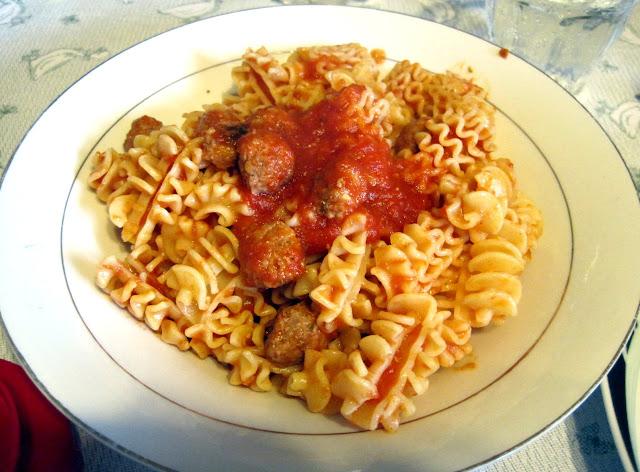
(photo: radiatori with tomato sauce or ragu and tiny meatballs or polpettini)

Radiatori are medium sized (short) pasta shapes that look like older style radiators (hence the name).  Radiatori are thick, have a ruffled edge, and are used like fusilli (with thicker sauces such as a ragu).

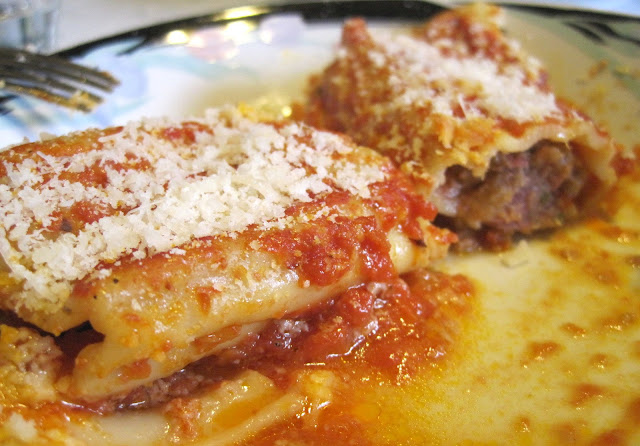
(photo: cannelloni with tomato sauce, filled with ground beef)

Stuffed pasta, of any variety, is adored in Italy and it is served on special occasions and on ordinary Sundays.  Stuffed pasta includes ravioli, tortellini, lasagna, cannelloni, manicotti, etc. The cannelloni with beef (or minced beef) recipe below is a variation on the traditional cannelloni with ricotta / cheese recipe. 

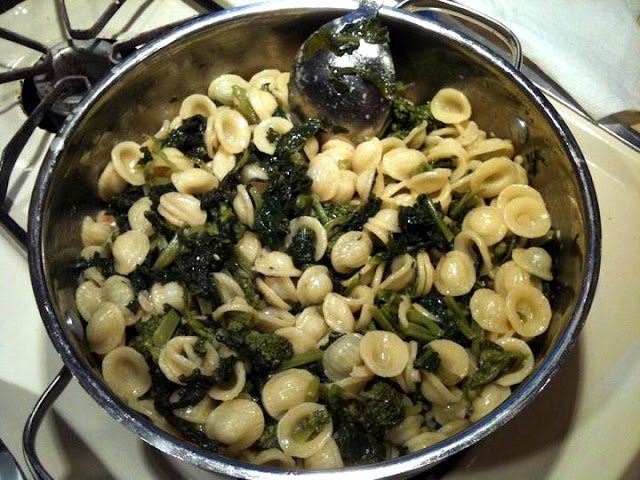
(photo: Orecchiette with broccoli rabe)

Orecchiette is literally translated as "little ear" and the pasta is created by using the thumb to press down on the pasta dough to create a concave shape or disc.  Orecchiette originate from the southern Italian province of Puglia located on the "heel" of the boot.  

I like orecchiette because the shape holds the condiment or sauce well making it a very versatile pasta shape.  
 
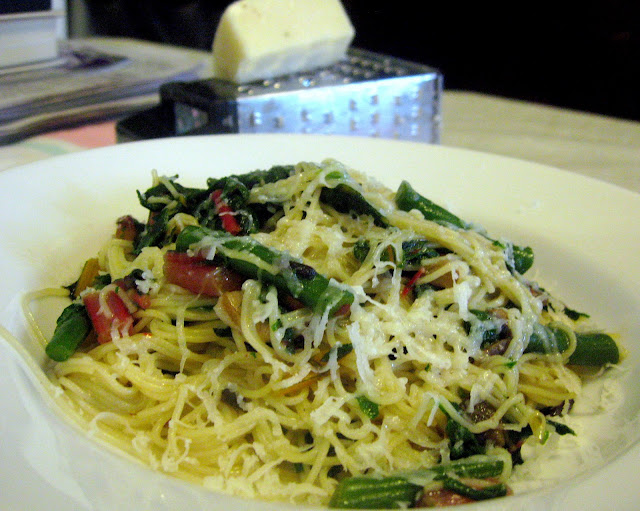
(photo: finished product with lots of vegetables, grated Pecorino, and extra virgin olive oil)  

If you haven't noticed we don't have many dessert recipes on Scordo.com  And the reason doesn't stem from a philosophical objection to sugar, flour or butter, rather we don't bake because we're, frankly, not very good at it!  

Baking requires precision and following recipes one to one; a process that goes against our imporvizational talents and cooking whatever looks good at the market or is contained in our Italian pantry.  For example, the following pasta dish came about because the acclaimed (sarcasm) writer for Scordo.com returned from a tough tennis match famished and was faced with the prospect of a Saturday filled with hunger or making a pasta dish with whatever was available in the house.  
 
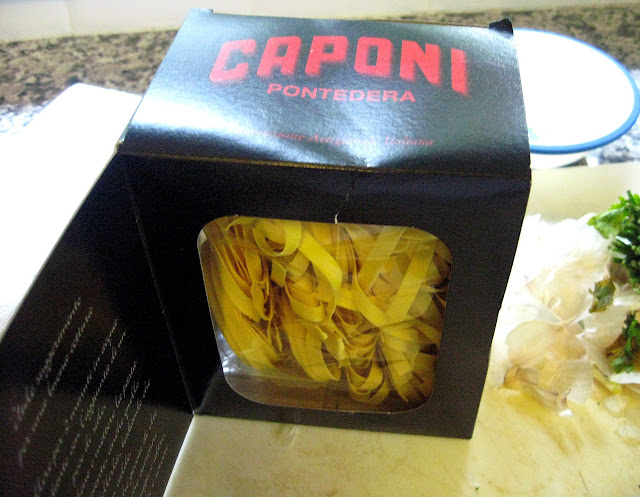
(photo: packaging is first rate, if not a little wasteful) 

We've covered the pasta shape tagliatelle here on Scordo.com in the past (via the Scordo Pasta Challenge) but we decided to review the pasta shape one more time given the quality of Caponi Pontedera tagliatelle and the fact that it's an egg based pasta (pasta all'uovo).  

Pastificio Caponi is a Tuscan pasta factory (located in Pontedera) headed by two brothers, Andrea e Alessandro Tagliagambe.  Caponi produces dried egg pasta and utilizes Canadian durum wheat flour because they believe the wheat has a high intake of protein.  Caponi's pasta utilizes fresh eggs and and is cut by hand by a single craftsmen/women.  The drying process at Caponi takes an amazing 70-80 hours at room temperature.

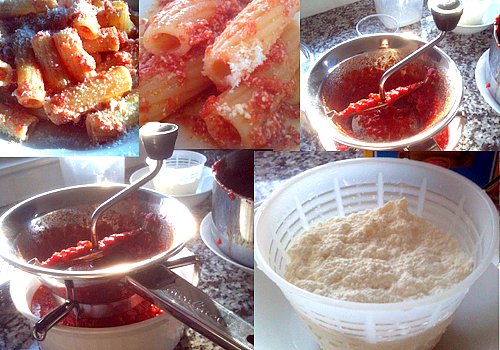
I talk a lot about pasta here on Scordo.com and I like to think for good reason!  One of my go to pasta recipes for any occasion is tomato sauce, ricotta, and grated Parmigiano Reggiano.  The ricotta is usually homemade (see our recipe) and the tomato sauce comes by way of our canned tomatoes.  Combine the cheese and tomato sauce with a pasta shape like tortiglioni and you have one of the most ideal representations of pasta and condiment on the planet!  The Tortiglioni was from De Cecco. 
(photo: Calugi tagliolini, about 1/2 pound)

Tagliolini is another variety of tagliatelle that is long and cylindrical in shape.  Tagliolini are generally thinner in shape and more delicate than tagliatelle.  

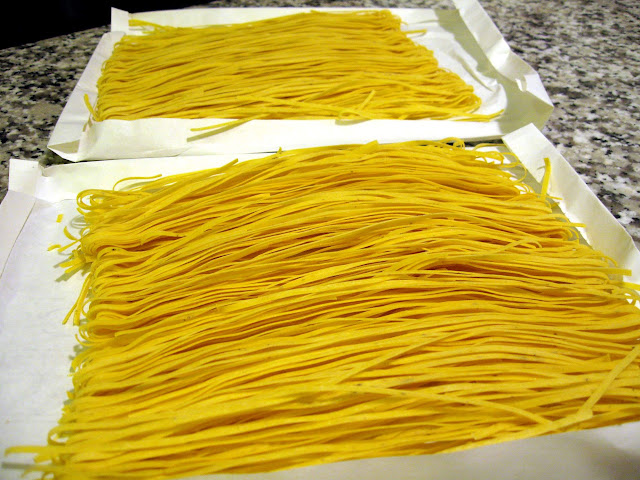
Recently, I was fortunate enough to try Calugi's dry tagliolini from Cambiano Castelfiorentino situated between Livorno and Firenze in northwestern Italy.  Calugi makes their tagliolini with eggs and flour but adds truffle for a subtle flavor component.  Calugi uses a special process to create their handmade pasta using special machines regulated at a very low speed to guarantee a perfectly even dough. The dough is then rolled out, cut and laid on special sheets of paper - all folded in the traditional way. The pasta is left in special drying rooms at room temperature with a gradual but continuous change of air for about two days.  The pasta is then beautifully packaged - the best I've seen! 

(photo: homemade cavatelli with broccoli)

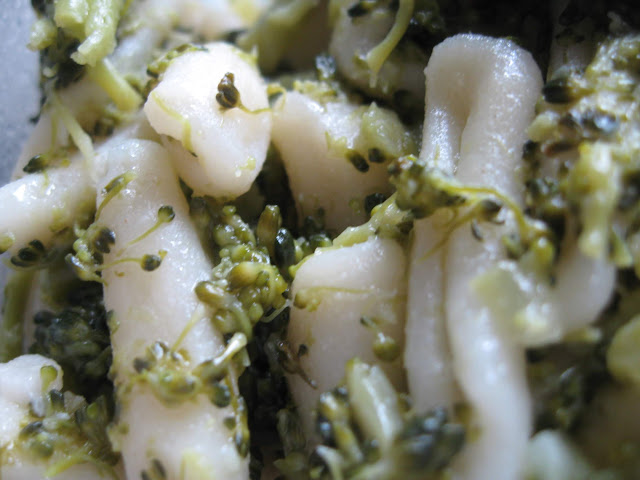
Cavatelli are about an inch to an inch and a half in length and are made from semolina, flour, and water.  Cavatelli usually have a rolled edge and are easy to make at home.  We paired our homemade cavatelli with brocolli, garlic, and extra virgin olive oil.  The Scordo Pasta Challenge chugs along!

(photo: homemade cavatelli with broccoli)
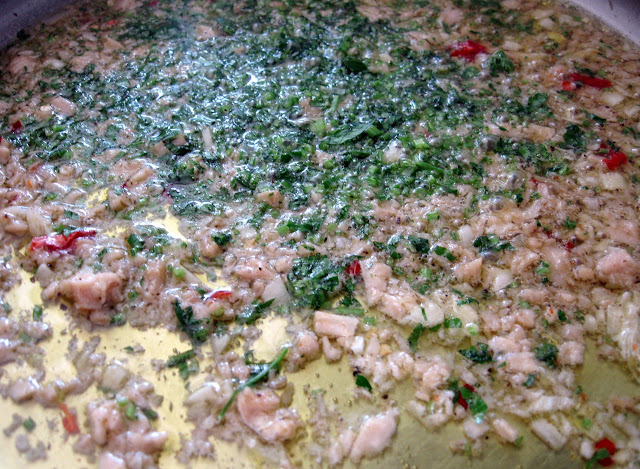
(photo: clam sauce in pan including chopped clams, garlic, olive oil, red pepper, and parsley)

Why I Would Want to Be Reincarnated as Pasta and the Scordo Pasta Challenge.

In many Indian religious traditions, such as Hinduism, Jainism, and Sikhism, it is believed that when a human dies s/he is reborn into a new body.  You'll also find the same concept in Greek philosophical thought.  In my view, the idea of reincarnation sounds pretty damn good, but I'd certainly wouldn't want to come back as a living and breathing thing (certainly, not a human being with all of the complexities associated with consciousness and morality - one lifetime of figuring out what to believe in, what is right and wrong, and how one ought to live is plenty for me ).  Rather, I'd want to come back as a perfect representation of food (to serve a single function and then expire <read: be eaten!>).  Some of the examples I've been thinking about include the tomato, the fig, cured pork, and pasta.  Just think: coming back as a pasta shape to be made into a wonderful dish that is consumed by a hungry Italian who would be instantly satisfied (how's that for a fulfilling, yet short, existence).

(photo: penne lisce with tomato sauce, photo taken with iPhone hence grainy picture)

Say it slowly, almost in a whisper: "L-I-S-C-E" (doesn't it sound sexy).  OK, come back to reality now and specifically the Scordo Pasta Challenge.  The word lisce is translated as smooth and part of the exquisite and versatile pasta shape known as penne lisce.  Penne lisce differs from it's buddy penne rigate (rigate is translated as ridges) because of it's smooth exterior making it ideal for creamed based sauces (think of peas with heavy cream and butter), tomato sauce, or paired simply with very good extra virgin olive oil and grated Parmigiano-Reggiano or Grana Padano (very similar and less expensive than Parmigiano Reggiano).
(photo: from the Geometry of Pasta, Hildenbrand and Kenedy; Gemelli pasta shape.)

See Below for Contest and Book GiveAway!

You have to admire any book that documents well over 110 authentic Italian pasta sauces and the hundreds of pasta shapes that marry best to a given sauce.  If a book goes further and contains beautifully rendered graphic shapes for each pasta then you have a timeless cookbook that should be part of every Italian kitchen.  

Caz Hildebrand and Jacob Kenedy's recently published The Geometry of Pasta, in it's simplest form, is a guide to basic pasta shapes (and a topic that has been covered exhaustively by Oretta Zanini De Vita in her magnificent work the Encyclopedia of Pasta).  However, what elevates the book to a worthwhile work is the emphasis on the critical, and often overlooked concept that:

the form (namely, the pasta shape) is critical, and deeply related to, the flavor (pasta condiment or sauce).


Spiral pasta gets a bad rap in the United States as the pasta shape is often used in generic, and deli type, "pasta salad" dishes.  Generally, the pasta is overcooked, mushy, and devoid of flavor.


Wow, wow, and even more wow!  I was blown away by a dry pasta from the Italian pasta company Pastificio Vicidomini, specifically the Tagliatelle. The Tagliatelle shape has been around for a long period of time and originally comes from the Emilia-Romagna region of Italy.  The word Tagliatelle is derived from tagliare, meaning "to cut."  Tagliatelle is similar to fettucine in shape and often made fresh in the northern regions of Italy.  

I served our Pastificio Vicidomini Tagliatelle (made with semolina flour) with a basic tomato sauce but any type of meat sauce (pork or rabbit would work very well) would be ideal given the rough surface of the pasta. The Pastificio Vicidomini brand is excellent and worth every penny.

Follow the Scordo Pasta Challenge, where Vincent aims to eat every known pasta shape on the planet! 


I like to refer to Lasagna as the "secret weapon" pasta; that is to say, it's easy to prepare, freezes well, and seems to be a perennial favorite (thus you can make and consume it often!).  And as Wisegeek.com suggests, the history of the name lasagna is also very interesting. The word lasagna is derived from the Greek lasanon, which is translated as "chamber pot."  The Romans borrowed the word to refer to cooking pots of a similar shape, and at some point the word came to be used to refer to the noodles which were traditionally layered in a lasanum, a Roman lasagna dish.

Ingredients:

My version of lasagna includes flat lasagna pasta (no ridges, per the Italian standard), tomato sauce (click here for my homemade recipe) with a bit of meat (pork and beef), ricotta (click here to learn how to make ricotta at home), mozzarella, and grated Parmigiano-Reggiano (see my guide to cheese).  Some recipes call for Béchamel sauce but adding the sauce seems like an unnecessary ingredient and task, so like most Italian dishes, keep it simple.  You can prepare your pasta in a separate pot or use lasagna pasta that cooks with the moisture of the ingredients.  Rustichella makes a great lasagna pasta.  

Lasagna is also #68 on the Scordo Pasta Challenge - the challenge marches on!   

Process:

Begin to prepare your lasagna by placing the pasta on the bottom of a pan, then add sauce, mozzarella, and grated cheese. Repeat until your ingredients run out!  Note: the top layer should be the sauce with a bit of grated cheese, if you'd like. Place aluminum foil over baking dish and bake in oven at 375°F for 40 minutes.  The ideal lasagna should be about the right combination of pasta, tomato sauce, and cheeses and not simply a cheese bomb!


(photo: closeup of tortellini, broth, and chicken)

Tortellini in Brodo represents everything Italian food ought to be; that is to say, simple, satisfying, and elegant.  

 
(photo: closeup of pasta and chicken)

Here, then, is my recipe made with, mostly, chicken brodo and spinach tortellini.  Tortellini is also a pasta so this counts towards the Scordo Pasta Challenge - shape #145)    

Ingredients:

- 1 large celery stalk chopped coarsely 
- 11 quarts of fresh, filtered, water
- Kosher salt and freshly ground pepper
- 1 - 2 pound of beef and/or veal bones (optional)
- 1 3-4 pound whole chicken cut into pieces
- 1 onion chopped coarsely 
- 2-3 tablespoons of passato
- 1 large carrot chopped coarsely 

 
(photo: tortellini en brodo in a bowl)

Process:

Place the chicken, onion, carrot, and celery in a large pot.  Next, cover the ingredients with water and slowly bring to a boil. Set to simmer as soon as the mixture boils and cook for 3-4 hours.   Remove from heat and strain the liquid through a sieve (for an extra light broth or leave as is if you like a more hearty brodo) and let cool.

You can prepare your pasta in a separate pot and add to your soup pot five minutes prior to the pasta being fully cooked.  You can finish cooking the tortellini in the brodo (on a high simmer / light bowl).  

 
(photo: hot broth ready for tortellini)

You can of course make your own tortellini or buy some perfectly fine tortellini from your local Italian specialty store.  I like spinach tortellini for the color and subtle flavor of the spinach in the dough.  Add grated Parmigiano-Reggiano before serving and enjoy with a cold glass of lager or white wine.  Note: I know purist would argue for a lighter colored brodo but I enjoy a slightly darker brodo simply because of the enhanced flavor; moreover, I also like adding some of the meat used to make the brodo in the serving bowl along with the tortellini.
(photo: linguine fine tossed with tomato sauce and grilled calamari)

I bet you thought the Scordo Pasta Challenge lost a bit of steam during the late summer!  You shouldn't, however, fear because we're back with shape #72A, the extraordinary linguine fine (a variation of the standard linguine shape that's quick cooking <4 minutes!> and wonderful with delicate sauces such as calamari in tomato sauce.).


(photo: the calamari are first grilled and tossed with olive oil, parsley, and lemon juice)

(photo: the calamari are then stewed in tomato sauce for about 10 minutes)


This week's Scordo Pasta Challenge was special to me, you see the Scordo family canned tomatoes this past weekend and the penne lisce we consumed included the first tomato sauce made from 2010 tomatoes!

"Penne Lisce", or smooth penne, is essentially the standard penne you can find in any supermarket and on most menus at restaurants.  The second, standard, penne variant is "Penne rigate" or penne with ridges.  While the penne is common, it's trully a superstar pasta that can be tossed with a fresh tomato sauce, pesto, or baked in the oven with cheese (click here to learn how to cook like an Italian).    Penne is a well designed pasta because it holds the condiment or sauce very well and it's jagged edge can also scoop up sauce!  I like the taste sensation penne lisce provides because of it's smooth surface.

I've now consumed 18 pasta shapes for the Scordo Pasta Challenge and suddenly the 150+ shapes do not seem like a daunting task!
IMG_0220 
(photo: prior to breaking the pasta into smaller pieces, notice the length!)

I love impromptu meals; that is to say, one of the biggest thrills I experience in the kitchen is when one dish I have in mind turns into something completely different or helps inform a second dish.  For example, when starring at a few chicken legs in my refrigerator this evening I immediately thought of a stove simmered chicken dish (a type of chicken cacciatore).  The dish included garden zucchini, one whole onion, about 8 pieces of coarsely chopped garlic, parsley, and a 1/3rd of a bottle of Pinot Grigio from Venezia.  I simmered the ingredients on the stove top for about 1.5 hours and, this is where the "one dish informing another" comes into play, after producing a wonderful liquid in the pan infused with chicken, zucchini, garlic, and white wine flavors, I boiled 250 grams (enough for left overs) of Zitoni Casarecci from Pastificio Vicidomini and tossed with the wonderful impromptu sauce.  

zitoni_dry

chicken cacciatore with white wine
(photo: chicken legs with whie wine, onion, zucchini, and a bit of hot pepper)

Zitoni Casarecci is an extremely long pasta which is bent about halfway in length (it's about 4x the length of a typical strand of linguine).  The pasta has a large hole running the length of it's shape and holds sauce / condiment very well.  The short version of Casarecci goes well with a meat sauce and so does the Zitoni variant.  My Calabrian mother informed me that Zitoni Casarecci was often sold at her local pasta shape in Pellegrina (Bagnara Calabra) by the pound (dry of course, as fresh pasta is not often found in Calabria).  The pasta designated an important time and was only purchased a few times a year (due to cost).  Typically, the pasta is broken into short lengths before boiling.  I was especially excited about the quality of the Casarecci and I've been re-energized to continue the Scordo Pasta Challenge!
 
zitoni


zitonia
eggpasta

Think of Pappardelle as fettuccine (see our guide to dry pasta) on steroids (basically very broad fettuccine).  Pappardelle derives from the word "pappare" which means "to gobble up."  The pappardelle I consumed was egg based and made by Rustichella.  

I always associate Pappardelle with meat sauces, specifically a ragu made out of rabbit (it was a favorite of mine growing up in NJ).  Pappardelle also pairs well with a sauce made out of wild boar.  Like many Italian food types, there is a festival in Italy honoring pappardelle (yes, food is honored in Italy!); Sagra delle Pappardelle al cinghiale (Pappardelle with wild boar festival) is held every August in the city of Gemmano in the Emilia-Romagna Region. 

The Scordo Pasta Challenge putters along even in the oppressive East coast heat - long live the king of starches.   
 
IMG_6250
(photo: the main ingredients outside the pasta)

IMG_6254
(photo: the boil; 6-7 minutes)

IMG_6257
(photo: tossed in olive oil, parsley, and garlic)

IMG_6265
(photo: the pasta obsession is passed on to the next generation)
pestobowl
(photo: completed pesto sauce in a bowl made from the famous ceramic factories in Bagnara Calabra)

Chitarra is similar to spaghetti, but with squared edges. It was once cut on guitar strings, hence its unique name.  Here's a great link to a "guitar pasta maker"

pestbowl_close
(photo: Chitarra with pesto and a glass of Pinot Noir from Chile <light years ahead of any under $20 Pinot from Oregon or California>)

I used Rustichella Chitarra and prepared a pesto sauce to accompany the pasta.  The squared edges on the long pasta did a great job of adhering to the wonderfully thick and aromatic pesto sauce (see my recipe via Genoa-born neighbor Amelia).  The pesto sauce recipe has an interesting ingredient, so be sure to click through!

IMG_6083 
(photo: pesto via machine.  proper pesto is made from via mortar and pestle but I have soar arm from my poor, tennis, serving technique ) 

pestocloseup
(photo: close up of the pesto)


salad
(photo: salad with Romaine, dandelion greens, tomatoes, Persian cucumber, red onion, Greek feta with a mustard dressing)

My pasta intake is increasing in proportion to my current home improvement projects; good for getting weekend project completed but not for the author's waistline.  Long live the Scordo Pasta Challenge.  
ceppo2

Pasta al Ceppo is literally translated as pasta on a stick and knitting needles were once used to shape the pasta.  The pasta has a nice texture and works well with hearty sauces.  

The Scordo Pasta Challenge continues!

pastacepp
cann

Here's a quick and simple Scordo Pasta Challenge entry this morning as it's hot and sticky in the Northeast!  

Cannolicchi is a pasta from the Abruzzo region which is traditionally served with seafood sauces.  Cannolicchi has a distinctive shape including coiled ridges which separate after the cooking process!  I prepared the Rustichella Cannolicchi with broccoli and crumbled Creminelli sausage.  

cann2
IMG_5995[1]

Strozzapreti is translated as "priest choker."  The legend has it that the priests of  Emilia-Romagna and surrounding regions enjoyed the long pasta so much that they choked while eating it.  I can certainly understand eating Strozzapreti quickly as it is, indeed, a delicous pasta.

IMG_5996[1]

I prepared our 500 grams of Rustichella Strozzapreti with tomato sauce and then added some finely chopped mozzarella.  I didn't bake the dish, but rather stirred the ingredients in our serving dish (this is a nice alternative to baked pasta).  

IMG_5998[1]

The pasta served as a primo, followed by some Niman Ranch sausage sautéed with lots of onions and parsley and a romaine salad with some locally made Greek Feta cheese.
  
IMG_5999[1]
orecc_broc

Orecchiette is the little pasta (or "little ear", literally translated) that could; that is to say, at first glance the pasta shape from Apulia seems unremarkable, but when paired with vegetables it springs to life!  

In southern Italy, Orecchiette are made by way of wheat flour and the traditional method includes pressing down on dime sized pieces of dough to get the familiar dome shape.  

I prepared (well, my wife prepared) our Rustichella Orecchiette dish with brocolli, white mushrooms, and red onion.  The pasta was tossed with plenty of extra virgin olive oil and grated Parmigiano-Reggiano (staple condiments for the Scordo Pasta Challenge).  
raviolli

Nothing says special occasion like ravioli!  You see, as a young lad, standard dry pasta shapes like penne, linguine, and rigatoni, made their way to my mother's dinner table about 1x-2x per week.  However, whenever the regal ravioli made an appearance for lunch we knew it was a special day.  

Ravioli were reserved for holidays or a special occasion such as a birthday or relative flying in from Italy.  My mother often purchased Ravioli from a mom and pop shop in town that specialized in pasta or, if we were in luck, our Genoese born neighbor Amelia would offer her hand made spinach ravioli stuffed with homemade ricotta.  

I recently cooked up a batch of cheese ravioli from a local pasta company called Vitamia for the Scordo Pasta Challenge (hey, the Challenge is a special occasion!) and served the pasta with a mushroom (shitake) tomato sauce and grated Parmigiano-Reggiano.  

Three cheers to the king of pasta - the mighty ravioli!
IMG_5964

For many Italians, soup equals pasta (that is to say, a primo serving of soup in many Italian households includes some sort of pasta mixed in with Lentil, Peas, Chickpeas, etc.).  Adding a small amount of pasta to a soup increases the hardiness of any given soup dish and can also elevate soup to a meal in and of itself.

For the last installment of the Scordo Pasta Challenge I made a simple chickpea soup with onions, brocolli, fresh parsley, dried oregano, salt, pepper, and red pepper flakes.  I also boiled a small amount of Ditalini (pasta shaped like a small tube) and added it to the soup.  My dish also included plenty of grated Grana Padano.
IMG_5929

With some spectacular weather here on the East Coast my mind turned to the outdoors the last week or so, hence the long stretch without a post (my apologies).  

My latest pasta conquest centered on the Cencioni, a little known pasta from the Basilicata region of Italy.  Cencioni, or translated as "little rag", is perfect for loose sauces.   Cencioni has great texture and could work well as a substitute for baked ziti.  The pasta is a bit difficult to cook as the outer edges cook before the dense center, 

IMG_5927

I consumed the Cencioni as a "primo" with tomato sauce, followed by some roasted chicken with sauteed escarole.  The meal was extra special because it was accompanied by some newly bottled homemade wine (courtesy of Tommaso Sr.).   
escapasta
(photo: final product with a bit of extra provola and olive oil)

When it comes to living life, I'm a sucker for both luxurious and practical things.  I'm equally comfortable driving a Honda or a Mercedes-Benz or living amongst nose-in-the-air snobs or dyed in the wool blue collar types.  I lean towards the practical and modest side of living, but who doesn't like nice, luxurious, things on occasion.  

When selecting vegetables at the market I'm drawn to fancy Sicilian eggplant or in season fava beans (think of these vegetables as the equivalent of fancy German vehicles), but when it comes to the ultimate practical (or working class) vegetable it's Escarole that gets me excited (think of Escarole as the Honda Accord of greens).   

Escarole is a workhorse vegetable and is incredibly easy to prepare and almost impossible to overcook.  Escarole goes well with beans and a hearty broth or as an alternative to sautéed spinach.  Recently, I've been experimenting with escarole and pasta combinations (given, you guessed it, the Scordo Pasta Challenge). In turn, I've come up my definitive escarole and pasta dish: Sauteed escarole with garlic, onion, potato, red pepper flakes, and imported Italian provola.

Here are the ingredients:

- ¾ of a head of escarole (small to medium size head)
- 4 large cloves of garlic
- ¼ of a potato, thinly sliced.
- ½ a large onion (red or white)
- 1 teaspoon of red pepper flakes
- ½ cup of pasta water
- ¼ pound of linguine 
- 3-4 teaspoons of extra virgin olive oil
- 1 cup of grated imported provola (by the best you can afford and grate it like you would for a pizza <shredded>)

IMG_0127 
(photo: combined ingredients minus the pasta and provola)  

IMG_0128
(photo: shredded imported provola, which is a great melting cheese)

In a sauté pan, add 2 teaspoon of olive oil and heat.  Next, add your sliced garlic, onion, and potato.  Sautee the three ingredient for 5-10 minutes or until soft (add salt and pepper).  Next, add the red pepper flakes and stir for 2-3 minutes.  Add you're your bite size pieces of escarole and sauté until the liquid begins to leave the escarole (for about 5 minutes).  Season the mixture again with salt and pepper.  When your pasta is cooked drain it and save some of the pasta water.  


IMG_0129
(photo: always add pasta to the pot containing the sauce)

Add the pasta to your sauté pan with the escarole mixture.  Mix well and add in a bit of the pasta water (just enough to loosen up the sauce).  Finally, add a bit of shredded Provola and mix well.  Plate the pasta and add a bit more provola and a drizzle of olive oil.  Enjoy during lunch with a glass of Ciro Rosato from Calabria.

IMG_0132
(photo: end product ready to eat)

pastafett

(photo: With the Imperia in the background, tiny mounds of Fettucine lay to dry)

My wife's family celebrates Palm Sunday via a never ending feast of homemade Fettucine (made via the standard Imperia pasta machine).  The homemade fettucine are delicate and wonderfully light ("light" is something you hear lots of people say about homemade pasta, I agree but I'm not sure it's wholly accurate).  My wife's mother serves the Fettucine with a simple tomato sauce and toasted breadcrumbs (grated Roman cheese is present as well). 

IMG_5846

(photo: Lots of tomato sauce, breadcrumbs, and grated Romano cheese)

Fettucine is a classic pasta shape and known throghout the world.  Fettucine is a flat thick noodle and is sometimes referred to as tagliatelle in other parts of Italy.  The Scordo Pasta Challenge continues on... 

pastfetttande

(photo: T. and E. in awe of the pasta traffic jam)

scordo on twitter scordo.com on facebook become a fan stumble scordo rss feed for scordo

Scordo.com Free Newsletter - Sign Up Today
* indicates required

BECOME A FAN OF SCORDO ON FACEBOOK:


GOOD READING:


MORE ABOUT US:


FEATURED STORIES:


Homemade Sun Dried Tomatoes in Olive Oil Recipe
Don't settle for the canned varieties found at supermarkets; find out how to make your own [+]


How to Make Authentic Tomato Sauce
This is the authentic Scordo family recipe - straight from Calabria. You'll be amazed at how simple the recipe is to make [+]


Guide to Italian Extra Virgin Olive Oil
My grandfather produced his own extra virgin olive oil in Italy and I've put together an olive oil buying guide just for you [+]


How to Make Rice Balls or Arancini At Home
The ultimate Italian street food - these fried treats are great for the holidays or for any lunch or dinner; try them with your kids [+]


Guide to Making Espresso at Home
Making good espresso at home isn't easy but once you master a few easy tips you'll never settle for the junk served at most cafes in the US, including Starbucks [+]


Why You Should Not Eat Out
My argument on why eating out doesn't make sense [+]


Guide to Italian Meats: Salame, Capicola, Prosciutto, etc.
Learn all about the great "deli meats" and authentic cured specialties from Italy [+]


Scordo Pizza Recipe
Who doesn't love pizza, but did you know it's real easy to make at home [+]


English to Italian Translation Powered by
Grab this Widget


SPONSORS, AFFILIATES, SUPPORTERS:

Italian Food and Life Site


mymelange
Independent Budget Backpacking Travel Tips

Advertise with Scordo.com


DONATE AND HELP KEEP US GOING:


Feeling generous and want to help keep Scordo.com producing fresh and original content?


QUESTIONS, IDEAS, TIPS:


email scordo.com: blog at scordo.com


Note: The views expressed herein are solely my own and should not be attributed to my employer in any way. This site is not maintained utilizing my employer's resources or on company time.


RSS feed graphic for scordo.com Subscribe to Scordo.com via RSSBlog Flux Directory