Recently in Italian Culture Category

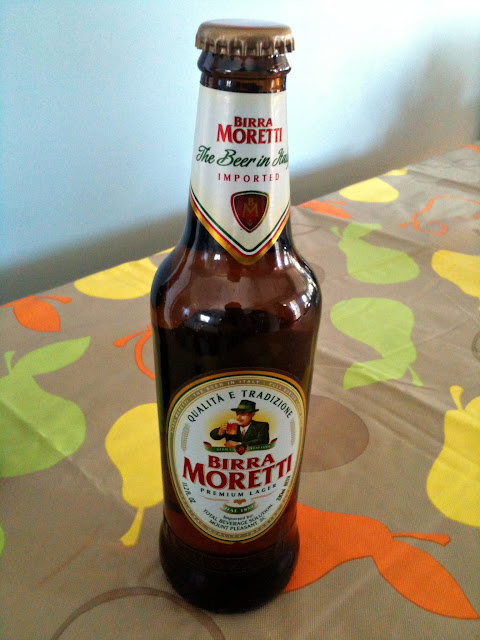
(photo: our favorite Birra Moretti - the traditional lager) 

Just the other day I was having one of those peaceful moments informed only by the serene; including an unusually warm and sunny weather, a wonderful match featuring Juventas and Udinese, and a cold beer or birra.  I was consuming Birra Moretti, the iconic Italian brew with the old man with mustache on the label and, without knowing it, originally produced in Udine (the Fruili region of Italy) and the team taking on powerhouse Juventas in an important Serie A match up.   Juventas went on to win the match and remain undefeated, while Udinese will live to fight another day.   Needless to say, I went on to finish my birra and take a nap!

(photo: Wild Fennel Seed (Semi di Finocchietto Selvatico) from Sicilia; you can use the seed as is or crush it via a mortar and pestle for savory and sweet dishes)

Wild fennel, or Finocchietto Selvatico, can be found throughout most parts of southern Italy and is part of the staple diet for many Calabrians, Sicilians, etc.  My father tells romantic stories of foraging for wild fennel in the Calabrian countryside just southeast of Pellegrina.  Wild fennel, unlike domesticated fennel, doesn't contain a white bulb and is prized mostly for the fronds it produces in the springtime along with the edible seeds.  Wild fennel fronds can be chopped and used in minestra or as a flavoring agent for a pasta dish made with pork sausage, for example.
 
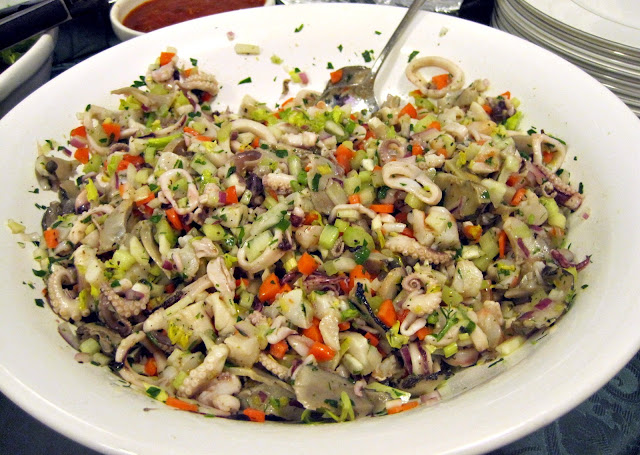
(photo: fish salad made with octopus, shrimp, squid, scungilli, and scallops; choose just a few fish for a good fish salad)

We hope everyone had a wonderful Christmas holiday and spent quality time with their friends and family!  We cooked a traditional Italian Christmas Eve dinner and wanted to share our photos with you, including pictures of our dinner antipasto and main courses. The final dishes included:

(photo: final dish: Zucchini & Summer Squash Risotto with Roasted Pork Chops)

Whenever I meet folks and I tell them I'm interested in food and cooking the inevitable question follows: "so, what do you cook?"  Before I answer I often pause and aim to think of luxurious ingredients and extraordinary dishes, but I always end up describing some variation of a pasta, soup, and/or risotto dish.  I qualify my answer by blurting out I also cook lots of fish, eggs, vegetables, and the occasional piece of meat.  When I'm feeling particular social and wordy I'll explain the concept of piattini or small plates of food, including salumi, cheese, tomatoes, canned high quality fish, pickled vegetables, et. al.  Yet, I always feel as though I've disappointed the person who has asked the question; as if my answer should have included some variation of Beef Bourguignon (popularized by the highly over-hyped Julia Child; if you ask me the typical Italian grandmother has done more for food in this country than the high pitched Child) or an experiment out of the ridiculous culinary discipline of molecular gastronomy.  
(photo: our saffron "threads" just prior to adding to the cooking broth for Risotto Milanese)

Saffron (or Zafferano) has always had a special place in my heart; more specifically, it's had a special place in my memory.  I associate saffron with my childhood and the yellow arborio rice my mother prepared for me on special occasions (viz., any time I asked for it and we happened to have some "saffron dust" busta <or envelope> in the house).  The variety of saffron my mother used to prepare risotto was packaged in a small yellow and red envelope and was supplied by Zia Teresa shop from Calabria.  And while I enjoyed the wonderful flavor that saffron gave my mother's risotto what I really enjoyed seeing was how the saffron dust would infuse a yellow/red color to the cooking liquid.  
 
(photo: the highly prized white truffle - courtesy of Alma Gourmet)

Truffle Primer 

One of my favorite aspects of visiting Italy in the Summer and Fall months is the abundance of festivals scattered throughout the country.  In Calabria alone, for example, the summer months include food festivals focused on bread, salt cod, wild boar, eggplant, red chiles, potato, etc.  Northern Italy is no different and the Piedmonte and Umbria regions include various festivals including multiple feasts celebrating the truffle (tartufi) during the Fall months.

Truffles are highly prized in the culinary world and given their price point, especially the rarer white truffle, most home cooks are priced out of this wonderful delicacy.  Truffles, like the closely associated mushroom, have an elaborate root system, however truffles never grow above surface. Truffles usually grow near trees and in Italy oak, willow and linden trees are popular species that support truffle production (with each tree imparting a different flavor to a given truffle variety).  

(photo: the author of Cucina Povera, Pamela Sheldon Johns)

If you were to tell people that Italy and America have a few things in common you'd most likely receive some awkward stares.  After all, America is a country driven by capitalism and rationality while Italy operates under a lifestyle driven worldview with importance placed on living well and understanding the subtleties of day to day existence (at least outside of large cities like Milan, Rome, and Turin!).      

With the above in mind, Pamela Sheldon Johns reminds us that there may, in fact, be some similarities in how we live in both the United States and Italy.  Pamela, through her new cookbook Cucina Povera - Tuscan Peasant Cooking, recounts her mother's days on a Midwest farm during the Great Depression, using everything around her and not wasting a single fruit or leftover.  Pam also describes the same tendencies in Tuscan women, having moved to to Tuscany to establish culinary workshops and write countless cookbooks.  So, maybe there's more in common between the two countries than we think!

(photo: an old door in Pellegrina, Italy)  

There's a certain comfort in all things deemed old: Old homes, old devices, old parts, old countries, old texts, old people, old trees, old clothes, old friends, etc.  The old can be defined as something not made or experienced recently and having a history (or story) or emotive quality.  An old friend can bring you back to your old childhood street and memories of running free while absorbed in a simple game of hide and seek.  And an old, weathered, home can bring joy and gratification knowing it's history, how it was made, and a sense of it's parts as a joyous collective.
 
(photo: the ScordoFrappuccino)

I'm not a big fan of Starbucks, but I do respect the chain for promoting the concept of a "cafe" or, as Europeans say, "bar" experience in the United States (the "bar" experience in Italy isn't, of course, about sofas, extra large portions, and wanna be Existentialists, but, like most things American, we can't leave well enough alone).  

While Starbucks has certainly aimed to open cafes in every town and city in the US, it hasn't done much to spread the word about high quality espresso.  That is to say, outside of the larger cities (and enlighted medium sized cities and towns like Portsmouth, NH, Burlington, VT, Madison, WI, Amherst, MA and various places on the West Coast) it's very difficult to find a proper espresso, caffè latte, or cappuccino.  Click here for my definition of a "proper espresso."
 
(photo: pastries are art in Italy and each ingredient is specially selected to make the given item blow your mind!)

One of the biggest fallacies in the Italian culinary world is centered on the idea that Italians do not eat dessert.  Italians do, in fact, enjoy dessert and the items consumed range from creamy gelato to luxurious cakes and icy granita to mind blowing cookies.  Here are some irresistible photos, including gelato, pastries, cookies, and granita.  

 
(photo: no exotic flavors in this gelateria in Scilla, just great local flavors)

(photo: the famous espresso granita, especially popular and well made in Calabria; shaved ice, great espresso, and fresh whipped cream)

(photo: there are as many cookie varieties in Italy as there are wine types; the cookie is king in Italy and it's treated like royalty; respect the cookie!)
(photo: Typical Durum wheat bread from Calabria, produced by Giovanna Latella and Terresa Zagari at the Latella Panificio in Pellegrina, Calabria)

To say that bread is an important part of day-to-day life in Italy would be an understatement.  In fact, it's more likely that the Italian political and economic system will be reformed over the next couple of years than it is that Italians will change their longstanding relationship with pane or bread.   Most modern Italians still buy artisanal bread and the small amount of pre-packaged/sliced bread purchased in northern cities is still considered a novelty.  Bread is also very expensive in Italy due to high flour prices and the dwindling numbers of Panificios or bakeries.


(photo: Latella Panificio <or bakery> in Pellegrina, Calabria fired by olive wood and made with grano)
 
(photo: marinated anchovies in lemon juice, sea salt, garlic, black pepper, red pepper flake, and parsley).

Walk down any street in the seacoast town of Bagnara Calabra during the summer months and you'll encounter women dressed in black screaming their lungs out!  No, the ladies aren't auditioning for a new Jean-Paul Sartre play about existential angst, rather they're selling fish.  The ladies set up shop early in the morning, usually during outdoor "market day" on Tuesday and hold court over passers-by with screeching annunciations such as" "pesce fresche" (fresh fish), "alici" (anchovies), "anguilla" (eel).  

Click here for all of our fish recipes.

The female fish mongers usually carry a selection of 1-2 fish and the quality and freshness isn't up for discussion.  One can, of course, bargain with the ladies and if you're nice enough they'll even gut and descale your anchovies, as they did for me on an early August morning. 
(photo: an ancient olive tree on the family olive orchard)

Driving on the A3 autostrada from the Reggio Calabria airport to the village of Pellegrina (a tiny Comune di Bagnara Calabra) my mood changes instantly.  I'm greeted by a penetrating sun, flowing sea breezes, and intoxicating smells of earth.  The greeting has come courtesy of Calabria, the terra of my parents and the very foundation of my soul.   
 
(photo: beautiful bread is a work of art and our reader Dr. K is a maestro!  photo courtesy of Dr. K.)

I have to admit that I get very jealous of folks who bake with great success as I've been slow to experiment with baking bread, for example.   And it's also why I'm incredibly thankful for skilled Scordo readers like Dr. K. who specialize in whole wheat bread baking and other, from scratch, food products and homemade goods (Dr. K., for example, makes his own yogurt, roasts his own coffee beans, produces his own goat cheese, and whips up homemade Nutella)

Dr. K.'s latest bread product is the Kamut, whole wheat, sourdough loaf.  Kamut is a type of Khorasan wheat which is one of the oldes types of grains on the planet; a modern version of Khorasan wheat is Durum which is most often used in pasta roduction.  The most common type of wheat is hexaploid which includes spelt, modern bread wheat, and soft wheat used for cookies and cakes.   Italy is the largest market in the world for Kamut (Khorasan) wheat (half of what is produced annually is sold there and most commonly used to produce cereals, breads, pastas, snacks, etc.). 
 
(photo: Sangaspano extra virgin olive oil from Messina, Sicilia)

On the morning of December 28th, 1908 a massive earthquake and associated tsunami hit the western province of Calabria and moved across the Stretto di Messina into Sicilia destroying city after city (including Reggio Calabria and Messina).  In Messina alone 60,000 people were killed and in Calabria our family lost many people, including small children.  In total, over 100,000 people were killed in 1908 making it the deadliest earthquake in European history.    

Prior to the earthquake, Messina was home to ancient architecture and a vibrant port.   And although the city did re-build, it was bombed extensively in 1943 by the Allies killing thousounds of Italians.  However not all of the goings-on within the Province of Messina are gloomy.  For example, the olive oil producer Sangaspano is located in the hills of Valle del Mela overlooking the Gulf of Milazzo and the islands of Stromboli and Panarea.  The land and region is beautiful and the extra virgin olive oils coming out of Sicilia rival some of the best Tuscan oils.
 
(photo: thanks to drinkspirits.com for the image.  the label and packaging is top notch on the Amaro Nonino)

If I haven't mentioned it here on Scordo.com my father is a dyed-in-the-wool grappa fanatic.  In fact, he's grown so found of the elixir made from sugar and grape stems he produces a limited quantity batch for his immediate family and select friends.  So, it wasn't with great surprise when I brought over a bottle of Amaro Nonino Quintessentia on a recent weekend that my father proclaimed it to be the best amaro on the planet!

For all of the amari novices out there (please don't feel bad) Amaro Nonino Quintessentia is made from grappa infused with herbs, plus grain alcohol, and ingredients that include caramelized sugar, bitter orange, cinchona, galenga, gentian, liquorice, quassia wood, rhubarb, saffron, sweet orange and tamarind.  And like many amari it's a stew of exotic flavors and ingredients.  My father enjoyed Nonino because the high quality grappa component (made from a blend of Ribolla, Traminer and Verduzzo grapes) and all of the luscious herbs.  On my end, I gravitated more towards the sweet and burnt orange characteristics of the Fruili made amaro

(photo: iced espresso made with stove top espresso, thanks to slowtrav.com for the photo on right)

Growing up as an Italian America boy on the periphery of New York City iced espresso was a rite of passage, at least for the Italian natives on our New Jersey block.  My mother, specifically, would prepare a large carafe of sugary espresso and place it in the freezer to develop a slushy consistency.  Thereafter, the fancy glasses would come out and with 2-3 violent shakes my mother would pour rich and perfectly cold espresso for her guests.  The iced espresso was refreshing and a great pick me up during the hot and humid months from June through August.  

When I became of age and was allowed to consume espresso it was the iced variety I favored and craved.  And while my preference for an expertly crafted hot espresso is my clear favorite these days, cold espresso jump starts my hippocampus and brings me back to my lovely Italian American childhood.
(photo: Columbus Artisan hot sopressata sliced by hand)

Peperoncini
and Salumi

If there's one food item that the southern province of Calabria is famous for it would be peperoncini (or red chili peppers). Peperoncini are used in pasta dishes (Penne all'Arrabbiata, for example), cured meats and vegetables (including the trendy salumi spread, 'Nduja), soups, and an eggplant stew dish called ciambotta.  

Almost every Calabrian family grows their own chili peppers and many summer festivals honoring and praising the mighty capsicum peppers can be found throughout southern Italy during the summer months, including the most famous festival in the town of Diamante.   Most Calabrian homes have dry red chilis hanging from their doors or windows which is known as the practice of diavolicchio (a tradition which once was thought to ward off disease).   Some famous Calabrian hot chilis include: Italian Cayenne pepper or naso di cane, ciliegia (cherry), amando (loving), and sigarette (cigarette).
(photo: Averna on the rocks with a slice of orange)

Averna, the amaro and aperitif/digestif from, and still produced in, Sicilia, is a bona fide rock-star.   Yes, like Bono, Freddie Mercury, or Roger Waters, Averna makes you tingle all over and has you wondering how anything can be (taste) so damn good.  

For those of you not in the know, Averna is a Sicilian liqueur made of herbs, roots, and citrus rinds which are soaked in alcohol; caramel is also added to give the product a distinct color.  Averna was founded in 1868 by Salvatore Averna and is still produced by the same family.  Averna is usually served straight (on the rocks) with a slice of orange and is 32% alc/volume (64 proof).  There are also some classic cocktails made with Averna including Vertigo, the mojito Italiano, and the Sicilian triangle.


Our 22 month old son Tommaso has been on a frenetic streak over the last 6 months, that is to say, he has both the energy and ferocity to take on any task including doing full fledge sprints with theatrical spins and twirls, pooping dramatically, greeting family members and complete strangers ad nauseam, separating his parents from a warm embrace and kiss (read: jealousy), and reading letters/sections of books with Herculean zeal.


(photo: Carnevale in Reggio Calabria, thanks to Demetrio Bruno for the photo)

Carnevale, which means "farewell to meat", is celebrated throughout the world including in the United States (known as Mardi Gras) and Italy.  Carnevale usually takes place 40 days prior to Easter and in Italy the celebration includes food, parties, music, various entertainment, masquerade balls, and wild pranks!  This year the Italians began celebrating officially on March 8th (today), but unofficial festivities began in February!  
IMG_5355_garlic

Food Philosophy - You Got to Be Kidding!

If you're not an avid reader of the Atlantic (or similar general interest magazines like the New Yorker) then you've undoubtedly missed both B.R. Meyers' anti foodie argument/rant (in a piece called, "The Moral Crusade Against Foodies - gluttony dressed up as foodie-ism is still gluttony") and James McWilliams' March 1st response entitled, "B. R. Myers and the Myth of 'Sustainable' Food".

Both articles are entertaining and touch on highbrow food terms/concepts such as organic, locavore/local, slow food, food sustainability, etc. yet have the stench of pop sociology that would make David Brooks rage with anger (Brooks is the only popular writer that is objective enough to get non academic sociology correct).   Heck, McWilliams even mentions Immanuel Kant and French philosopher Pierre Bourdieu  - is he kidding (and this is coming from an ex-Philosophy major who was entrenched in circles which espoused theoretical bullshit on a consistent basis)?  At the end of day here's what both writers are saying: Meyers' article condemns "foodies" for being glutenous while McWilliams' points out no one is correctly doing sustainable food.
(photo: beaches in Scilla, with its castle overlooking the Sicilian coas, Piero Morello)

By now you know my connection to the region of Calabria in southern Italy and my familiar, immigrant, story. You know, for example, my parents immigrated to the U.S. from a tiny hilltop village in southwest Calabria called Pellegrina in the 1970's and that I've been influenced greatly by the traditions found in the region.  However, I've never told our loyal Scordo.com audience what I specifically love about Calabria, so here are the five things I love about Calabria and, in turn, the Italian life (and yes there are negative aspects about the Province but I'll save those observations for another post):

Our friend and avid home cook Dr. K. continues his mastery of all things Italian with a terrific homemade bread from Sicilia; namely, Durum Pane Siciliano - a bread shaped in the form of the Occhi di Santa Lucia (i.e., a pair of eyeglasses in homage to Santa Lucia, the patron saint of vision).

Dr. K. utilized a recipe from Carol Field's, The Italian Baker (however he doubled it yielding four loaves and also used freshly milled 100% whole wheat <instead of store-bought bread flour> and durum flours, with middlings, bran, and all).  Moreover, he used more water, and slightly less flour, given that the dough would be too dense and wouldn't pass the windowpane test for a strong gluten network (yielding a brick).  He also added a touch of vital wheat gluten and lets the dough rest for five minutes after mixing and prior to kneading. 

Here's the recipe (using commercial flour).
(photo: close up of panforte made by Pasticcerie Sinatti in Siena)

We've never been much of a dessert type of site here at Scordo.com - holding the view that sugar and chocolate can't compete with salt and fat!  So, when we had the opportunity to try a traditional Italian dessert we were a bit skeptical given our countless posts on pastas, salumi, crocchette, eggplant parmigiana, and fried, whole, sardines.  

Panforte is a an Italian dessert and is the equivalent of a Tuscan fruitcake (specifically made in the city of Siena).  Panforte (literally translated as "strong bread") is a flat, dense, round cake made with honey, hazelnuts, almonds, candied citron, citrus peel and spices.  The Nero version (as shown in the photos) includes cocoa powder and differs from panforte fiorito (which includes a layer of marzipan).  
(photo: some of Dr. K.'s homemade duck prosciutto sliced thin and eaten with bread and Prosecco)  

I'm a big believer in chasing happiness in life and not the 30 minute kind that's associated with a new car, electronic device, or a bigger house (sorry all you hedge fund managers and Goldman employees).  Happiness, after all (and there's empirical evidence for this) is derived from things like time with family, meaningful friendships, social outings, and travel.  I'd also equate eating well with happiness as time with family and most meaningful social interactions inevitably include food and drink.  

One food type that brings great joy to both my taste buds and mental state is cured meat.  Cured meat, when done well, is one of the greatest representations of food on the planet (and also one of the most primitive).  Curing (and smoking) meat dates back to the Ancients and in the United States Native Americans smoked meat by way of hanging it on their teepees (the smoke from their fire would do the preserving).  My own family in Calabria has been curing whole muscle pork and salame for a couple of hundred years and it's a food product that I grew up with and continue to enjoy fiendishly.
(photo: homemade yogurt courtesy of bfeedme.com)

History of Yogurt

Historical fun facts about food provide great joy for me; I can't explain the phenomena but I enjoy the epistemological randomness that, for example, yogurt prior to the mid and late 19th century was used primary as a cleaning agent (that's right, including as a body wash and shampoo)!  In the early 20th century a Greek named Isaac Carasso started a small business called Danone and began mass producing yogurt.  In Europe, yogurt consumption took off as a popular milk product around the same time Danone began selling his product and the trend quickly spread to the United States 10-20 years later.
(photo: locally produced bacon from a nearby butcher)

By now, you've read my countless references to salame, prosciutto, capicola, cured pork, etc. and you may be thinking: what's wrong with this guy, does he have a thing for pigs or something?   The short answer is yes and the pork obsession is centered on the cured kind - that salty and spicy perfection that is, in my view, the ideal epicurean representation of the pig.
(photo: Typical Italian breakfast, brioche with gelato.  Image courtesy of THE MUESLI LOVER)

Italians Love Coffee and Sweets for Breakfast!

News break: if you're Italian, you can have cookies for breakfast.  Seriously, cake is a traditional breakfast food in Italy and so are other sweets including cookies, brioche, pastries, croissants,etc.  Coffee is consumed as well and it's usually a quick espresso or a cappuccino (please don't order a cappuccino after 10:00 AM in Italy or just after your dinner, you'll be officially deported).  If you're consuming your breakfast at home then you'll most likely make espresso via a stove top machine and add a bit of milk for a cafe latte and maybe eat a cookie or two before heading out the door.
(photo: Making pasta; illustration from the 15th century edition of Tacuinum Sanitatis, a Latin translation of the Arabic work Taqwīm al-sihha by Ibn Butlan.)

The Italian People and Pasta

Just in case you were having sleepless nights concerning the birthplace of pasta, the esteemed food critic, Oretta Zanini de Vita confirms that there were records of pasta in Italy 500 years before Marco Polo returned from China; so pasta was, in fact, invented in Italy.  I'm glad we cleared the air on this bit of trivia so we can get to the important stuff!
scordo on twitter scordo.com on facebook become a fan stumble scordo rss feed for scordo

Scordo.com Free Newsletter - Sign Up Today
* indicates required

BECOME A FAN OF SCORDO ON FACEBOOK:


GOOD READING:


MORE ABOUT US:


FEATURED STORIES:


Homemade Sun Dried Tomatoes in Olive Oil Recipe
Don't settle for the canned varieties found at supermarkets; find out how to make your own [+]


How to Make Authentic Tomato Sauce
This is the authentic Scordo family recipe - straight from Calabria. You'll be amazed at how simple the recipe is to make [+]


Guide to Italian Extra Virgin Olive Oil
My grandfather produced his own extra virgin olive oil in Italy and I've put together an olive oil buying guide just for you [+]


How to Make Rice Balls or Arancini At Home
The ultimate Italian street food - these fried treats are great for the holidays or for any lunch or dinner; try them with your kids [+]


Guide to Making Espresso at Home
Making good espresso at home isn't easy but once you master a few easy tips you'll never settle for the junk served at most cafes in the US, including Starbucks [+]


Why You Should Not Eat Out
My argument on why eating out doesn't make sense [+]


Guide to Italian Meats: Salame, Capicola, Prosciutto, etc.
Learn all about the great "deli meats" and authentic cured specialties from Italy [+]


Scordo Pizza Recipe
Who doesn't love pizza, but did you know it's real easy to make at home [+]


English to Italian Translation Powered by
Grab this Widget


SPONSORS, AFFILIATES, SUPPORTERS:

Italian Food and Life Site


mymelange
Independent Budget Backpacking Travel Tips

Advertise with Scordo.com


DONATE AND HELP KEEP US GOING:


Feeling generous and want to help keep Scordo.com producing fresh and original content?


QUESTIONS, IDEAS, TIPS:


email scordo.com: blog at scordo.com


Note: The views expressed herein are solely my own and should not be attributed to my employer in any way. This site is not maintained utilizing my employer's resources or on company time.


RSS feed graphic for scordo.com Subscribe to Scordo.com via RSSBlog Flux Directory