Recently in New Jersey Category

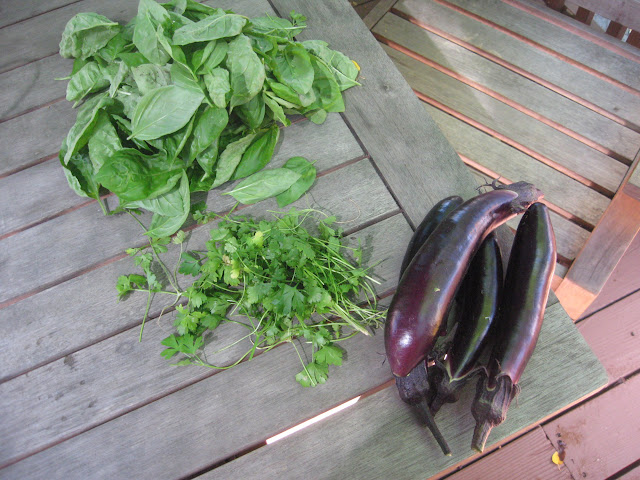
Hello everyone!  Just a simple post today with some items from our New Jersey garden:


(photos: close up of a red, mission, fig)

 
(photo: red, mission, fig cut in half)  

(photo: the red fig)

 
(photo: cucumber)

(photo: eggplant)

(photo: basil)
Related Posts with Thumbnails
italy_father_brothers
(photo: my grandfather and his sons in mid 1960 Pellegrina <Bagnara Calabra> Calabria)

The year was 1997 and I was a college junior applying for a prestigious fellowship for first generation college students.  The fellowship provided funds and a mentor to guide and prepare students for graduate work in the humanities and sciences.  The fellowship had strict academic and social-economic requirements.  On the socio-economic side, students were expected to be first generation college students, fall on the lower end of the income scale, and come from an ethic group that were/are underrepresented at US graduate programs.

In my view, I was qualified for the above fellowship and was excited to apply.  The question as to whether I was from a distinct ethnic group (underrepresented in academic circles) was not an issue in  my mind (the last I checked most prestigious universities had faculties brimming with Waspy sounding last names and not surnames ending in vowels).  After all, I did not learn to speak English until I was 5 and thought the American side of my Italian-American moniker was just a way of acknowledging that we breathed the air in New Jersey and not Calabria; I spoke, ate, lived amongst, and thought like an Italian, so I was a true Italian.  

italy_wedding
(photo: typical Italian wedding in Pellegrina, <Bagnara Calabra> Calabria) 

When I got the call from the faculty advisor alerting me that I would not be selected for the summer fellowship program, my immediate reaction was rage.  Not because I had been denied, but rather because I had been denied for not being from an appropriate "ethnic group"; at least the groups that were currently in fashion as being minorities in the US and in turn at Academic institutions.  I pleaded my case with the advisor and asked, for example, how many of the students that had been selected spoke a second language or had been to the region/country that deemed them to be a minority, for example?  The answers that came back were disheartening and I felt betrayed.  

The incident made me think long and hard about what it means to be an Italian-American living in the United States today.  Unlike Geremio and his son Paul in Pietro DiDonato's classic novel Christ in Concrete, being an Italian American in New York at the turn of 20th century did not come with the added effort of proving one's status as an American with Italian ancestry.  After all, Geremio's son Paul was Italian, although born in New York (like the author who was born in West Hoboken).  No one at the turn of the 20th century would accuse Paul as being an American, rather he was an Italian who happened to be born to recent immigrants from Italy.  Suffice it to say, if such an academic fellowship existed in Paul's time, he would have surely qualified as being part of a true ethnic group.

italy2_greatgreat
(photo: my grandmother's family posing as though they were well off - they were not)

So, what has happened to the Italian-American in the 90+ years since DiDonato's seminal novel?  Has the Italian-American remained truly unique with strong ties to what it means to live like an Italian?  Or have the images of Sonny, Tony Soprano and the cast of Jersey Shore penetrated our media driven society so deeply that to be Italian in America is solely about being involved in crime, putting gel in one's dark colored hair, and consuming tomato sauce?  What has happened to the attributes of the Italian American that were so pronounced and vivid in DiDonato's America yet so dull and mis-represented in our current epoch?   In short, what has happened is as simple as unadulterated assimilation (some self induced and some pushed by the larger American society) of the negative kind that leaves the current Italian American in a state of watered down culture and misrepresentation (in short, a sort of sudo Italian-American).

All is not lost for the modern Italian American, however, and there are glimpses of living the Italian way in America that are centered on core attributes like practical living, working hard, recognizing quality food and products, and just, plan, living well.  I see first and second generation Italian Americans shunning the popular, and myth driven, portrayals of the goofy, unintelligent, "Tony" (don't let the literary critics convince you he was seminal TV figure) and "Sonny" characters and argue strongly that being Italian in America is just that; namely, living like a typical Italian that has been transplanted to North America (with a focus on food, family, friends, and enjoying deep and meaningful experiences every day).  

How do you live as an Italian in America today?

Related Posts with Thumbnails
IMG_5740
(photo: Tripolini close up)

The Northeast saw a monster wind and rain storm over the weekend with many downed trees and electrical lines.  Some of our neighbors in NJ also lost water pressure.  Luckily our home was spared and we didn't see any crashing white pine, sycamore, or silver maple, as was the case a couple of years ago when a large silver maples crashed into our neighbors front porch.

IMG_5735
(photo: Meatball close up)

With high winds and rainy weather I become like a house cat looking for comfort and, as you've probably guessed it, my mind turns to the ultimate comfort food: pasta!  

On Sunday I consumed pasta shape #149 Tripolini (via the Scordo Pasta Challenge) with a braised meat (baby back pork ribs, pork sausage, and meatballs) tomato sauce.  Tripolini are oversized fettuccine with ridges on both edges of the pasta.  Growing up, Tripolini was a specialty pasta we only had once or twice a month (I suppose it was hard to find and commanded a higher price) and we consumed it with a braised chicken tomato sauce.  

The pasta brand is Paone.


IMG_5741

IMG_5734

IMG_5732 
(photo: braised meats: spare ribs, sausage, and meatballs) 

IMG_5733
Related Posts with Thumbnails
IMG_4815
(photo: notice the natural mold on the exterior of the Creminelli product; this mold imparts lots of taste on meat and also prevents it from drying out, along with the casing)

There are certain items or products that are immediately associated with a given country, for example: ice hockey and Canada, beer and Germany, haute cuisine and France, hot dogs and the USA, and vodka and Russia.  As a first generation Italian-American kid growing up in New Jersey, I secretly associated Italy with just one magical product, and it wasn't Ferrari or Soccer (calcio), but rather salami!  Yes, salami (or salumi, as the Italians would say), that seductive product comprised of salty / cured / spiced perfection!  

IMG_4987
(photo: I sliced up four different types of Columbus Artisan product for a Thanksgiving appetizer) 

My love of salami started as a young child during summer vacations in Southern Italy, as I described in my recent Guide to Italian Cured Meats and I thought it was a short lived love affair until I rediscovered that there are, indeed, high quality salumi that are being hand crafted and sold in the US (one doesn't need to hop on an Alitalia flight to Rome to find pork perfection).  

With the above said, I recently had the pleasure of sampling eight distinct salumi from two US producers: Creminelli Fine Meats of Springville, Utah and Columbus Artisan Collection from San Francisco, CA.  On the Creminelli side, I sampled Cacciatore, Sopressata, Piccante and on the Columbus Artisan Collection I tried Cacciatore, Finocchiona, Crespone, Salami Secchi, and Sopressata.  Not only did I try the salumi but all of the varieties were tasted by immediate family including many salumi dignitaries who have produced and sampled hundreds of products both in Italy and the US.  Some of the comments I heard at the gathering included:

"Is this from Italy?"

"Wow, what great flavor and texture!"

"Vinny, did you fly to Italy this weekend, where did you get this?!"

What follows, then, is an entirely subjective review of the aforementioned salumi (which were enjoyed with simple bread from Angelo's in Jersey City, NJ, homemade wine, and a variety of cheeses).  Let's start with the Creminelli products:

IMG_4807[1]
(photo: I think the packaging on the Creminelli product is top notch!)

I'll begin by saying that the Creminelli packaging is top notch.  Each individual sausage is hand wraped in fine butcher paper and held together by an elegant sticker with the Criminelli logo, name of the product, and ingredients.  The passionate owner Christiano Creminelli understands that along with a great tasting product, a customer starts his or her food "user experience" with their eyes and hands.  Christiano uses no sodium nitrates in his products and his salumi recipes originated in Italy and are now being duplicated, by hand, in the US (Christiano is a Maestro of Salumi!).  The Creminelli products I sampled were naturally molded salumi and were soft to the touch out of the packaging.  I would have preferred to have had the salami age for 1-2 months in my cellar before sampling the product so that more complex flavor could develop, but I couldn't wait (I tried the product after having the product sit in fridge for 4 days)!  

IMG_4810
(photo: Creminelli exterior)

IMG_4816
(photo: starting from upper right clockwise: Creminelli Piccante, Sopressata, and Cacciatore)

Creminelli Sopressata 
Sopressata is traditionally made with wine and garlic and Creminelli's sopressata was no different, yet the wine and garlic flavor was muted letting the intensity and quality of the pork come through.  The meat to fat ratio was also ideal, which is tough to get right in Sopressata.  I would have preffered a bit more garlic flavor in the Sopressata and little bit less upfront salt but overall it is a fine salumi.  Creminelli Sopressata would work well in a sandwhich combined with other ingredients.  

IMG_4817
(Photo: Creminelli product)

Creminelli Picante
My favorite of the bunch and not overly spiced with red pepper.  The salt content was perfect in the Picante and the combination of high quality pork with mild heat made me quite happy. The color of the Picante was also well done, it's not the typical fiery red color you see in most spiced salami.  

IMG_4989
(photo: Columbus Artisan Cacciatore)

Creminelli Cacciatore
The first thing that jumped out was the subtle juniper berry flavor in the Cacciatore!  Moreover, the consistency and texture was typical old world, as was the physical size of the sausage itself (very small; afterall, tradition has it that hunter's stored the salami in their coats and when they got hungry in the forest they simply cut a few pieces and had a quick bite).  Next to the Piccante, I really enjoyed the Cacciatore.  There were some bitter components (at the very end) that may have been coming out of homemade wine I was having when sampling the salami, but overall you could tell that high quality ingredients were used in production.  Finally, this salami also had a wonderful scent!  This is a great all around salami to keep in the house for a quick meal on the weekend or for impromptu quests.  

As I said above, I would have liked to have tried the Creminelli salumi after the aging process has a bit more time to do it's thing and, in fact, I do have a few samples aging in my cellar and I'm excited to retry the product in a month or so (stay tuned for an update here).

IMG_4982
(photo: The Columbus Artisan collection is top notch and miles ahead of the standard fair salumi, the taste, texture, and ingredients are all old world and fabulous) 

Next I moved on to the Columbus Artisan Collection salami which are produced in San Francisco and differ, to a large extent, from the mass production line of cured meats from the same company.  Columbus does use sodium nitrates in their products and the salami did arrive pre-aged and hard to the touch.  Like Creminelli, Columbus Artisan has a natural mold skin with all natural imported casings.

IMG_4984
(photo: Columbus Artisan Finocchiona, my favorite amongst both the Creminelli and Columbus products)

Columbus Artisan Finocchiona
Let me qualify the following sentence first by saying that fennel seed was one of the key ingredients in my grandfather's salumi making arsenal and, as a result, I've been pre-programmed to respond positively to fennel flavor.  And there's tons of authentic fennel seed flavor in the Finocchiona, in fact it was my favorite salumi out of the 9 products sampled.  The Finocchiona had great texture, rich and flavorful pork, and the perfect balance of salt and bitter that is needed in any artisan salami.  

IMG_4985
(Photo: Along with the Creminelli cacciatore, the Columbus Artisan Salame Secchi would be an excellent overall choice for pre-dinner appetizers, small parties, and to enjoy with a glass of wine and good bread)

Columbus Salami Secchi
Columbus claims this is their oldest recipe and product and it shows.  The Salami Secchi (meaning very dry) is the most subtle of the Columbus salami's I tried and I love the ratio of fat to pork.  The salt and spice seasoning was also idle.  This type of Salami is a good all round choice for keeping in the house at all times, while the Finocchiona, for example, would be something that you would consume a little less frequently (just because of the intensity of the fennel seed).

IMG_4986
(photo: Columbus Artisan Cacciatore)

Columbus Cacciatore 

My first thought when trying this cacciatore was, wow, this is kind of sweet tasting with lots of deep flavor.  It was difficult to pick a winner between the Columbus and Cremenilli cacciatore, but Columbus had an advantage because the product seemed to have been pre-aged and, of course, the sodium nitrates help quicken the hardening process in the refrigerator.  I think with more aging time, the Cremenilli would come out on top because of better ingredients (stay tuned!).

Columbus Crespone and Columbus Sopressata 
Similar to the Finocchiona but without the fennel seed Crespone is a very rustic interpretation of salami (I should also say that Crespone and Finocchiona are also slightly larger in size than the rest of the salamis sampled).  I found the Crespone, similar to a sopressata, to have a bit more fat composition than I ordinarily like but I did appreciate the simplicity and adaptability of the product (it went well with basic bread and cheese).  A bit more course in texture than the Cremenilli sopressata, Columbus Sopressata was also a good basic salami but I would have liked a little bit more flavor profile.  The sopressata was my least favorite of the Columbus salamis, but still light years ahead of any mass produced salami in the US market.

IMG_4988
(Photo: Columbus Artisan Crespone, Sopressata, Cacciatore, and Salame Secchi, from left to right)

Where to Buy
- You can buy Creminelli products at retail or online at Creminelli.com 
- You can buy Columbus products online or at your local retailer.  

One observation that many of my family members made about both artisan salamis was the price!  At between $25 - $30 per pound for the Creminelli product and between $11 - $15 for the Columbus Artisan, the salamis aren't cheap and are on par with a product like Prosciutto di Parma (which is one of the few Italian cured pork product allowed to be imported into the US).  Charging the same amount of money (or more) for a US salumi product is a big risk for hardcore Europeans customers who are particular about value.  
Related Posts with Thumbnails
pestofinal

Growing up in New Jersey I was surrounded by people from all over the world (on my block alone I remember families from Italy, Egypt, Lebanon, England, Spain, etc.); needless to say, the aroma of food hovered on Oregon Ave like haze hovers over Los Angeles.  

One of my favorite food smells came from my next door neighbor Amelia.  Amelia worked in the New York City garment district as a dress designer, but her real passion was food (and the occasional Americano cocktail in the afternoon).  Amelia was also born in Genoa, Italy - the Pesto capital of the world. You see, in Genoa (given it's geographic position), basil grows like wild flowers.  And the basil in Genoa isn't the metallic, bitter herb you find in your run of the mill supermarket in the US, rather it's sweet, aromatic, and more equivalent to a succulent peach then an herb.

I was lucky enough to watch Amelia make pesto on several occasions as a teenager and to this day I still use her traditional Genovese recipe when I make pesto at home.  The following is Amelia's recipe with a few caveats:

1. Try to find "young" basil; that is to say, first picked basil usually tends to be sweeter and less bitter.  Growing basil is fairly easy and I would recommend purchasing seeds from Europe.  

2. Amelia included a bit of parsley in her recipe and while it's not usually called for in most Pesto recipes it adds another layer of complexity to mixture, which I highly recommend.

Ingredients:

- 1, large, bunch of basil leaves (washed and dried very well - no water)
- 1 handful of Italian parsley (washed and dried) - you can leave some of the parsley stem, but make sure to cut off about half the stem.
- 1 cup of Parmigiano-Reggiano (grated on a box grater) - see my guide to Italian cheese
- 3-4 tablespoons of cream cheese (yes, yes, don't laugh!)
- Handful of pine nuts
- Salt and pepper to taste
- 4-5 tablespoons of olive oil
- 2-3 cloves of garlic

You can combine the above ingredients via several tools, namely, 1. food processor, 2., mortar and pestle, or 3. chopping with a large chef's knife or mezzaluna.  Amelia used a mortar and pestle, but you can use a food processor (it does take a little bit away from the flavor of the pesto given the strength of the blade/machine, but, to be blunt, it's tough to get the right consistency with a mortar and pestle set up unless you're accustomed to the tool). 101 Cookbooks swears that a mezzaluna is the best tool, but I think if you use a knife for pesto you're getting more of an alio e olio type of pasta condiment.  

If you're going to use a food processor, start by adding the garlic and pulsing.  Thereafter, add your basil, parsley, and pine nuts.  Let the machine process the ingredients and slowly add your oil, salt, and pepper.  Thereafter, add your cream cheese and pulse again.  Finally, add the Parmigiano-Reggiano and the remaining olive oil.  You are looking for a consistency just before the mixture turns into a paste.

I like serving pesto with thin linguine (or linguine fine) and tend to add a splash of fresh olive after plating and, of course, more Parmigiano-Reggiano. A dry red wine like Aglianico from Basilicata (southern Italy) goes well with pasta pesto
Related Posts with Thumbnails
revised_hadley_ma
Photo: Hadley, MA

I've always had romantic notions about living in the country.  I've dreamed of waking up early and going for long walks and surveying the many acres on my "property" ; maybe encountering wild life and foraging for wild mushrooms (just like Mayle's book, "A Year in Provence").  I would certainly take refuge in the fact that I could not see another neighbor for miles and enjoy fresh country air entering a rustic, but chic, 19th century farmhouse (renovated with all the necessary modern conveniences, of course).  Our country home would be near the sea as well, so I could enjoy the water at the beginning of each day.  

The above is just a dream, of course.  And the fact is that suburbanites in American are significantly more satisfied with their living arrangements than are residents of cities, small towns or rural areas, according to a Pew Research Center Social & Demographic Trends.  Our family lives in a relatively small town (about 9,000 citizens) just 10 minutes outside of New York City in New Jersey.  Our town has a suburban feel with many trees, sidewalks, lawns/ivy, and an active, family-oriented, base population.  The proximity to a major city, however, does skew the town feel a bit towards the urban, at times.  

Choosing where to live is a major life decision and folks are usually influenced by several factors including:

price of homes.
- quality of schools.
- proximity to job(s).
- proximity to other family members / where they grew up.
- safety.
- available social/recreation activities
- available commercial outlets (shopping).

nh_harris
Photo: Harris Farm, Hollis, NH

As I see it, living in a suburban/urban area has many advantages and while I dream of the rural life enjoyed by my Italian family in Calabria, I could not spend the majority of my time in the country (at least at this stage of my life). Living in a suburban area allows me to:

1. Enjoy my extended family and good friends.

2. Enjoy a short commute to my job (and the availability of potential future jobs)

3. Access to good food/recreation/commercial establishments (I can play tennis, go food shopping, and find virtually any product I may need all within ten miles of my home).

4. Access to different people and cultures (in today's world, if you can't speak the language of diversity and feel comfortable with folks from different part of the globe you might as well have no skill set)

5. Access to educational resources (this not only means good schools for our kids, but also access to libraries, universities, lectures, etc. for adults; if you stop learning, then you stop living)

The suburbs do have disadvantages and I'm sure the average New Yorker, for example, will rattle off many reasons why they're happy to exist only on the Island of Manhattan, but there does seem to be some difficulty in living, long term, in an urban environment (such as cost <see Free Money Finance's article on cities and cost of living>, proximity to other people, space, etc.).  

I'll stick to the Burbs for now and aspire to short stints by the sea and the chic countryside.  
Related Posts with Thumbnails
stickball.jpg

Sport has always been part of my life; partly because of genetics yet mostly because of the hyperactive friends I made growing up in 1980/90's New Jersey. As a young kid, I played on our suburban block until dusk and only came in for dinner after my mother unleashed her fiery call: "il pranzo è pronto!"  As a 13 year old I spent my weekends traversing New Jersey and New York in a white Dodge van, running up and down a soccer field dreaming of becoming the next Roberto Biaggio or, if our deeply committed coach Frank was particularly inspirational that day, Diego Maradonna.  By the time I reached high school, I was in love with many sports and split my time as a wannabe Flutie-esque quarterback, a mediocre tennis player, and a way too skinny striker on the soccer team.  My senior year in high school I fell in love and shrugged off the athletic pursuits for romance - dropping the proverbial "ball" turned out to be a godsend as the woman I feel in love eventually became my wife.

I still have urges to run fast and throw an oblong ball down field, but I'm limited to the occasional run on my treadmill and weekly tennis matches.  Sport makes me feel good and along with the physical sensation of moving through the air and hitting good topspin on a forehand, for example, I enjoy the competition and how I feel the next day (namely, a bit tired and sore; there's something about using your body that makes the primordial brain release lots of good neurotransmitters!).

Are you looking for a few reasons to get back in shape?  Maybe you want to start playing club soccer again or want to train for a 5K race?  Whatever the reason there are some obvious benefits to keeping active, here are six:

1. Mental Sharpness  
Sustained physical activity makes your brain work more efficiently and actually improves neural performance

2. Stress Killer   
Does your work environment resemble a battlefield?  If so, getting in a morning workout will help combat your super aggressive, Patton-like, boss.

3. Waistline Preserver
If you don't like to eat (and have a nice glass of wine) then you're not human in my book!   If you pursue sports as a hobby, then you'll be able to eat well (with the occasional, high fat, splurge) and have your nightly glass of wine without too much guilt or additional weight gain.  And if you're blessed with the metabolism of a humming bird and thinking, "I don't need to exercise", trust me that will most likely change at some point in your life.

4. Money Saver  
Being fit (both physically and mentally) will save you trips to the doctor's office and your local CVS pharmacy.  Keeping your heart rate, cholesterol level, and blood pressure in line can help you with your bottom line!

5. Better Sleep and, Yes, Sex!  
Consistent exercise can help you fall asleep faster and also provide for a much deeper slumber.  On the improved sex thing, exercise can help with circulation and energy level.

6. Overall Health  
Exercise combats chronic diseases such as osteoporosis, heart disease, Type 2 diabetes, and certain type of cancer (source Mayo Clinic).  Regular exercise can also help combat mental illness such as depression.  

Related Posts with Thumbnails
njgarden.jpgLike the popular folk song states, "I'm from New Jersey."  Yes, that State next to New York defined by the "Turnpike", Tony Soprano, and Bruce Springsteen.  However, and as Lee Siegel point out in an excellent Wall Street Journal article, "The Hidden State of Culture", New Jersey often gets a bum wrap.

New Jersey has produced countless artists, academics, musicians, intellectuals, actors, and its geography goes from gritty to picturesque in a matter of miles.  New Jersey is also packed full of cultural diversity from eastern European immigrants from Italy and Croatia to Asian imports from Korea and Vietnam.  

New Jersey is, indeed, awesome and Mr. Gorka we are good enough and do expect much!  Related Posts with Thumbnails
naru_tomatoes
(photo: via Naru Raghaven and his NJ backyard farm)

One of the reasons I love the Summer season is the availability of locally grown tomatoes.  Tomatoes are incredibly versatile and, like Olive oil, are a staple of eating well.  My favorite Summer time use for tomatoes is the tomato salad, here's my simple recipe

  • 3-4 tomatoes
  • 1/4 cup of high quality olive oil
  • salt (Kosher), pepper (freshly ground), and dried oregano (if you can avoid the generic oregano from big box markets then do so).
  • 1/2 red onion (medium sized)
  • Fresh basil (minimum 10 medium sized leafs)
  • (OPTIONAL) 1 medium sized cucumber (with seeds and skin removed)

Dice the tomatoes into small wedge and place in a medium sized bowl.  Next, slice the onions into thin pieces (large chunks aren't very good, as a fresh red onion will take a while to "mellow down") and place in bowl.  Add lots of salt (tomatoes and salt are best friends) and a dash of pepper, as well as the dried oregano (remember to crush the oregano in your hands to release the flavor). 

IMG_6246[1]

Finally, add your olive and basil (don't cut basil with a knife rather shred it with your hands to release the oils in the leaves) and mix well.  I usually like to let the salad sit for a few minutes so that all the nice juices in the bowl can blend together and do their magic.  Also, although I didn't cite the ingredient above you will need a good loaf of bread to go with the tomato salad.  In fact, I'd say good bread is a requirement as you'll probably want to mop up the olive oil in the bowl!

Related Posts with Thumbnails

The Jackson Hole Diner opened its doors (New York City) in 1972; more recently the diner opened a New Jersey location in Englewood.  The diner is famous for its 7 oz burgers, but I'm personally drawn to their "Bronco" Chicken sandwich with melted blue cheese, bacon, lettuce, and tomato.  The sandwich roll is toasted and buttered, but I think the real secret is the 24-hour marinated chicken breast (the owner told me the marinade is a secret, however he then proceeded to say the chicken is marinated in lemon juice, olive oil, oregano, and steak sauce!).

If you're in NJ or NYC any time soon, go and have a burger or, better yet, a chicken sandwich.

Related Posts with Thumbnails

Welcome To Scordo.com

Google Ads:


Follow Us:
twitter scordo facebook fan page scordo rss feed contact scordo.com more about scordo.com


Read Through Our Top Categories:
personal finance best of house and home best of italian way food and products best of how to and home improvement best of

Sign Up: Scordo.com What's New Newsletter
* indicates required

Help Keep Us Going:

Feeling generous and want to help keep Scordo.com producing fresh and original content?

Questions, Ideas, or Tips:

email scordo.com: blog at scordo.com


Blog Flux Directory

Note: The views expressed herein are solely my own and should not be attributed to my employer in any way. This site is not maintained utilizing my employer's resources or on company time.

RSS feed graphic for scordo.com Subscribe to Scordo.com via RSS