Recently in products Category

thermos

At just under $15.00 the Sagaform vacuum flask is a great value and made from tough stainless steel.  Bring espresso or French Press style coffee to the office with you and save big on coffee runs!  

But, wait, there's more!  Use the exclusive coupon code for Scordo.com reader (scordo50) and get 50% off!  

Click here to purchase one for your coffee obsessed friend, husband, or blogger!
Related Posts with Thumbnails
(Photo: Espresso machine meets the Star Trek Enterprise)

I was a big fan of the Sci-Fi series Battlestar Galactica.  Battlestar, as it was known to series insiders, was serious science fiction that was elegantly produced with big ideas, a great script, and blissful (almost film noir) type visuals.  The central plot of Battlestar centered on man made machines called Cylons that evolved into sentient and free will-laden beings that ultimately destroy all of humanity (this is why we shouldn't train primates) except, of course, for a few interstellar space ships and it's human inhabitants (I forget how much of humanity was left, but I think it was under 500 and it didn't include Joan Rivers). 
 
The very first iterations of the Cylon machines were robot-looking with lots of shiny stainless steel, curved surfaces, and proportions that weren't exactly right (kind of like an Audi TT).  The Cylons evolved and eventually came to look like humans, but it's the first iteration of the Cylons that I immediately thought of when I layed eyes on the MyPressi Twist portable espresso machine by Espressi, Inc.  No, I didn't think the MyPressi espresso machine was going to obliterate New Jersey and most of my Italian friends and family, but the large circular head and sleek curved handle somewhat mirrored the Cylons or better yet the StarTrek Generations version of the space ship Enterprise.
 
I can assure you after using the MyPressi Twist for a few weeks that the machine has only one major existential goal, namely, to produce world class espresso at home.  And produce quality espresso the Twist surely does!


(photo: packaging is nice, but Handpresso had nicer packaging materials ala Apple)

Here are the produict details: The MyPressi Twist is comprised of aluminum (I'm making an assumption) and plastic components and weighs about 38 ounces (or a little over 1 kilogram).   The unit measures in at less than 11 inches in length and is capable of producing 135 psi or 35 bars of pressure (this is important).  The unit comes with a ton of accessories including a carrying case, tamper, drip catcher coaster, o-ring replacement kit, and baskets for both fine espresso and more coarse espresso used in a stovetop espresso unit like the Bialetti.  The pressure is derived from N20 gas cartridges which are recyclable.  One gas cartridge will produce 8 single or 4 double shots of espresso.   The Twist handles freshly ground espresso or ESE pods and a typical extraction lasts about 25 seconds.  The unit requires hot, boiling, water.  The unit retails for $169.00 (you can find it for $149.00 at OpenSky and help support Scordo.com!) and comes with 5 N2O cartridges; you can purchase additional cartridges for $15.84 (24 pack). 
 
(photo: all the parts!)


(photo: group head)


(photo: closeup of water chamber, where's the water line? took some time to find)

I used my Twist in a home environment with fresh boiling water produced via a Krups water kettle.  I used both illy fine grind coffee and Lavazze Crema e Gusto Ground coffee, 8.8counce brick.  I didn't use freshly ground coffee with the Twist because I don't think most users purchasing the unit will be grinding their own beans via a burr grinder (unlike say a coffee enthusiast purchasing the Rancilio Silvia).  Twist espresso was sampled by 6 individuals (including yours truly, my Italian born father/mother/aunt/uncle, and US born cousin (all are avid espresso drinkers and have experience drinking coffee in Italy and the US <at cafes, via semi and full automatic machines at home, and standard Bialetti stovetop espresso>).  Here are my wholly unscientific observations:
 
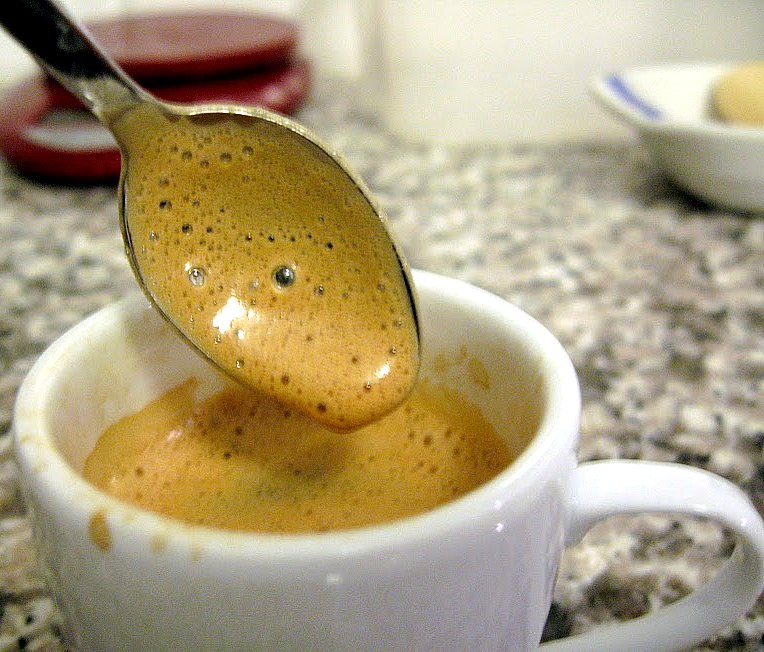
1. The Twist produces semi-automatic type espresso at home, meaning the coffee is similar to espresso brewed in units costing between 4X-8X more than the $169.00 Twist.  And even with pre-ground coffee, the Twist produced a lovely crema head that hung to the side of the espresso cup.  The espresso itself had complex notes of chocolate and almond.  The espresso had a nice consistency and was very "clean" tasting but maybe a little "bright" as other reviewers pointed out.  Twist espresso is no where near a ristretto type of espresso, even when pulling a single shot.  The Twist easily produces a better cup of coffee than most mediocre semi and fully automatic home machines and in terms of coffee quality beats both the Handpresso Wild Domepod and Wild ESE.


(photo: required top water lid)


(photo: pulling a shot, took a couple of trials to learn the machine)


(photo: with my third pull I was finally producing good crema)

2. The Twist is a cumbersome and a bulky son-of-a-gun to use.
 The unit is comprised of a group head, handle, water container, water container top, basket, and diverter lid (which funnels the coffee into a one or two cups).  It took me multiple times to learn how to assemble the unit and moreover align both the group head and diverter lid to the handle set (even with clear indicator marks visible).  Moreover, filling the water container and thereafter the basket with coffee can get messy so it's best to do this over a large kitchen towel.  Unscrewing all the components after use was also messy and I had to use a dish towel to unscrew the group head from the handle because some of the part stuck.  Dumping the coffee grounds from the small basket required the use of a spoon to dig out the grinds.   In terms of ease of use I'd opt for the Handpresso Domepod.
 
3. It's no secret the Twist produces great espresso because of the use of N20 cartridges, the cartridges produce the necessary pressure but there are two huge drawbacks to this system: 1. cartridges are expensive and yet another required accessory and 2. a single cartridge only lasts 3-4 (double) shots.  A single shot was not enough coffee for an individual, in my view (and my guests agreed).  A single shot is appropriate when drinking authentic ristretto or corto because of the richness of the end product, but in all other espresso drinking cases a long or double is the appropriate amount of coffee for a single person (or an almost full standard espresso cup).

(photo: you need N02 cartridges for the MyPressi)

4
. The temperature of the espresso was not adequate.  I used boiling water (seconds after coming to a boil) and also preheated my espresso cups with boiling water for several minutes and all my guests had the same reaction: the coffee is excellent but the coffee temperature is not correct or appropriate (this equivalent to making a wonderful tomato sauce and buying imported dry pasta from Italy only to bite into your first forkful of linguine and realize you undercooked the pasta and it's incredibly crunchy, it just ruins the whole experience).

5. The Twist uses a considerable amount of coffee.  The standard basket uses 21 grams of ground espresso or almost 4.5 teaspoons of coffee for a double shot.  The unit is designed for single coffee drinker so don't plan on using the Twist for a dinner party.    

6. From an industrial design perspective, and like the Chemex drip coffee maker, the Twist is a nice piece of consumer gadgetry and design and all Sci-Fi analogies aside it looks nice and will easily impress your techie and art scene friends, if that's your goal in life. 
 

Overall, the MyPressi Twist surprised me immensely as I didn't expect the unit to pull the quality shots it did and when compared to some semi-automatic home machines it's a steal in terms of price and size (there's no bulky machine sitting on your counter top, just slide it into your kitchen drawer).  

However, only single cup espresso drinkers should purchase the Twist because it's really designed for single use and moreover requires additional components to work (namely, the purchase of N20 cartridges on a consistent basis which makes my frugal alter ego cringe).  

If you're willing to sacrifice how your espresso tastes and want ease of use without the additional expensive of buying cartridges (including easy clean up) then opt for a Handpresso Wild Domepod for $88.95 (non ESE pod version).  If you're the occasional, single dose, espresso drinker and value quality over an easier use experience go and get yourself a MyPressi Twist!

Related Posts with Thumbnails
IMG_5484[1]
(The unit comes in many colors and is perfectly sized.  The two simple buttons are large and easy to use.  The LCD screen is huge and there's no guessing the amount when scrambling in your kitchen preparing a dinner party) 

Update: Congrats to Ami for winning the contest.  The giveaway is now closed.

For years, I've used a Salter metal body kitchen scale to measure everything from pasta portions to cups of flour for baking (well, my wife is the baker so she uses the scale for measuring flour for sweets).  We also use our scale to measure cereal and oatmeal amounts so we don't overeat (especially when we're consuming Cheerios!)  The Salter is a practical enough kitchen tool but I've always had a secret dislike for the product because it 1. is large and takes up valuable countertop space and 2. is not precise.  I do like the industrial design of the tool and if our kitchen was a museum I would indeed leave it out for guests to admire, but a home kitchen is first and foremost a practical space where the user (or home cook) completes tasks (that is, makes food)!  

In turn, I've been looking for a replacement for our Salter for years and it looks like I just found an elegant and cheap solution, namely the EatSmart kitchen scale.  The EatSmart takes up a fraction of the space my old Salter occupied and is also more precise; kind of like an old Model T being replaced by a modern vehicle with a turbo engine and electronic stability control!  The electronic kitchen scale can also measure in ounces, lbs, grams, and kgs.  It also has a handy tare feature which eliminates the weight of whatever item your flour, pasta, etc. is being held in (a bowl or measuring cup, for example).  The scale is easy to use (a big plus for someone who takes ergonomics seriously) and has an auto off button so you don't go wasting battery life!  I can't talk to reliability as of yet as I've only been using the scale for a few weeks, but I can say that I've had no significant problems thus far.  One thing I was concerned about was moving from a device that didn't require batteries or electricity to another "powered" kitchen item (in the case of the EatSmart, 2 AAA batteries).  And while batteries are needed I think the accuracy and functionality of the digital scale outweigh the use of batteries (just a Green acknowledgement).  The device retails for $27.99.


One of the other reasons I get excited about kitchen scales is that they are great mediums to keep calories and portion sizes top of mind when cooking.  For example, even though I've grown up with dry pasta and can pretty much tell you how many grams of linguine fine I'm holding in my hand, I occasionally guess wrong and cook too much pasta for one sitting.  And what ends up happening inevitably is that I consume a larger amount of pasta (usually with a dish like Alio e Olio) than I would like (especially given that I include pasta as a primo or starter at home between 1-2 nights per week).   

Kitchen Scale Giveaway!

IMG_5485[1]
(Kind of looks like a space ship from Star Trek Generations)  

In an effort to control the world wide problem of eating too much pasta (or any food for that matter!) I'll be giving away a single EatSmart digital kitchen scale to one lucky Scordo.com reader.  Here's what you need to do to enter:

- 1. leave a comment under this post on how you use your kitchen scale or an incident on eating too much of one food and not really being aware of it (for example, pasta, potato chips, Cheerios, etc.) and 2. sign up as a fan of Scordo.com on Facebook here or Scordo.com newsletter, it doesn't need to be both).  If you've done both already, then I'll ask you if you can please re-tweet the article URL (http://bit.ly/b6wR9u) on Twitter and include the article URL and and @scordo in your tweet)
 
- Only one entry per person please.

- The contest is open until 12 midnight on 2/27 and a single random user will be picked via Random.org.  The winner will be announced immediately on Twitter (so please follow me) and on Scordo.com by 5PM on Monday, 3/1.


- Please use a valid email address when leaving a comment so I can contact you just in case you're the lucky winner (I'll need your shipping address). 

- EatSmart will send out the digital scale to a single contest winner during the week of 3/1 (you should receive it within 7-10 business days).

That's it, so please sign up for a chance to win a kitchen product that all home cooks should own and use!  If you can't wait to use the EatSmart kitchen scale, you can buy it online via the OpenSky Project (proceeds go towards supporting Scordo.com).  If you don't see the product on my page right away, come back tomorrow in the AM.  

Related Posts with Thumbnails
IMG_3482-thumb-450x599
(photo: the DF366, or 36 inch, 6 burner, Duel Fuel Wolf range with custom burner lids from Uncle Frank) 

I live by the rule that you don't need fancy kitchen equipment to produce great food.  I'm also a fierce believer in kitchen tools that have multiple uses (via Alton Brown's mantra that one use tools should not have a place in a home kitchen) and I cringe at expensive home cooking machines like the Sous Vide Supreme and manual kitchen gadgets like a mandolin or pizza stone.  Of course, the three kitchen tools in the previous sentence all work and do their respective tasks well, but the question every home cook needs to ask (just like any good consumer) is: do I really need a particular tool to cook and eat well?  As an example, I turn to the many extraordinary home cooks in my family.  Specifically, I remember my well traveled grandmother who prepared all of her food via an aged 1.5 foot by 1 foot maple cutting board and small plastic handled steak knife from Italy.  She used the knife to dice, chop, and slice and pretty much utilized the "cut into your pan or pot" method of cooking (the cutting board was decorative).  My mother, for example, has never owned a dishwasher, chef's knife, Boos cutting board, All-Clad cookware, etc. and only recently converted over to using a Kitchen Aid Mixer for pizza dough.  And let's just say that the type of cuisine both women were/are producing would make even the fiercest food snob / "expert" salivate with envy. 

It's with a slightly guilty conscious, then, that I admit to owning a necessary, but highly gluttonous, kitchen product; namely, the gentrified industrial range (it's insulated and will not catch on fire randomly, so it's not truly industrial or commercial).  The product in question is the duel fuel 36 inch, 6 burner, Wolf range (model DF366, specifically).  Yes, the monstrous cooking machine that contains enough stainless steel metal to sustain 2 or 3 southern Italian provinces (a crafty Calabrian would, for example, sell the metal from the stove and live a comfortable life via the profits; this is what my father thought when I showed him the unit).  

Our Wolf stove was installed about two years ago and replaced a  25 year old four burner Thermador range top.  Our old Thermador worked but it was reaching the end of its product lifecycle and it required that we light each burner (one of which didn't work) with a match.  When it came down to selecting a new stove we turned to the so-called high end brands like Wolf, Thermador, Viking, and a few other manufactures at the local "fancy appliance" shop (like a luxury car showroom without the exhaust fumes).  


Prior to purchasing our range, I had done my research via third party rating organizations, online message boards and forums (see the GardenWeb Kitchen Forum for a great resource), and, of course, the product literature from each of the manufactures.  However, and uncharacteristically, I made my choice based on design/aesthetics and, to a lesser extent, on performance.  For example, I knew the Wolf Duel Fuel 36 inch range wasn't going to boil water faster than our 25 year old range top and, most likely, require more maintenance and possibly have some sort of reliability issue down the road (Wolf model DF366 has more electronic wizardry than my Mazda3 station wagon) but I still lusted after the large hunk of metal.   I wouldn't necessarily say I made a poor choice when it came to selecting a new stove, but I certainly didn't make the logical choice as there were plenty of smaller, and less expensive, 4 burner gas/convection type stoves on the market.  

In turn, I wanted to share some specific insight on my personal experience with a semi-industrial (insulated) "professional type" range with anyone considering the same type of product for their next kitchen renovation.  Here are my unstructured thoughts on the $7,000+ Wolf 36 inch duel fuel range (6 burner set up):

- Aesthetically, the stove looks great and when all of the stainless steel, black enamel, and burners are cleaned and polished you'll get goosebumps whenever you walk by it.  The stove resembles an Audi sedan with conservative, yet elegant, lines.  And from an build perspective, the unit is more in line with a fine watch than a box that heats things up.  Note, I've experimented with a few stainless steel cleaners and polish and only one has worked well; that is, Wolf's recommended "Signature" polish (which seems to be made specifically for Wolf).

- The stove is a royal pain in the butt to keep clean if you cook consistently.  The stainless steel attracts smudges and scratches easily.  The black enamel cook top requires daily soap and water to keep clean and if it's not buffed with a clean cotton rag you will get annoyed by all of the smudges.  

- The large, porcelain coated, grates are very heavy and difficult to move (which is required when cleaning the black enamel surface).   Further, the grates quickly turned gray due, I'm thinking, to our metal pots rubbing against the cast iron grates (this happened with our fancy Shaw's Original porcelain sink as well; note to these two manufacturers when constructing items out of porcelain please use the same material Italian porcelain tile is made out of as they are truly indestructible).  To Wolf's credit when I called to complain about the grates they simple sent out new grates.   

- The sealed burners have a grey, metal material, that quickly stained on our unit and I haven't been able to remove the brown/black spots to date.  This is annoying especially when the rest of the stove is clean, yet brown spots persist on the sealed burner material.

- The burners themselves are of high quality and 5 out of the 6 burners are capable of producing 15,000 BTUs (I know that many food "experts" will yell at me and say that the BTUs are not high enough and established a good sear, for example, is not possible; to the naysayer I say: "That's no true."  All 6 burners have a simmer setting and 1 burner is capable of a Melt feature with only 9,200 BTU.  

- The auto ignite burners have worked flawlessly and are well engineered overall.  

- The large oven takes an inordinary amount of time to reach temperature and to boot it's quite loud during operation (including venting which happens for a prolonged period of time after the oven is turned off).  We purchased a smaller Cadco convection oven and we end up using the unit more than the Wolf oven given the aforementioned issues.

- The oven has ten cooking modes but beyond the "convection" and "broil" modes I can't differentiate between the remaining eight modes, including "roast" and "bake" (for example, if I want to bake a ham is it the same as roasting it - which mode do I use?) 

- The pivoting electronic control panel is easy to use and does retract flush against the stainless front (a nice design feature which creates a very clean look when pushed closed). 

- The adjustable oven racks are well made, yet they're incredibly difficult to adjust vertically.  The three racks are very wide and you need both hands to go from one position to another (don't attempt to do this once your oven has reached temperature because once you open the oven door to perform the task you'll lose heat because it takes such a long period of time to perform the task).

- The oven cavity has dual halogen lighting so there's plenty of light to see your food. And the oven door construction, along with the oven insulation, is top notch.  The oven size is also very nice and especially handy when it comes to baking larger quantities of cookies, pizzas, etc. (of course with size comes heating time, per above bullet).

So, there you have it, overall I like my fancy Wolf range.  Would I buy a fancy range all over again if I had the choice today?  The answer is most likely no, rather I would buy a higher end version of a standard 4 burner gas range from a company like GE or Bosch (problem is I wouldn't get the same subjective warm and fuzzy feeling every time I walked by a GE Profile).  But, you know what, my pasta water would boil just as fast (somewhere a dead Calabrian relative is laughing at me and my range).    


Related Posts with Thumbnails
OS_logo_sign_string
Do you remember what it was like to buy something?  No, I'm not talking about filling up the tank at your local gas station or going out and buying some other commodity, rather I'm talking about the important buying decisions (such as buying a new car, a new stove, a few cases of wine, etc.).  I threw the cases of wine into the example just to make sure you were paying attention (note I do take wine shopping seriously)!  What was common about buying stuff before the web came around was that, in most cases, you asked the opinion of a family member or neighbor before handing over your hard earned money.  Purchase factors like reliability, value, customer service, subjective experience with the product, etc. all play important roles in buying products and who better to tell you about how a product performs than a trusted friend or family member (can Amazon or Wal-Mart do this?).

With the above notion in mind, I've partnered with a new eCommerce shop called the OpenSky Project to help recommend products that I've personally used and endorse (read: really, really love).  Having written on the topics of living a practical life and saving money (it's, after all, what my immigrant parents taught me) earning an endorsement or recommendation from Scordo.com is no easy feat.  In fact, the items that you'll see in my personal OpenSky storefront have all been stellar performers in my household for years.  And none of the OpenSky shopkeepers are paid to promote any of the products sold in his/her shop; this is what makes the OpenSky so special and unique (you'll only see products that have been tested, used, and approved by passionate experts in their respective fields).  

For example, you'll see shops from Michael Ruhlman (the well known food expert) and KathEats.com (a blogger who shares her personal recipes, tips, and healthy lifestyle views).  What Kathie and Michael have in common is that the "stuff" they're selling is the stuff they use and love (period) - with no gimmicks or runarounds.  I hope you get the sense that I share the same viewpoint, namely, that my endorsement means I want to help share some of my favorite consumer products with my readers.

You can read more about OpenSky here, including a little bit about their operating principle and beliefs.

My storefront will continue to grow and I hope to begin offering some of the speciality items I've written about including salami, pasta, wine, coffee products, and other great home and garden items.  For now, you can have a look at the chef's knife I use to prepare all of my southern Italian meals (I've owned it for 10+ years) or the cutting board that I meticulously maintain after each use (it's 12 years young).  I also recommend a few larger kitchen appliances like my favorite hot water kettle (you'll be amazed at much I use the device, including coffee, tea, boiling water for pasta, etc.), mixer, and food processor.  

Have a look at the Scordo.com storefront on OpenSky and, if you need something for your home or kitchen, see if I have a suggestion (I promise only to share what I have used and tested in my own house).  
Related Posts with Thumbnails
IMG_5102

The Aerobie AeroPress Coffee / Espresso Maker produces the best American/drip style coffee I've ever tasted.  There, I've said it and I mean it!  I've come out and made the aforementioned claim because the AeroPress looks more like a high school chemistry prop than a world class coffee maker and looks can indeed be deceiving when it comes to making excellent coffee at home.

Here are the facts on the AeroPress:

- The unit retails for $29.99 and was invented by Stanford University engineering lecturer Alan Adler (Adler is also the inventor of all the cool Aerobie sports products).  

- The AeroPress coffeemaker makes coffee in about 30 seconds (typically a French Press coffeemaker takes about 4 minutes and a high end espresso machine about 10-15 seconds).

IMG_5099

- Adler designed the unit so that boiling water is not needed.  Rather, the unit specifies using water at the 175 F (80 C) mark which prevents the typical bitterness and acidity found in drip machines.  

- The unit requires fine grind coffee (an espresso grind) as opposed to a course grind used in French press coffee makers.  Adler argues that fine grind coffee has more surface area for better extraction of full bodied coffee (I love when products are designed with science/engineering in mind!).

- The unit does require small, paper, microfilters.  Thankfully, a large amount of paper filters are included with the unit and they should last 6 months (brewing two daily cups). 

- The unit is not made out of fancy stainless steel or tempered glass but rather high quality plastic which is easy to clean, will not break, or become a smudge attractor.  

IMG_5100

IMG_5101

- The unit works by way of creating air pressure in a small chamber that houses both the ground coffee and hot water.  After filling the chamber with coffee and hot water, the user stirs the mixture for 10 seconds and thereafter plunges down for a steady 20-30 seconds.  The coffee is brewed right into your favorite mug.  

IMG_5102

Here are my observations on the AeroPress:

- The flavor component of the coffee is excellent but one shouldn't expect the unit to produce true European style espresso with crema and complex notes of chocolate, for example.  The AeroPress excels at producing superb American style coffee (and by superb I mean the best cup of American brew I've ever tasted).

- To produce a full cup of American style coffee you actually brew 10 ounces of rich coffee.  Thereafter, you top off your mug with hot water (this was strange at first).  I consume my coffee without milk and just a bit of sugar.  

- The unit comes with a large scooper and requires 2 scoops for about 10 ounces of coffee.  The AeroPress unit does require more coffee than, say, a typical French press maker.  Specifically, I'm using about twice as much coffee on a weekly basis since incorporating the AeroPress into my early morning and post lunch coffee habit (i.e., two 10 ounce cups per day).

IMG_5104


- You can make a great mug of coffee in about 1 minute (20-25 seconds to grind your coffee beans, 10 seconds to stir the hot water/coffee mixture, and 30 seconds to plunge).

- Although the unit creates a cup of coffee in under 1 minute the user does have to fiddle with lots of items.  For example , the main unit is comprised of a plunger, chamber, filter holder, and filter.  All of the aforementioned parts needs to be assembled and then the user needs to grind his or her coffee and make hot water.  Thereafter, the coffee needs to be scooped into the chamber and stirred.  Finally, the user has to plunge the mixture into a single mug and add more water to yield a single serving of American style coffee.

IMG_5105

- Cleaning is very easy and the plunger also acts as an extractor to gently push the spent coffee grinds out of the unit.  The plastic components just need a quick rinse.  My French press maker, as a counter example, is a royal pain to clean.   

- At $29.99 the price point on the AeroPress is a huge bargain.  The unit includes enough microfilters for 6 months (350 individual microfilters) , a coffee scoop, a stirrer, funnel for grounds, and the unit itself.  

Overall, I prefer the AeroPress over a French Press maker and the countless drip style makers on the market.  The AeroPress produces a rich, flavorful, and hearty cup of American style coffee that is the best I've tasted in both the US and Europe.  The AeroPress should not be confused for an Espresso maker, however, as it cannot compete, for example, with a semi pro home machine like the Rancilio Silvia (yet the Silvia costs about 20X more than the AeroPress).  I can imagine ubergeeks and techies using the Aeropress along with coffee aficionados looking for a more refined variant of the French pressed cup of coffee.  


Related Posts with Thumbnails
IMG_4815
(photo: notice the natural mold on the exterior of the Creminelli product; this mold imparts lots of taste on meat and also prevents it from drying out, along with the casing)

There are certain items or products that are immediately associated with a given country, for example: ice hockey and Canada, beer and Germany, haute cuisine and France, hot dogs and the USA, and vodka and Russia.  As a first generation Italian-American kid growing up in New Jersey, I secretly associated Italy with just one magical product, and it wasn't Ferrari or Soccer (calcio), but rather salami!  Yes, salami (or salumi, as the Italians would say), that seductive product comprised of salty / cured / spiced perfection!  

IMG_4987
(photo: I sliced up four different types of Columbus Artisan product for a Thanksgiving appetizer) 

My love of salami started as a young child during summer vacations in Southern Italy, as I described in my recent Guide to Italian Cured Meats and I thought it was a short lived love affair until I rediscovered that there are, indeed, high quality salumi that are being hand crafted and sold in the US (one doesn't need to hop on an Alitalia flight to Rome to find pork perfection).  

With the above said, I recently had the pleasure of sampling eight distinct salumi from two US producers: Creminelli Fine Meats of Springville, Utah and Columbus Artisan Collection from San Francisco, CA.  On the Creminelli side, I sampled Cacciatore, Sopressata, Piccante and on the Columbus Artisan Collection I tried Cacciatore, Finocchiona, Crespone, Salami Secchi, and Sopressata.  Not only did I try the salumi but all of the varieties were tasted by immediate family including many salumi dignitaries who have produced and sampled hundreds of products both in Italy and the US.  Some of the comments I heard at the gathering included:

"Is this from Italy?"

"Wow, what great flavor and texture!"

"Vinny, did you fly to Italy this weekend, where did you get this?!"

What follows, then, is an entirely subjective review of the aforementioned salumi (which were enjoyed with simple bread from Angelo's in Jersey City, NJ, homemade wine, and a variety of cheeses).  Let's start with the Creminelli products:

IMG_4807[1]
(photo: I think the packaging on the Creminelli product is top notch!)

I'll begin by saying that the Creminelli packaging is top notch.  Each individual sausage is hand wraped in fine butcher paper and held together by an elegant sticker with the Criminelli logo, name of the product, and ingredients.  The passionate owner Christiano Creminelli understands that along with a great tasting product, a customer starts his or her food "user experience" with their eyes and hands.  Christiano uses no sodium nitrates in his products and his salumi recipes originated in Italy and are now being duplicated, by hand, in the US (Christiano is a Maestro of Salumi!).  The Creminelli products I sampled were naturally molded salumi and were soft to the touch out of the packaging.  I would have preferred to have had the salami age for 1-2 months in my cellar before sampling the product so that more complex flavor could develop, but I couldn't wait (I tried the product after having the product sit in fridge for 4 days)!  

IMG_4810
(photo: Creminelli exterior)

IMG_4816
(photo: starting from upper right clockwise: Creminelli Piccante, Sopressata, and Cacciatore)

Creminelli Sopressata 
Sopressata is traditionally made with wine and garlic and Creminelli's sopressata was no different, yet the wine and garlic flavor was muted letting the intensity and quality of the pork come through.  The meat to fat ratio was also ideal, which is tough to get right in Sopressata.  I would have preffered a bit more garlic flavor in the Sopressata and little bit less upfront salt but overall it is a fine salumi.  Creminelli Sopressata would work well in a sandwhich combined with other ingredients.  

IMG_4817
(Photo: Creminelli product)

Creminelli Picante
My favorite of the bunch and not overly spiced with red pepper.  The salt content was perfect in the Picante and the combination of high quality pork with mild heat made me quite happy. The color of the Picante was also well done, it's not the typical fiery red color you see in most spiced salami.  

IMG_4989
(photo: Columbus Artisan Cacciatore)

Creminelli Cacciatore
The first thing that jumped out was the subtle juniper berry flavor in the Cacciatore!  Moreover, the consistency and texture was typical old world, as was the physical size of the sausage itself (very small; afterall, tradition has it that hunter's stored the salami in their coats and when they got hungry in the forest they simply cut a few pieces and had a quick bite).  Next to the Piccante, I really enjoyed the Cacciatore.  There were some bitter components (at the very end) that may have been coming out of homemade wine I was having when sampling the salami, but overall you could tell that high quality ingredients were used in production.  Finally, this salami also had a wonderful scent!  This is a great all around salami to keep in the house for a quick meal on the weekend or for impromptu quests.  

As I said above, I would have liked to have tried the Creminelli salumi after the aging process has a bit more time to do it's thing and, in fact, I do have a few samples aging in my cellar and I'm excited to retry the product in a month or so (stay tuned for an update here).

IMG_4982
(photo: The Columbus Artisan collection is top notch and miles ahead of the standard fair salumi, the taste, texture, and ingredients are all old world and fabulous) 

Next I moved on to the Columbus Artisan Collection salami which are produced in San Francisco and differ, to a large extent, from the mass production line of cured meats from the same company.  Columbus does use sodium nitrates in their products and the salami did arrive pre-aged and hard to the touch.  Like Creminelli, Columbus Artisan has a natural mold skin with all natural imported casings.

IMG_4984
(photo: Columbus Artisan Finocchiona, my favorite amongst both the Creminelli and Columbus products)

Columbus Artisan Finocchiona
Let me qualify the following sentence first by saying that fennel seed was one of the key ingredients in my grandfather's salumi making arsenal and, as a result, I've been pre-programmed to respond positively to fennel flavor.  And there's tons of authentic fennel seed flavor in the Finocchiona, in fact it was my favorite salumi out of the 9 products sampled.  The Finocchiona had great texture, rich and flavorful pork, and the perfect balance of salt and bitter that is needed in any artisan salami.  

IMG_4985
(Photo: Along with the Creminelli cacciatore, the Columbus Artisan Salame Secchi would be an excellent overall choice for pre-dinner appetizers, small parties, and to enjoy with a glass of wine and good bread)

Columbus Salami Secchi
Columbus claims this is their oldest recipe and product and it shows.  The Salami Secchi (meaning very dry) is the most subtle of the Columbus salami's I tried and I love the ratio of fat to pork.  The salt and spice seasoning was also idle.  This type of Salami is a good all round choice for keeping in the house at all times, while the Finocchiona, for example, would be something that you would consume a little less frequently (just because of the intensity of the fennel seed).

IMG_4986
(photo: Columbus Artisan Cacciatore)

Columbus Cacciatore 

My first thought when trying this cacciatore was, wow, this is kind of sweet tasting with lots of deep flavor.  It was difficult to pick a winner between the Columbus and Cremenilli cacciatore, but Columbus had an advantage because the product seemed to have been pre-aged and, of course, the sodium nitrates help quicken the hardening process in the refrigerator.  I think with more aging time, the Cremenilli would come out on top because of better ingredients (stay tuned!).

Columbus Crespone and Columbus Sopressata 
Similar to the Finocchiona but without the fennel seed Crespone is a very rustic interpretation of salami (I should also say that Crespone and Finocchiona are also slightly larger in size than the rest of the salamis sampled).  I found the Crespone, similar to a sopressata, to have a bit more fat composition than I ordinarily like but I did appreciate the simplicity and adaptability of the product (it went well with basic bread and cheese).  A bit more course in texture than the Cremenilli sopressata, Columbus Sopressata was also a good basic salami but I would have liked a little bit more flavor profile.  The sopressata was my least favorite of the Columbus salamis, but still light years ahead of any mass produced salami in the US market.

IMG_4988
(Photo: Columbus Artisan Crespone, Sopressata, Cacciatore, and Salame Secchi, from left to right)

Where to Buy
- You can buy Creminelli products at retail or online at Creminelli.com 
- You can buy Columbus products online or at your local retailer.  

One observation that many of my family members made about both artisan salamis was the price!  At between $25 - $30 per pound for the Creminelli product and between $11 - $15 for the Columbus Artisan, the salamis aren't cheap and are on par with a product like Prosciutto di Parma (which is one of the few Italian cured pork product allowed to be imported into the US).  Charging the same amount of money (or more) for a US salumi product is a big risk for hardcore Europeans customers who are particular about value.  
Related Posts with Thumbnails
campari-aperatif

Do you do bitter?  No, no I'm not asking you if you like to complain or wake up each morning looking for a fight with the world (or worse your spouse)!  What I'm asking is if you've ever had the pleasure of experiencing what the Italians refer to as Amari?  Amari are traditional digestivos or spirits (read post dinner drinks or liquids that will help you digest your massive meal).  Amari are made by distilling a wide variety of herbs and spices - no one Amari shares the same makeup or ingredients.  For example, Amaro Averna from Sicily is comprised of citrus, herbs, roots, and caramel and Fernet-Branca includes aloe, gentian roots, rhubarb, galangal, red bark, etc. (Fernet-Branca keeps most of the ingredients a secret).

Generally speaking, and as Eric Asimov explains in a recent "The Pour" article, bitter drinks aren't exactly the rage in the US and, moreover, Americans haven't yet reached the ephemeral state of post digestive bliss.  That is to say, Mr. Smith could care less about how his stomach is doing after a large meal, conversely, in Italy, the digestive system is taken more seriously than Catholicism, hence the fascination with post dinner Amari designed to soothe both the stomach and the soul (don't worry I'm not a Cartesian).   Also related to post meal digestion, the Italian tradition of fruit after lunch and dinner is also meant to cleanse the palate and help the stomach do it's thing. 

I grew up with a few basic Amari including Campari (which is made from cascarilla bark and the insect Dactylopius coccus which gives the liquor it's distinctive red color) and Vecchio Amaro del Capo (an herbal and minty amaro made in Calabria).  My parents served Amari before and after lunch or dinner.  In terms of consuming fruit after a meal, it was a given that we had a virtually fruit stand at our dinner table every night, including two types of pears, a couple of varieties of apples, oranges, cactus pears, grapes, peaches, plums, etc. (all according to the correct season).  I still consume tons of fruit after dinner, but I can't peel a pear like my father or grandfather.

The following is a wholly non comprehensive list of Italian Amari (thanks to both Asimov <NY Times> and Weber <San Francisco Chronicle> for doing all the heavy lifting; let's start with Weber's list (quotes are straight from his wonderful article, That's amari: Italy's traditional bitter liqueurs find new life with American consumers):

amaro_nonino1

Amaro Nonino (about $42).
  "A lighter style of amaro made in Friuli at the Nonino distillery. Its flavors are warm, with a gentle spiciness and smooth texture. The spice character lingers on the finish, proof that Nonino is one of the more elegant amari on the market. Contains a portion of ÙE Grape Distillate, a proprietary aquavit aged in small barriques of nevers, limousin and sherry woods, plus an infusion of herbs. It is best enjoyed as a digestivo or as an aperitivo with ice and orange peel."

AMARO_AVERNA

Amaro Averna (about $35).
  "A sophisticated and complex amaro that hails from Sicily. The addition of blood orange and lemon peels to the aromatic herbs used to make this amaro adds a bright and refreshing character. Averna is widely considered to be one of the most versatile Italian amari."


capo

Vecchio Amaro del Capo.
 An herbal and minty amaro made in Calabria, my parents place of birth.  Capo is excellent when served on the rocks or ice cold from the freezer.  

cynar

Cynar (about $22).
  "The earthy flavors in this herbal amaro are enhanced by the flavors of the artichokes used in its production. Cynar also has a relatively low alcohol level (16.5 percent), making it a popular amaro for cocktails, as well as a style of amaro that's enjoyable as an aperitivo."

fernet-branca

Fernet-Branca (about $30).
 "A pungent and black drink made in Milan and considered by many to be the benchmark Italian amaro. Flavors of anise and saffron add complexity to this forceful drink."

mariaal

Santa Maria al Monte ($38).
 "This shows an engaging herbal complexity that recalls fresh basil and spearmint. Its strength and power are similar to Fernet-Branca, while the vibrant finish feels spicy and rich." From the Valle d'Aosta, Santa Maria al Monte is a digestivo that uses bitter orange peel and ginseng among other flavoring agents.  Menthol presence is heavy.

ramazzotti

Ramazzotti ($24).
  "One of the more popular Italian amaro brands, Ramazzotti is made in Milan. The balance between bitter and sweet in this aromatic amaro feels almost seamless, while the snappy flavor of fresh ginger lingers on the finish."

Other brands mentioned in Asimov's article:

12campari

Campari (about $26).
 Originally produced in 1860 by Gaspare Campari in Milan.  As stated above, Campari is made from cascarilla bark and the insect Dactylopius coccus which gives the liquor it's distinctive red color (note: as of 2006 insects are no longer used to give Campari it's red color; a red dye is now used).  I like Campari via the Negroni, Americano, or with grapefruit juice and a splash of red vermouth)
luxardo

Girolamo Luxardo of Veneto.  A pleasant aperitif liqueur obtained by the infusion of several herbs and fruits such as: sweet oranges, bitter oranges, rhubarb, mint, marjoram and thyme.

brancamenta

Branca Menta (about $27.50).
 As one online reviewer put it, "Deep chestnut, mahogany. High toned, mineral, alpine herbed, licorice aromatics. Rich texture. Wild, intensely concentrated palate - like liquid Ricola. Very fresh, minty and clean with a powerful infusion of spice. For all its presence, it retains nice balance. Use this in winter - should cure anything."


mioamaro

Inga Mio.  More info to follow.

Chinati.  Made from wine with the addition of herbs
Related Posts with Thumbnails
IMG_4763

At first glance it just doesn't make any sense.  That is to say, how could a shot of liquid gold (aka, fresh espresso) come out of a handheld device?  Afterall, if you walk into your neighborhood café or Starbucks you'll mostly likely see a $10,000 plus hunk of steel with a brass broiler, multiple portafilters, a warming tray to accommodate 40 cups and saucers, and enough electrical circuitry to make the latest iPhone 3G S seem like your grandma's beige rotary phone.  The handheld device in question is the new Handpresso Wild Domepod.

IMG_4762
(photo: product packaging is real nice and is similar to the way Apple packages products)

The Handpresso Wild Domepod is an update to the Handpresso Wild ESE. The key difference between the two models is that the Domepod can be used with freshly ground coffee and cannot be used with ESE pods.  As stated in my earlier article on the Handpresso Wild ESE, the Domepod contains the following features:

- The unit does not require electricity but rather creates 16 bar of pressure via a "bicycle pump" like mechanism on handheld device .  This method differs from the CO2 cartridges used in products like the MyPresso Twist which I've yet to try.  

- The unit contains a filtered plastic/metal basket that holds about 4-5 teaspoons of ground espresso (which is ground to a powder like consistency and different than, say, the ground coffee used for your typical French Press cup of coffee).

- The unit retails for $99.00 at Importika.com (it's not cheap).

I tried a sample version of the Handpresso Wild Domepod for a 1 week period (including a few trials with my Italian born parents).  I used both freshly ground espresso from WholeLatteLove.com called Malabar Gold which contains less acid and is milder in form than your typical espresso (it's been called a European type blend) and illy Café pre-ground espresso (find grind).  I used freshly filtered water to brew my espresso and what follows are my wholly unscientific impressions of the unit:

- I was excited that the Domepod would allow me to use freshly ground espresso versus ESE pods, yet I was worried about the process of both filling the unit with ground espresso and, thereafter, removing the grounds .  I'm happy to report that filling the unit was fairly easy.  I used both a standard plastic spoon and typical spoon served with espresso to fill the unit and it was an easy process.  Emptying the espresso cartridge which contains the used espresso grounds was easy and simply required a tap against the side of my garbage can to release.

- The pump mechanism seemed improved in the Domepod versus the ESE version, though the product packaging contains no indication the pump is improved or redesigned.  The unit required about 7-10 pumps to reach 16 bar pressure; this isn't bad considering that the end user is providing the power and not dependent on a CO2 cartridge or electrical plug!

- As I mentioned with the ESE model, boiling water is required to produce decent results.  Using warm water, or water that is even 4-5 minutes off the boil will significantly reduce the quality and extraction of your espresso (unfortunately, this rules out using water at work via a hot water dispenser or even water from a thermos).

IMG_4768
(photo: Ground Malabar Gold)

 - As stated above I used both Malabar Gold and illy fine grind Espresso.  When using the Malabar, which was ground fresh and via a professional grade grinder, the unit extracted the coffee well and there were no leaks at the beginning of the extraction process.  However, when using illy ground espresso (direct from the can) the results were disastrous.  The unit leaked and splashed water during the extraction process almost as though the ground espresso clogged the head (I tried to brew 5 separate cups using the illy ground espresso and each time I had the same end result) - see picture below.  When I used the Malabar Gold, the unit worked effortlessly.  My conclusion: the bean grind is critical to the Domepod (this has nothing to do with the quality of illy coffee, but rather maybe a byproduct of the compatibility of certain bean grinds with the Domepod).

- The espresso cartridge housing the ground espresso needs to be lightly tamped with each brew (I did this with the end of my spoon).  

IMG_4771 


IMG_4773

IMG_4774
  
- Using the right type of freshly ground espresso greatly enhances the quality of the product.  The Malabar Gold produced a rich and flavorful cup of coffee with decent crema and some complex flavors.  Don't get me wrong, the Domepod WILL NOT produce café type espresso (like the espresso found in the best spots in Europe; think northern Italy and Austria).  However, the Domepod does produce a better cup of espresso than a typical Bialetti stove top unit.  I would even go further and state that the Domepod espresso is better than the typical crap you'll find at your local Starbucks (yes Starbucks espresso isn't good, sorry I wish I had better things to say about the chain).  

- I was disappointed with the temperature of the espresso coming out of the Domepod.  Even with pre-heating my cup and using just off the boil water, my espresso wasn't at the ideal temperature I'm used to (whether I'm comparing it to stove top espresso or café/bar espresso).

- The Domepod model now contains a water level indicator to guide the user as to how much water to pour into the water chamber.  This is critical as the flavor and texture of the espresso varies greatly with the amount of water used; using too much water will produce a watery cup without much flavor and using too little will create a super concentrated cup.  I found filling the water chamber just below the water line works best (so don't follow the water level indicator exactly)

IMG_4776


IMG_4777
(photo: explosion when using Illy fine grind espresso, not sure if there is a espresso grind compatibility issue with the unit)
 
- I'm still experiencing a small amount of water leakage towards the end of the extraction process which is similar to what I reported in the ESE model.  The is a little frustrating as any excess water will dilute the flavor of your espresso; in turn, I've learned to move my espresso cup just before the final drops of coffee are being extracted).  

- Just as with the ESE model, the build quality is superb with the Domepod and the unit feels solid and should last a lifetime provided you keep the pumping mechanism clean and occasionally change the unit gasket.  As I said above, the product design and packaging is at a high level.

- The Domepod, like the ESE model, is really designed for single use.  I tried brewing multiple cups of coffee for family members one evening and the process of constantly removing coffee grinds and refilling the unit with water is cumbersome.  The unit is best for single service at the office or when traveling.

IMG_4766
(photo: Malabar gold espresso ground professionally)

The bottom line is that the Domepod is an improvement over the ESE model simply because the former utilizes freshly ground coffee and other than the aforementioned, the ESE and Domepod are identical machines.   While the flavor, texture, and aroma are all improved via the Domepod, I wouldn't want to mess with ground coffee at the office or on a business trip, for example.  So, the choice is yours in terms of which model to purchase:  The ESE (Wild) is convenient but produces a lower quality cup, while the fresh ground coffee (Domepod) makes a richer and more flavorful espresso but requires carrying and handling finely ground coffee.   
Related Posts with Thumbnails
walmart

With the notorious holiday shopping season fast approaching I'm having nauseous visions of deals, coupons, free mass produced turkeys and hams, free shipping, wal-mart, and 40 percent off blow out sales.  The visions are not only vivid and haunting they are actually true!  

Don't get me wrong, I wouldn't pass up a deal on a particular consumer item that I needed, but much of the typical consumer's behavior and the retail and/or manufacture's promotional tactics to sell a product are logic defying acts.   Especially when you think hard about what the entities in question are trying to get you to do and what channels they are utilizing.   Let's look at a few examples:

1.  Free Shipping.  The typical ground shipping cost for a consumer electronic items like a GPS device or digital camera is between $7-$9 (I used Best Buy as an example).  The typical cost for a middle of the road GPS device or digital camera is about $150-$250.  Using common sense does it make sense to purchase an item you don't need in order to obtain or "save" on free shipping?  The answer, of course, is no.  This tactic aims to bring a nominal cost, such as shipping, to the forefront of the shopping experience in order to downplay the actual cost of the item.  Think actual need ahead of nominal savings.

2.  Percentage off / Deals.  The main tactic here, again, is highlighting a percentage off a certain item.  You see the deals language lots a week or so before "Black Friday" (or the day right after Thanksgiving) so that retailers can attract foot traffic and curious shoppers.  Often, if you look closely at the products being discounted they are not only items you can probably do without (mediocre electronic devices, men's gloves made of fake leather, a set of 5 Teflon-like pans, etc.) but the quantity or model number is often limited.  This is the same tactic car dealers use to lure you into the dealership in Sunday morning newspapers (i.e., you'll see a ridiculously low price for a certain unreliable and gas-guzzling model which is often tied to a single VIN number).  Again, think about whether you need the item ahead of savings measly 10-20 percent.  

3.  Coupons.  The number of coupons sites on the web must double each and every day (I haven't validated this, but it's just a hunch).  These days you can save twenty five cents on yogurt at ShopRite, get two large pizzas at Domino's for $5.99, and find an oil change joint that will replace your engine oil and filter for $15.  I have to admit that coupons don't excite me, rather what excites me is value.  For example, if I see generic yogurt on sale that contains tons of sugar and limited real fruit/flavor I'll often pass on the sale item and spend an extra couple of cents per container because I'd rather purchase the brand that uses real sugar, organic milk, and fresh, real, fruit.  With food specifically, I don't want my choices of what I prepare for my family and myself to be influenced by a circular in the paper or a mass email campaign from Stop & Shop.  The bottom line is that the choice in the food that I consume is something I value highly and don't want influenced by saving, for example, five dollars at check out at my local market (this shouldn't be interpreted as some sort of elitist, East Coast, view, but rather a viewpoint that is centered on quality of life and the best choice).

cart 

Overall, when it comes to shopping and buying stuff (including clothes, food, shoes, consumer electronics, auto renewing services and subscriptions, etc.) I'm a big believer in putting 1. real need and 2. value ahead of spontaneous and pure "saving" shopping behavior.  What I'm driving at is that you shouldn't buy what you don't need regardless of a blockbuster deal or free shipping and you shouldn't let important consumer decisions, like food choice, be driven by coupons; instead, look for value when shopping (which I define as the best product for the best price).      

Related Posts with Thumbnails
retrokitch

Back in February I wrote a short article on how to clean your kitchen and touched on hot topics such as floor washing, stainless steel polishing, and granite cleaning (I'm sure you're thinking: riveting subjects!).  On the topic of cleaning granite, I suggested folks use a white vinegar/water solution to clean their granite, but I'd like to now officially retract my suggestion.   After a few months of consistent use, I have started to see some very light etching take place.  The etching is minor and I may have overdone the percentage of white vinegar to water ratio, thus causing a bit of etching.  Moreover, I have started to use a small microfiber towel and regular dish soap to wash and sanitize my granite on a every other night basis (this is a three step process: washing, remove soap, and dry).  The dish soap does a great job of cleaning the granite, so long as the granite is free of debris (i.e., no crumbs, ground coffee, etc.) before washing.  The dish soap cleaning method also does not cause any etching.  

What my new method does not do well, however, is polish granite.  Our granite has been fairly shiny and new looking, but now that we're entering year three with our countertop I'm craving that new granite look again and rethinking the idea that you do not need specialty products to clean a kitchen well.  Enter Goddard's, a 170+ year old brand that earned it's reputation on silver cleaning products.  Nowadays, Goddard's produces a whole range of cleaning products, including a granite polish, stainless steal cleaner, and appliance and countertop polish.

IMG_4744
 
Stainless Steel Polish and Cleaner

I recently sampled the three Goddard products mentioned above in my own kitchen (partly out of pure necessity given that our metal and stone surface were a big old mess and also because of a sample pack). My black/white granite was dull and fading fast and my stainless steel appliances were full of smudges, micro-scratches, and very dull looking overall.  The first Goddard product I tried was the stainless steel cleaner.  The cleaner had a watery consistency and came in a spray bottle.  I sprayed my fridge and dishwasher twice and proceeded to remove the excess liquid with a microfiber clothe (I did this in two distinct stages).  I was also careful to wipe with the grain of the steel.  Overall, the stainless steel cleaner did not do a good job removing smudges or provide any sort of polish or shine to the metal.  The product did remove some of the contaminants on the surfaces of my fridge, stove, and dishwasher, but overall I was disappointed with the product and, to be perfectly honest, the cleaner gave me the same end results as using hot water and dish soap.  

I've had much better success with Signature Polish, which is recommended by Wolf / Sub Zero and acts as both a cleaner and polish.  I received a sample bottle with my Wolf stove purchase and it has outperformed all of the stainless steel cleaners that I've applied to my appliances in three plus years.  The Signature Polish provides a deep shine, removes small scratches, and cleans exceptionally well.  Moreover, the polish/cleaner goes a long way and only a small amount of liquid is needed to clean a large area.  Overall, when it comes to cleaning stainless  and getting that great, smudge less shine, I think it's always best to go with a thicker, polish type, solution versus a water based product.  

IMG_4778


IMG_4780

Granite Polish and Cleaner

I also tried Goddard's granite polish and without jumping the gun the spray solution was outstanding.  I applied the polish with a paper towel and removed excess with a microfiber cloth.  The solution gave my granite an exceptional shine and provided an ultra smooth feel to my countertop.  In fact, my wife thought our granite felt just like the day we installed it some 3 years ago.  The only two compliant I have are that the solution is a bit oily, in turn leaving some swirl marks and a bit of elbow grease is required to get the stone dry and free of any polish.  The bottle also doesn't state whether the polish is food safe (i.e., whether you can place fruit, vegetables, etc. directly on the stone).

Finally, I tried the much thicker Goddard's Appliance and Countertop Polish on our granite only and compared to the granite polish it did not provide the same sort of shine and feel.  The solution was also much thicker and more difficult to wipe up.  There may be a better application for the appliance and counter top polish (such as a glass stove top), but it was only average on our granite countetops (the solution provided decent cleaning power, but it did not produce a superb shine).  The product would be better labeled as a cleaner versus a true polish.  On the positive side, Goddard's Appliance and Countertop Polish is labeled food safe and is also a certified Kosher product. (UPDATE: I tried the Appliance and Countertop Polish on black, stove top, enamel and the result was very positive.  The polish did indeed provide a nice, deep, polish and cleaned the enamel quite well.  The polish did require a bit of work in terms of removal (it was a little oily) and to get a true shine, but it seems the mirror like finish will last a bit.  I'm curious to see how the polish holds up to spills, oil, heavy cooking, etc.)

So, yes I do recommend a good stainless steel polish and granite/stone cleaner for your home kitchen, as well as a basic cleaning kit including white vinegar (floors), Murphy's Oil (wood cabinets), Pine Oil, dish soap (granite, stove burners and top), and Soft Scrub with bleach cleanser (porcelain sink).   What are you waiting for, get out there and go clean those hunks of steel and stone in your kitchen!

Related Posts with Thumbnails
IMG_4732

As I stated in my guide to renovating your kitchen, splurging on good quality kitchen cabinets is usually a good idea when it comes to redesigning your home kitchen (especially if you're looking to stay in your home for long term).  High quality kitchen cabinets are usually composed of solid wood cabinet faces (e.g., maple), full plywood box construction, dovetail drawers, etc.  Moreover, hiring a quality craftsmen to install your cabinets is always a good idea.  For example, during our kitchen renovation our cabinet installer Brian was meticulous when it came to hanging lower and upper cabinets, preparing for the install of our farmers sink, installing crown molding, and attaching our cabinet latches and pulls.

IMG_4729

One of the small details of our kitchen renovation that I had not given much thought to was cabinet hardware.  In fact, the only thought I had when it came to selecting cabinet hardware was to head down to the local hardware store and select a moderately priced set of pulls.  Well, as soon as I got a hold of some the "genuine brass" pulls and latches offered at the neighborhood Ace hardware store I knew they wouldn't work in our new kitchen.  The hardware store components were cheap looking, didn't function well, and were of a low quality design and construction.  That's when I stumbled upon Horton Brasses via a recommendation from the GardenWeb Kitchen Forum.  

Horton Brasses, a Cromwell, Connecticut based hardware company, produces more than 1,000+ pieces of cabinet and furniture pieces, from kitchen cabinet pulls to clock finials!  For our kitchen cabinets, we choose to go with a traditional pantry latch and drawer pull.  

IMG_4728

We ordered latches in both polished chrome and antique brass as well as pulls in polished chrome (The pulls and latches are available in seven finished).  The first thing I noticed when I received the hardware was the overall build quality of the pieces.  Each item had a high quality brass finish and the latches, specifically, had a high quality mechanism.  In fact, I had some concern about using pantry latches for our upper cabinets because I heard horror stories about the mechanism failing after prolonged use, but the customer service department at Horton assured me their latches were built to last.  And last they have for well over 3 years now!  Horton's hardware also comes with historically accurate fasteners (screws) that complete the look of the kitchen hardware.  

IMG_4730

Where Horton also shines is in the customer service department.  I spoke to Amy at Horton several times via the phone/email about both replacement parts and technical issues and she was a pleasure to work with.  Moreover, when one of the screw heads broke during a latch install because of tough hardwood and applying too much torque, a technician at Horton got on the phone with me and explained what drill bit to use when pre drilling, how to remove a broken screw head, and, generally, how to install the latch mechanism.  The people at Horton went well beyond the typical customer service support call.  What also gets me excited about Horton is how well priced their items are and, moreover, that the items are manufactured by the company in the United States.  Horton isn't a big company, but it's the type of customer experience I had that makes small companies grow and earn an outstanding reputation for both product and customer service.  Building a company is easy when you stick to the basics: great product, fair pricing, and outstanding customer service.
 
If you're looking for high quality kitchen hardware for your next kitchen renovation project check out Horton's bin pulls, pantry latches, and other fine hardware.  
Related Posts with Thumbnails
IMG_4168

Back in October of last year I wrote about essential kitchen tools and kitchen simplicity.  The article attracted a few comments from readers stating that my list was too extreme and left out some key tools and items.  So, I've decided to take another look around my kitchen and update my essential kitchen tool list (sorry still no pizza stone):

1. CuisinArt Food Processor and Kitchen Aid Stand Mixer
OK, I'm going to start off by saying that both my grandmother and mother never used or owned the above tools and they both made/make fantastic food.  In fact, I remember trying to convince my grandmother to let us buy her a large stand mixer so that her weekly bread making would be a little easier for her (she of course said no).   

I use our CuisinArt Food Processor for making hummus, slicing onions for French Onion soup, and, when I'm lazy, pesto. Our Kitchen Aid Stand Mixer is used for pizza dough, bread, and countless cakes. Both products are very well built and should last a lifetime.

2. Krups Hot Water Kettle
Boiling water takes time, not a whole lot of time, but just enough minutes to annoy me at certain key moments (for example, waiting for boiling water in the early morning for your French Press Pot).  We picked up a Krups electric kettle two years ago and it's been a terrific, time saving, device.  We use our kettle for tea, coffee, pasta water, etc.  Plus, it actually saves energy when you consider that the device boils water faster than our fancy Wolf, 18,000 BTU, gas stove.

3. Microplane Grater
For citrus zest and emergency cheese grater.

4. Kitchen Shears
For emergency tasks, quick herb mincing, etc.

5. Large Grater
For the best way to grate most soft cheeses.
 
6. Serrated Bread Knife
The best knife to cut fresh bread.

7.  Locking Tongs
Tongs are essential and most are made in an inferior manner.  Buy two , well made, products (one with metal pincers and one with rubber) - All-Clad makes a pricey, but well built, all metal version.

8. Vegetable Peeler
Pepin used a paring knife, for everyone else get a vegetable peeler.

9. Instant Read Thermometer
You'll throw this out after becoming a competent cook, but you should have one in your kitchen for the early years.

10. Peppermill
You'll use this every day and there' a big difference with freshly ground pepper (same difference with freshly ground coffee).  I own a French made, Prefex, that's compact and very functional.

11. Salad spinner
If you eat tons of greens then you need to dry most of them before cooking or consuming, the salad spinner is a revolutionary product and you should have one.

12. Colanders
You should have about three of these for draining pasta, cleaning vegetables, etc.  

13. Toaster Oven
This will cause some debate, but I could not live without our small toaster oven.  I used out tiny DeLonghi toaster oven to broil thin white flesh fish and salmon, heat up pizza, toast bread, etc.  The device cooks food in no time and unlike a microwave it perfectly toasts and browns food for tremendous flavor.  The device also does not use as much energy as our larger Wolf or Cadco ovens. 
Related Posts with Thumbnails
IMG_4464

I love pasta; in fact, I'd venture to say it is a glorious food product!  And it doesn't really matter how it's prepared (condiment or sauce-wise, that is); I'll eat penne rigate with good olive oil (recipe) and freshly grated Parmigiano-Reggiano, Bucatini with a fresh, tomato, pan sauce (recipe), or linguine fine with a homemade pesto sauce (recipe).  The condiment for any pasta is important, but what's key is that the pasta is not over or under cooked and that the water used to boil the pasta is both salted and abundant (don't crowd your pasta during the cooking process).  

You'll also hear the word al dente thrown around a lot but it's the food equivalent of drinking only Bordeaux; that is to say, you can cook pasta al dente most of the time (and be happy), but all pasta does not need to be cooked, "to the tooth" at all times (large rigatoni is a good example). 

Moreover, dry pasta is not inferior to fresh pasta and, in fact, the very best dry pastas are superior to average, fresh made, pasta.  I always aim to keep, at the least, 5 varieties of dry pasta in my pantry, including:

The pasta cooks very fast and is great for loose sauces like tomato or cream based sauces, like the ubiquitous Alfredo.  I also use linguine fine when I cook up a batch of super simple Aglio e Oli pasta.

The fastest cooking dry pasta on the market.  You need an abundant condiment for this type of pasta or you'll get lumpy bundles of thin pasta.  My mom used to make angel hair for me during the school year (with plenty of tomato sauce and freshly grated cheese); in fact, every time I have Angel Hair I'm brought back to lunch time during my elementary school years.

Another pasta staple that goes well with pesto or baked in the oven with fresh mozzarella, ricotta and a bit of tomato sauce.

Ah, this was the go to pasta for Nonna Rosa.  Nonna Rosa preferred the large type rigatoni and she would often serve the pasta with a ton of olive oil (mixed with a bit of corn oil because she liked to save money) and freshly grated Pecorino Romano.  Large rigatoni is also the base for my white wine dark turkey meat Bolognese sauce (pictured above).

5. Bucatini  
This is a thick spaghetti with a hole in the middle.  Bucatini is a hardy pasta that, because of the hole at the center of the pasta, takes any sauce surprisingly well.  I like bucatini with anchovy, hot peppers flake, garlic, freshly chopped parsley, and olive oil.

Pasta is a wonderful food ingredient.  It gets a bum wrap in the US because most Americans tend to have pasta as a main dish when having dinner (this will lead to you getting fat!).  Pasta, if proportioned correctly, can be used to start a meal 2-3 times a week (as they do in Italy on most nights).  The correct portion is about two ounces.  And if the condiment or sauce is made well (and used sparingly) you will feel very satisfied (the problem occurs when there's no taste in your sauce and you look for additional pasta to make up for the lack of taste).  Good pasta also needs two key ingredients to thrive: olive oil and Parmigiano-Reggiano.  Moreover, don't forget to save some of the golden water used to cook your pasta (you may want to add a little bit with your condiment/sauce when mixing it with pasta) and always bring your pasta to your pan containing your condiment/sauce (never the other way around).

Finally, you may want to know which dry pasta brand is best.  In terms of large, well known, and readily available brands I like De Cecco.  I also think Colavita makes a good dry pasta.  I used to consume Barilla but I think their quality has suffered a bit in the last ten years or so (I'm not sure what it is but De Cecco pasta tends to have more flavor and a better consistency). There are also tons of small production type dry pastas from Italy (such as Rustichella), but you really just need to try them and stick with what you like (many are also outrageously priced and, in my view, not worth the extra money).

Related Posts with Thumbnails
kitchen

Nothing makes a home more desirable these days then a new kitchen with all the bells and whistles (well maybe good schools and neighborhoods are more important!).   And most new homeowners either look for a home with a great kitchen or desire to renovate their kitchen at some point during the homeownership experience.

The kitchen home renovation process is grueling, and if done correctly, very rewarding in terms of ROI and pleasure-factor (that is to say, how it feels to spend time in a new space).  You can, indeed, avoid some of the grueling aspects of the kitchen renovation process, but there is no way to avoid feeling frustrated, defeated, and upset during some stage of the renovation project - this is just a fact.  

Here, then, are my 11 major kitchen renovation tips and advice:

1. Avoid adding square feet to your kitchen by expanding. Adding a room or even a small bump out to increase the size of your kitchen will be costly and complicated (permits, foundation work, framing, etc.)  Instead, see if you can find additional space in an adjacent closet, hallway, sun room, etc.  Large, open, kitchens are the current fad, but that may not always be the case (especially when you go and sell in twenty years).  Plus, you don't need a huge kitchen to cook great food and you'll avoid being a slave to your general contractor for 6-12 months.  Kiplinger Magazine even offers the same advice!

2. Splurge on cabinets and flooring.  If there are two elements of your kitchen that will take the most abuse it's your floor and cabinets.  Opt for solid wood cabinet faces and full plywood box construction.  Also, look for drawers that have dovetail joinery and bulky mechanical slides (I like the Blum line of mechanisms and hinges, some Ikea cabinets even use Blum hings!).  I've found that it doesn't really matter who the cabinet company is, but very important if they incorporate the above construction and design items into their product.  On the flooring side, avoid hardwood floors (it just doesn't make sense in a room that will see tons of foot traffic, spills of all sorts, water, etc.)  Instead opt for a Porcelain tile or possibly a natural stone surface (though the latter will require sealing).  Hardwood floors are nice to stand on because they give a little and help with back pain, but it's no substitute for the resilience of a solid, and indestructible, tile surface.   

3. High end appliances don't always perform better.  It's a fact that a $10,000 Viking stove will not boil water faster than a $500 Amana stove, however an industrial will often give you additional burners, beefier construction, and the looks most folks desire in a high end kitchen renovation.  We opted for a duel fuel Wolf stove (6 burner) and it has worked very well thus far, however the stove is very difficult to clean and the large oven takes a long time to reach temperature.  

4. Gut it!  Just like I advocate in my five tips on bathroom renovations, it's best if you gut your existing kitchen so that you can re-wire, re-plumb, level the floor, look for potential problems, etc.

5. DIY within reason.  Professionals cost money and general contractors cost even more.  I would stay away from hiring a general contractor and opt for a 50/50 job where you outsource to professionals for technical tasks (new gas line, installing cabinets, etc.) and insource (i.e. DIY) for not so hard jobs like demolition, painting, etc.

6. Do your research and compare prices when it comes to cabinet makers, appliances, faucet, cabinet hardware, etc.  That is to say, make sure you visit 3-4 appliance shops and cabinet designers and get plenty of estimates on your stove, fridge, dish washer, etc. You can often receive a discount if you purchase all of your appliances from one shop.  On the research side make sure to read plenty of user reviews, read reliability ratings, and check out the manufacturer warranty specs.  Our appliances have had good reliability thus far and the only issue we're really had is with a counter depth Maytag refrigerator (Model MFC2061HE) whose water line (for interior water dispensing) stops working at random times.  On the faucet and cabinet hardware side we purchased all of our material online and saved a ton (I would opt for a high quality faucet and cabinet hardware, we purchased a Rohl Perrin and Rowe bridge faucet and bought cabinet hardware from Horton Brass <Horton has excellent customer service!>).  We also have a Rohl farmhouse sink which has worked well, but beware the surface isn't as tough as they claim and farmhouse sinks, in general, cause lots of water to splash out into your lap and kitchen floor given lower height.  The GardenWeb Kitchen forum is an excellent source for kitchen renovations in terms of asking questions and contacting folks who are going through the renovation process.  

7. Stone surfaces are nice, but require upkeep.  Shh, and don't tell anyone, but Formica countertops are great!  Formica is easy to clean and cheap, but unfortunately it gives a new kitchen a cheap kind of feel.  In turn, most high end kitchen renovations include a stone countertop surface.  Generally, granite is the best choice in terms of durability, price, and upkeep time.  Marble and soap stone require constant maintenance and can chip very easily (marble also yellows over time and it's not pretty after a few years).  We have a standard granite in our kitchen and it has been fairly easy to maintain thus far (I seal it every 6 months and wipe it down every night).

8. Lighting is important.  We live in an older type home and have original, and some replica, lighting throughout our house.  Our kitchen has replica school house fixtures from Rejuvenation Hardware and they look great, however I wish we would have gone with some additional recessed lighting.  We do have pendants over the main work surface and sink, but some general task lighting over the entire kitchen would have provided more light.  

9. Don't overlook ventilating your kitchen.  Whether you opt for an industrial-like stove or go with a traditional 4 burner model, you should overcompensate when it comes to an exhaust system (especially if you do any sort of consistent or serious cooking).  Moreover, try and get your stove installed on an outside wall so that you don't have a long run to the outside (with your vent tubing).  We have a Vent-a-Hood vent and it is quiet, easy to maintain, and very efficient and powerful.  

10. It helps if your basement is not finished when it comes to renovating a kitchen - let me explain.  When you re-wire, re-plumb, add a new gas line, etc. you'll need to access to your electrical panel, water system, main gas line, etc. and, you guessed it, all this stuff is locate in basement (specifically the basement ceiling area).  So, if you're basement is finished you or your pro is going to have a hell of a time running electrical wire, new copper pipes, etc. (this is a small example of why a plumber, for example, will charge you a ton for new kitchen work.).

11. Set up a make shift kitchen in your basement with a cooking element, sink, table, and your old fridge.  Avoid the urge to go out and eat every night and spend even more money by cooking some of your meals at home.   It's not fun eating in your basement, but your waistline and pocketbook will thank you when you're done with the project.

Related Posts with Thumbnails
cous
Photo: via Veri on Flikr.

If you haven't experimented with Couscous then you're missing out on a wonderful product.  Most couscous is made from semolina wheat, but Israelis make their couscous with hard wheat and it's usually larger in size.  Traditional couscous takes a good amount of time to prepare, but most folks in the US use the quick cooking, and thus further processed, variety.    

I love the texture of couscous and appreciate the fact that it's made from whole wheat and can be made in bulk and refridgerated for use throughout the week.

Couscous ranks in the top five side dishes of all time for me and here's a quick recipe, starting with the ingredients:

- 1 cup of couscous
- 1 large ripe tomato
- 1 cucumber (with skin and seeds removed)
- 1/2 large red onion
- Fresh Basil ,Parsley, and Mint
- 1/4 cup of olive oil
- Salt and Pepper to taste
- Juice of 1/2 a lemon
- Freshly crumbled feta cheese (about 1/2 a cup) - if you can avoid buying Feta at a supermarket then do so (go to your local Greek or Mediterranean specialty shop and taste all the varieties until you find a variety you like)

To prepare the couscous itself simply bring a cup of water to a boil and then turn off gas and add couscous.  Cover the pot and let the couscous sit for 5-6 minutes.  The couscous should be light and fluffy when done.

Next, finely dice the tomato, cucumbers, and onion (small cubes) and include in a large serving bowl.  Add you couscous and mix well.   Thereafter, finely mince your herbs and add to the bowl.  Next, add olive oil and lemon juice along with feta cheese.  Mix the ingredients well and add salt and pepper after tasting the mixture.  

Enjoy with grilled pork chops and a glass of Temparanillo from Spain. 
Related Posts with Thumbnails
IMG_4201

I wasn't always a coffee drinker, in fact, I made my way through my senior thesis at the University on granola bars and orange juice alone (I must have been crazy not to consume caffeine).  However, once I graduated and began the 9-5 routine I needed a pick me up to get me going in the morning and sustain me through my post lunch slumber  - coffee was the silver bullet.


Handpresso_Wild_fond_blanc_close-up_20071107 (2) 

I grew up with stovetop espresso brewing at all hours of the day, but didn't take a liking to the rich, velvety, nectar until my early twenties.  Espresso in it's best form has a thick crema head, buttery mouth feel, and consistent, almost chocolate-like, coffee taste.  Unfortunately, the only way to properly experience a cup of espresso is via a good neighborhood café (Starbucks doesn't cut it) or at home with top of the line equipment.


Handpresso_Wild_fond_gris_3 4_00_ 20071107 (2)

IMG_4203

Recently, I had the good fortune to sample the handheld Handpresso Wild portable espresso machine, specifically the ESE pod version (the Handpresso Wild DomePod is also available which works with any ground espresso).  The Handpresso Wild works without electricity and is comprised of a hand held pump device that creates 16 bar of pressure to drive hot water (provided by the user) through an ESE espresso pod.  I've used the Handpresso in several environments over the last two weeks including at home and in the office.  I've also prepared several cups of coffee for both espresso experts and first time espresso drinkers.  I've only used illy branded ESE pods and have used both boiling water produced by a kettle and standard hot water from a water cooler (which has a lower water temperature).  UPDATE: I've also tried Lavazza's Gran Creme ESE Pods and they are a huge improvement over the illy ESE pods; moreover, the Lavazza pods are also less expensive (about $45 for 150 at Amazon).  Here are my initial impressions:

- The Handpresso Wild isn't designed to produce espresso equivalent to
what you would find in a $5,000 Italian made machine.  The Handpresso's main competitor is the $20 stovetop espresso pot (Bialetti being the standard brand).

-    The Handpresso Wild is fairly easy to use.  The unit has a hand pump which requires about 10-15 pumps to reach the right pressure (there's a little gauge on the unit that signals the user when the right pressure is achieved).  The last 2 pumps are kind of hard to get through and it's difficult to lock the pump handle after achieving the right pressure.

-    The Handpresso unit I've been using only uses ESE pods (pre-ground espresso that has been pre-packaged).  The advantage to this set up is that there's no messy process to fill the unit with ground espresso, but the huge disadvantage is that one cannot use freshly ground beans to maximize flavor.  Plus, ESE pods are expensive.  UPDATE: HandPresso now makes a version of the product that uses ground coffee: Handpresso Wild DomePod !

-    The Handpresso Wild has a see through water chamber that holds hot water.  The chamber is fairly large and filling up the unit is very easy.   The ESE pod is placed directly above the water chamber and the filter device easily attaches to the chamber unit.  Once the unit is loaded with fresh hot water, espresso, and the filter head the user simply turns the device over and presses the pressure release button (and your espresso flows directly into your cup)  The build quality of the unit is top notch and has a nice hefty feel.

-    It took some time to produce a decent espresso.  At first, I was using too much boiling water and the unit produced a very watery cup of coffee (there is no water line indicator in the water chamber and I had to guess as to how much water to use).  The unit also leaks a bit of water from the filter device during the extraction process (this could be a byproduct of the illy ESE pods I was using given that there is a bit of extra filter paper on the pods which prevented the head from screwing on tightly).  UPDATE: no more leaking with Lavazza Grand Crema pods (I haven't tried any other ESE pods, but I'm assuming they all have minor differences in shape and thus will behave differently with the Handpresso)!

-    The coffee itself was much better than stovetop espresso (both in mouth feel, taste, and consistency).  The Handpresso Wild produces more crema than your standard stovetop espresso unit and the flavor is outstanding for a portable device.
 
-    I noticed a big difference in taste when freshly boiled water was used versus just hot water.  The closer the water is to boiling temperate the better the taste of the espresso (I wouldn't recommend using a thermal to store hot water, you really need boiling water to produce a good cup of coffee).
 
-    Cleaning the unit is very easy (and much easier than a stovetop espresso pot).  

Overall, I'm a fan of the Handpresso Wild and so is my Italian born mother (she was amazed by the device and wants to buy a few for her sisters back in Calabria)!  I like the fact that the unit is fairly compact, easy to clean and operate, and produces a very good espresso.  You can find the unit for $85.00 at Amazon (you do pay for the convenience of espresso on the go) and will also need to purchase ESE pods (though Handpresso has just introduced a unit that works with freshly ground espresso!). 

The Handpresso is perfect for the office worker who wants to make an investment in making his or her own coffee (just be sure to shut your office door so no one sees you getting the unit up to pressure with the hand pump!).  
Related Posts with Thumbnails
foodtable.jpg

I'm kicking myself for missing a great food article by Mark Bittman published back in January.  The article, "Fresh Start for a New Year?  Let's Begin in the Kitchen", is a one stop source for what every aspiring cook needs to have in his/her pantry and fridge to cook well and, more importantly, quickly!

Let's get right down to the Bittman essentials (I've omitted items that I do not keep in my kitchen and added a few I think Bittman missed):

1. Freshly made breadcrumbs or toasted bread (don't buy store bread crumbs!).

2. Homemade stock (carrot, celery, and onion will make a simple stock if you don't have any meat or seafood on hand).  Don't buy bouillon cubes or prepackaged Swanson stock even if the packaging says "Organic" and "Low Sodium" - it's all crap!

3. Homemade salad dressing (don't buy salad dressing in a bottle make your own with my easy recipe)

4. Fresh lemons for juice and zest (don't buy pre-squeezed lemon juice)

5. Fresh spices like cumin, cardamom, fennel seeds, ginger, pimenton (Don't keep spices longer than 6-12 months and forget about dried parsley and basil)

6. Dried beans such as black beans, kidney beans, garbanzo, cannellini, etc.  Don't buy ridiculously overpriced canned beans!

7. Parmigiano Reggiano - the number one make any food taste fabulous ingredient on the planet (butter is a close second).  And please buy the real deal and not the generic Kraft crap they sell at your local A & P (Note Grana Padano is a good, authentic, substitute for Parmigiano Reggiano if cost is an issue).  Here's my guide to Italian cheese.

8. Frozen peas.  You can add frozen pees to soup, pasta, risotto, eggs, salads, etc.

9. Olive Oil - here's my guide to olive oil.

Bittman also mentions miso paste, dried mushrooms, frozen shrimp, walnuts and pignoli, capers, anchovies, tomato paste in a tube, olives, fish sauce, and bacon and/or Prosciutto from Italy or Spain (technically Spanish ham is not Prosciutto).

I like to also keep free range chicken parts, dark and white meat ground turkey, pork chops, frozen corn and edamame, and homemade frozen pizza dough.  More importantly, I also keep seasonal fruits and vegetables in stock at all times as well as brown rice, plenty of Italian made dried pasta, arborio rice, soba noodles, sardines, freshly pured canned tomatoes, and tuna packed in olive oil.  

The idea of having the right ingredients in your kitchen at all times centers on being able to cook satisfying meals quickly and efficiently (this will keep you happy and prevent you from paying someone else to cook and serve you food - which is the biggest rip-off in recent human history).

Related Posts with Thumbnails

mypressitwist6.jpg

MyPressi Twist is taking pre-orders for a unique, hand-held, espresso machine that promises an outstanding cup without the need to plug in a bulky machine.  The Twist uses pneumatic pressure, via re-chargeable Co2 cartridges, throughout the extraction cycle.  The CEO of MyPressi promises that his little caffeine stick provides tons of crema and real espresso goodness all for under $129.00.  The Twist requires the user to boil water and either use pre-ground espresso beans or espresso pods.  I've yet to try MyPressi Twist, but the technology and end product look impressive!  If you don't want to spend $129.00, however, there's always stovetop espresso!

A competing product which I have experience using is the Handpresso Wild ESE, see my review and photos here.  

Related Posts with Thumbnails

cinzcamp.jpg

As a young kid, I used to marvel at how sophisticated our Genoa-born neighbor Amelia used to appear as she sipped her pre-dinner drink on the back porch.  Amelia would often put together a bitter aperitif (usually red vermouth and Campari), along with a few toasted pieces of bread and Italian cheese, and sit elegantly waiting for her pasta water to boil (not a bad way to spend your retirement years).  Amelia has since moved from my childhood block in New Jersey, but I've kept her pre-dinner cocktail ritual alive and well!  Recently, I've fallen in love with the Americano which combines a refreshing, yet bitter, taste with just the right amount of alcohol (don't get me wrong I enjoy the occasional Martini, but I'd like to be sober after a cocktail so I can enjoy dinner with a glass of wine).  Here's a super easy Americano recipe; first, the ingredients:

- 1 1/2 ounces Campari
- 1 1/2 ounces sweet, red, vermouth
- Cold club soda
- Slice of orange (you can also use lemon)
- Fresh ice

Pour the Campari and vermouth over ice in a glass, then fill with club soda. Garnish with a slice of orange (or lemon).

Here's a video of the drink being prepared by a master bartender:

Related Posts with Thumbnails
foodpolice.jpg

According to Food and Wine magazine home cooking is the number one food trend for 2009!  And the news is no surprise as more and more people elect to not eat out and cook meals from scratch.  This is great new, right?  Well, according to a recent New York Times article by Tara Parker Pope it really depends who is doing the cooking, the recipe, and in what size dishes the food is served.

A 2006 report in the Journal of American Dietetic Association states that the person who purchases and buys the food has the biggest influence on family eating habits (the research labeled these individuals as "nutritional gatekeepers!" and they also seem to influence children's lunches, snacks, and food ordered at restaurants).  The old guard nutritional gatekeepers used to be comprised entirely of women, but these days the gatekeeper can be a grandmother, father, housekeeper, or nanny.  

The New York Times article also went on to describe the distinct types of nutritional gatekeepers found in most homes:

>> Giving - these cooks specialize in home cooking and baked goods; they're also very eager to cook for people.

>> Methodical - these cooks follows recipes exactly and all the food they produce is a byproduct of the cookbooks they read.

>> Competitive - these cooks want to impress people and don't really care about health.

>> Healthy - these cooks are a little less concerned about taste and prepare lots of fish and vegetables (and use fresh ingredients in general).

>> Innovative - these cooks experiment lots with ingredients and cooking styles and they tend to produce healthy meals.

The New York Times has a quiz that will allow you to determine your cooking personality.   There are also some great tips that come out of determining what type of nutritional gatekeeper you are, including:

>> "Giving" cooks turn out to be the least healthy.

>> "Innovative" cooks seem to employ the best overall philosophy, using fresh ingredients to improve taste and the heath factor.

>> Recipes should be scrutinized; just because a recipe calls for 3 sticks of butter and 10 egg yolks doesn't mean you need to produce the dish in the same exact manner.  A study by two universities concluded that, "Even some cookbooks recipes have fallen victim to the super sizing trends made popular by fast food restaurants.  Researchers examined seven editions of the Joy of Cooking published from '36 - '07.  In 14 of the 18 recipes studied the calorie content had surged by an average of 920 calories or 44 percent per recipe."

>> The dishes and bowls you serve food in can increase food consumption by more than 20 percent (see the book, "Mindless Eating: Why We Eat More Than We Think").

>> Foodies will probably not want to associate with "healthy" cooks, as they are focused less on flavor and taste.

Related Posts with Thumbnails
IMG_3522.jpg

I'm often asked how and what I purchase for food each week given my love for food and my desire to save money.  And my answer is: I look for fresh, high quality, food first, then price, and finally food items that gave me pleasure

My first stop at the local, independent, market is the produce section.  Fresh fruits and vegetables are relatively inexpensive when compared to prepared and package foods, so I load up on these items each week (keeping in my mind the quality and whether or not I will consume all the items in a given week).   Here's what I purchased this week:

1. Dandelion greens (bitter)
2. Oranges (8)
3. Pears (5), Organic
4. Romaine Lettuce (3 large hearts), Organic 
5. Bananas (5) Organic 
6. Eggplant (1)
7. Strawberries (1 package)
8. Red pepper (5)
9. Cantaloupe (1)
10. Escarole (1 bunch)
11. Carrots (1 pack), Organic
12. Potatoes (5)
13. String Beans (3/4 of a pound)

IMG_3523.jpg

The above list of fruit and vegetables may seem like a large amount for two individuals, but we have no problem getting through the items by the end of the week.  I usually prepare at least one green with dinner each night and we consume fruit for both lunch and dinner (there's usually no dessert in the Scordo home - dark chocolate and occasional cookie doesn't count, correct?!).

IMG_3521.jpg

I next head to the butcher and dairy aisle; this week I picked up:

1. Bell and Evans chicken breast with bone and skin (about 1.5 pounds)
2. Pork Chops with bone in (2)
3. Stonyfield 1 percent yogurt (4 small containers) 
4. Laughing Cow spread able cheese

With just two individuals in our family, I do not purchase milk or eggs every week.   Next, I'll pick up bread and other grains:

1. 100% Whole Wheat Bread (sliced and with no corn syrup in ingredients)
2. Arnold's Brick Oven Bread (this is a great bread to toast in the morning)

Finally, I pick up miscellaneous items that we've run out of or need for a special meal:

1. Natural or organic peanut butter
2. Jelly (Polaner's All Fruit is nice because it does not contain sugar or corn syrup)
3. Red wine vinegar

IMG_3524.jpg

The total bill for the above items came to $60.00 and included many organic items and/or free range products.  You can of course clip coupons and visit large, national, supermarkets and probably save quite a few dollars on the above shopping list items, however I like to buy the freshest ingredients possible, support my local independent food store, shop locally (use less gas), and purchase as many organic/free range/antibiotic free products within reason (there are products that do not need to be organic).  Note I also purchase fresh fish every week, but I do not purchase it ahead of time (rather just before consumption).

Here are two related articles on Scordo.com:


IMG_3525.jpg

Related Posts with Thumbnails
barker.jpg

According to the Journal of Consumer Research, "shoppers pay a disproportionate amount of attention to the leftmost digits in prices and these leftmost digits impact whether a product's price is perceived to be relatively affordable or expensive"

In one experiment, the researchers took two price points ($2.00 and $4.00) and lowered one price by one cent turning $4.00 into $3.99 and keeping the $2.00 price point.  As a result, the researchers found when a set of the same products were priced at $2.00 and $3.99, 44 percent of the participants choose the higher priced product!  However, when the products were priced at $1.99 and $4.00, only 18 percent choose the higher priced product.  

Here's how the researcher explains the result above:

"The larger perceived price difference between the pens when they are priced at $1.99 and $4.00 led people to focus on how much they were spending and ultimately resulted in a strong tendency to select the cheaper alternative."

The study also tested round numbers and you can read the rest of the findings at ScienceDaily.com.

At the end of the day, shoppers should be paying attention to all prices period, but given some of the unconscious effects of the "left digit" phenomena pay special attention to price points at $24.99 or $49.99, for example.  

Related Posts with Thumbnails
IMG_3480.jpg

Every person has a series of products that they can't live without when it comes to their home.  For many, it's a flat screen TV or a backyard Jacuzzi, but being the practical guy that I am my list includes a stainless steel stove and fleece blanket!  Don't laugh because I can hear you, have a look at my top ten list and then let me know what I've missed:

These things rock and do a great job of keeping our hardwood floors clean and shiny.  I also use the swifters to dust our furniture, light fixtures, and molding around doors and windows.  They are not exactly cheep, but you can buy them in bulk and one does go a long way (and both sides can be used).

IMG_3481.jpg

I've been using a Krup's electrical tea kettle for about two years and it's become invaluable.  I can get 4 cups of water to boil in about 2 minutes, which is faster and more energy efficient than a traditional tea kettle used on your gas or electric range.  Not only do I use the kettle for tea and French press coffee, but I boil water for pasta in the kettle and then transfer the water to a pot (no more waiting 15 minutes to get my pasta pot water to boil).

3. Mini-Vacuum
I use a mini-vac to clean underneath cabinets, the refrigerator, and the upholstery and carpet in my car.  I purchased our Dirt-Devil Scorpion at Wal-Mart about 4 years ago and I think I paid about $12 and it's still going strong (the new model has been redesigned).  However, there are plenty of models on the market to choose from, including the Shark Bag less cyclonic hand vac.

IMG_3484.jpg

4. Fleece Blanket
In case you haven't noticed it, heating your home is very expensive (I won't tell you how much our heating bill was last month and I'd like to think I've done a good job of winterizing our home).  Needless to say, try turning down the thermostat at night and getting under a high quality fleece blanket.  Land's End makes a nice product.  

IMG_3483.jpg

5. Portable heater
If the fleece blanket is not enough on a cold February evening, then you may want to use a safe, portable, ceramic heater.  I've been using a Lasco for 2 years and they are amazing little machines.  The Lasco heater I own is compact, has an anti-tip mechanism, is fairly quiet, and very efficient.  We can keep a large room very warm with all the doors shut and the house thermostat turned down to 60 degrees. 

6. Paint Kit
If you live in an older home, you know that painting cracking walls, ceiling, and molding is inevitable.  In fact, I'm retouching parts of our interior, at the least, every 6 months or so.  Arm yourself with high quality paint from Benjamin Moore, primer, Purdy brushes and rollers, and plenty of sandpaper, plaster of Paris for crack repair, drop cloths, and clean up supplies

7. Baking Soda and White Vinegar
Baking soda deodorizes, can be included with your washing machine load, cleans Formica counter tops, cleans stainless steel pots, polishes silverware, keeps drains clean and free flowing, removes odors from hands, etc.  A white vinegar/water solution can clean tile, plastic, windows, grease, lime deposits, brass, copper, pewter, food containers, etc.

OK, I have to admit, I don't iron.  The task is very hard for me and I just can't master the technique.  However, I'm a lucky guy, and my wife does a tremendous job ironing our pants, dress shirts, etc.  She loves the Black and Decker steam iron.

9. Stove
We recently underwent a kitchen renovation and we splurged a bit on our stove/range.  That is to say, we opted for a 36 inch, commercial-like (it's insulated), range with 6 burners and a large oven (we cook at home about 6 nights a week).  The oven is duel fuel and, overall, is an amazing machine which allows us to sear, roast, boil, sauté, fry, etc. with ease and great efficiency.  The oven has precise controls and can accommodate many pots at the same time.  We choose a Wolf Duel Fuel 36 inch range (with six burners).  There are some downsides, however: your food will not taste better, water will not boil faster, you will use more gas/electricity, and it's a pain to keep clean.  Having said the above, we would purchase the same oven again.

IMG_3482.jpg

10. Fiberglass Ladder
I purchased an 8 foot Werner fiberglass step ladder when we bought our home and I use the ladder at least once per week.  The ladder has helped me clean windows, get to the first level of the roof, change light bulbs, paint, run electrical wire, do plaster work, trim trees, etc.  The best attribute of the ladder is how light it is in relation to the stability and strength of the thing.

Are there home products that YOU cannot live without?
Related Posts with Thumbnails
coffeestar.JPGIn yet another move away from its core business, and to curtail increasing losses, Starbucks introduced special breakfast pairings such as a tall latte with coffee cake and a tall coffee with a breakfast sandwich, all for $3.95.

The move comes after the chain announced job cuts of 6,700 and the closing of 300 stores.

My advice to the average consumer in the midst of recession:


-and-

2. Have breakfast at home
Related Posts with Thumbnails
cacio.jpgUnlike other parts of the world, Italy is blessed with varied micro-environments.  The micro-environments help preserve the varied culture, foods, and traditions of the 107 provinces or regions of Italy.  

Cheese is an ideal example of how each Italian region produces it's own version of a basic food commodity.  The region of Calabria, and the birthplace of my parents, produces some great cheeses, here are the top 8, in my view:

1. Pecorino.  Pecorino is the king of Southern Italian cheeses (specifically, Calabria).  Pecorino is made from sheep's milk and some varieties are aged (such as the type used for grating).  My grandafather produced a version of Pecorino with his 20 or so sheep.  Most folks know Percorino Romano which can be sharp and tangy.  Buy the imported kind.  

2. Provolone.  Another Calabrian favorite, Provolone can be eaten young or, like Pecorino, it can age and become more flavorful.  Provolone is readily available in the US and can be used in sandwiches and antipasti.  Buy the imported kind.

3. Caciocavallo.  The horse cheese - don't ask me why.  Caciocavallo is a cross between provolone and gouda.  Caciocavallo goes well with fruit or can be grated.  The pic above is of Caciocavallo.

4. Incanestrato.  This is the cheese you see hanging in a basket at Italian specialty shops.  Incanestrato is a spicy cheese and can be grateed (when aged) or eaten fresh.

5. Mozzarella.  The best Mozzarella in the world comes from Naples (sorry, Calabria).  Mozzarella is a semi-soft cheese made from water buffalo milk.  If you can find imported Mozzarella from Italy, it is a grand treat (especially when eaten raw with extra virgin olive oil, a ripe tomato, and some basel).  Fresh mozzarella can be found in the US and the quality has become quite good (but note the cheese is made with cow's milk).  Provola is similar to mozzarella, but is a bit firmer.

6. Ricotta.  Ricotta is one of my favorite cheeses. Ricotta means "cooked twice" or re-cook.  Ricotta is made with cow's milk and is very creamy and smooth.  Ricotta can be used as is with a drizzle of olive and spread on toast or you can combine linguine, olive oil, and freshly grated Parmigiano Reggiano to make one of the loveliest pasta dishes on the planet.  I don't recommend buying the supermarket variety (as it is tasteless and often lacks consistency and texture), rather go to a local Italian speciality shop and ask for the fresh variety.  My mother makes a version of Ricotta in her New Jersey kitchen, I'll post the recipe soon!  

7. Scamorza.  A cow's milk cheese shaped like a pear with a dark yellow exterior. Scamorza is a soft cheese and is usually eaten on its own.

8. Gorgonzola.  A blue cheese, but usually a bit milder and sweeter.  Gorgonzola does not contain a high level of salt and I especially enjoy it in salads.  Buy the imported kind. Related Posts with Thumbnails
bread_toasts.jpg
I've often mentioned here that one of my secrets to leading a happy life is by way of food.  Specifically, I enjoy the hundreds of Italian specialty products that are now available in the US, including panettone, polenta, anchovies, lupini beans, tuna in olive oil, arboria rice, etc.  My mother tells me that when she first came to the States in the 1970's she often could not find the products that were readily available in her native Calabria in the Northern New Jersey area (and if she did manage to find extra virgin olive oil or capers from Siciliy, the prices were often extremely high).  

Buying a few specialty items and having them readily available in your pantry can put a smile on your face each and every day.  Just imagine brewing a pot of rich, velvety, espresso in the morning or making a quick afternoon snack with bruschetta from Puglia.  Sure, good food costs a bit more than the latest Kraft special at your local supermarket, but at the end of the day spending more on special items can help bring a little happiness into your life.  Leading a good life is not about living like a peasant (and even Suzie Orman will tell you this!)  Here, then, are some of my favorite Italian specialty products:

Alps's Dry Sopressata. Sopressata is an Italian salame cured with spices and salt.  Importing pork from Italy is currently illegal, so you'll have to shop for US salame or take your own risk with Customs.  While the US versions aren't as good as the products from Italy, there are some good producers (especially coming out of California, I think Michael Chiarello sells some good salame via his shop NapaStyle). 

Boninelli Camomile Tea.  As far as calming and relaxing teas go, you can't beat a cup of Camomile.  This particular brand is whole leaf tea and imported from Italy (the flavor is outstanding) 

Caffe Kimbo White.  Unless you own an expensive burr grinder that can grind coffee beans at a very fine level, then you're best bet for espresso is to buy pre-ground cans.  One of my favorites (beyond Ily which tends to be expensive) is Caffe Kimbho White. 

Panettone.  Many Italians have this sugary bread on New Year's Eve, but it's also wonderful in the morning (toasted with butter) with a cup of coffee. You can also make French Toast with it!

Pastene Tuna in Olive Oil.  I've written about Italian tuna in olive oil in the past and the Pastene brand is my all time favorite. 

Lupini Beans.  My grandparents used to soak their own Lupini beans and they make a great snack.  

Instant Polenta.  I like making polenta in the winter with a bit of butter and lots of grated Parmigiano Reggiano (the king of cheeses). In general flour/wheat/corn products from Italy are of a superior quality and much better then you can find in the US (corn meal from Italy is no exception). 

Arborio Rice.  This is the rice used to make risotto.  The rice has a high starch content and it's what gives risotto it's creamy texture, if prepared correctly. 

Effervescent.  The Italian Version of Tums - it's wonderful!

Anchovies in oil.  You can use anchovies as a pizza topping, standalone with a piece of fresh bread, or for a salad dressing. 

Red Wine Vinegar.  There is a big difference between mass produced red wine vinegar and the specialty stuff. 

Capers.  The caper capital of the world is in Southern Italy. Capers can be used to make sauces for fish, chicken, veal, etc. 

Cookies and Biscotti. When it comes to cookies and pastries I don't think any region or country can top Italy, here are some of my favorite packed varieties.  Let the French keep their fancy pastries! 

Toast / Dried Breads.  I use these products to create appetizers with olives, salame, diced tomatoes, cheese, etc.


Related Posts with Thumbnails
You'll be hard pressed to find a person who does not enjoy the occasional jazzed up hamburger.  You can approach a serious Foodie, a European transplant, and even a borderline vegetarian and they will all light up when you mention the idea of putting together a perfectly grilled hamburger with the appropriate toppings!  Moreover, with the downward swing in the economy it's inevitable that more people will turn to fast food given it's price point and convenience, but don't be tempted to head to McDonald's, Burger King, or Sonic, just make your own:

Here's my ingredient list:

- 1 teaspoon of kosher salt
- 1 teaspoon of freshly ground pepper
- 1 teaspoon of garlic powder
- 1 tablespoon of dried oregano
- 1-2 soft hamburger rolls (I don't like fancy bread for hamburgers and I especially don't like hard crunchy <or toasted> bread - in my view, hamburger rolls should be soft.  My preferred brand is Pepperidge Farm Whole Wheat Hamburger Rolls)
- 4 larger pieces of white cheddar 
- 1 large red onion
- Ketchup (Heinz has the market, will someone please challenge them?!)
- 3-4 slices of Bacon (Nodine's is good but expensive)
- 2-4 Arugula leaves (I like the bite it gives versus iceburg) 

My version of the perfect burger starts with 80 percent lean ground beef.  You can, of course, buy leaner ground beef, but fat equals flavor (so be forewarned if you opt for leaner meats).  I always purchase my meat from a local butcher or the local Whole Foods (I like knowing where my meat comes from).  

½ a pound of ground beef should equate to two ¼ pound hamburgers.  In a medium sized bowl, lightly and gently combine your room temperature ground beef with the salt, pepper, garlic powder, and oregano. It is key that the meat be at room temperate and that you do not overwork/mix the ingredients in your bowl.  Once you combine the meat, take half the mixture and form a somewhat round patty and give it a light squeeze with both hands (lightly flattening the ball to create a burger shape).

In terms of the onion, I like to have sautéed onions for my hamburger instead of the raw variety you find at diners and hamburger joints.  So, grab your large onion and dice into thin slices.  Next, slowly heat a small sauté plan and add your sliced onions and a bit of salt.  Give the onions a good stir every 4-5 minutes and you should get perfectly caramelized onions in about 15-20 minutes (the key is slow cooking the onions).

I use a large All-Clad non-stick grill pan to cook my hamburgers and I usually apply a bit of olive oil to the pan (both for flavor and to help the non-stick thing).  I start by preheating my grill pan for 4-5 minutes on a medium flame.  Next, place the burgers on the pan (preferably in the center) and do not touch for about 3-4 minutes.  After a few minutes, flip the burgers and again do not touch for roughly 3-4 minutes. During the last minute of cooking place your cheese on the burger and add a bit of water to the pan (this should create steam) and cover with a lid. The cheese should melt pretty quickly (about 30-60 seconds)  The total cooking time should yield medium burgers (with some pinkness in the center).  

In terms of the bacon, I like to use a microwave oven.  So, place a paper towel on a large plate and layout your bacon strips on the towel.  Take a second paper towel and place it on top of the bacon.  Microwave the bacon for 4-5 minutes depending on the strength of your oven.

My final assembly order is: 1., hamburger role bottom, 2., hamburger, 3., ketchup, 4., sautéed onions, 5., bacon, 6., arugula leaves and 7., hamburger role top.  And, even though the main character in Sideways drank a fine wine with his takeout burger, I prefer beer.  Specifically, there's no better match  than Brooklyn Lager with the above burger!

Related Posts with Thumbnails

stovetop.jpgIn my view, espresso is the greatest representation of coffee on the planet.  I do enjoy a cup of French Press coffee each and every day but when I crave pure coffee taste, I brew up a batch of stovetop espresso.  True espresso aficionados head for a coffee bar or own their own equipment, but I can't justify both the cost of a high end espresso machine and grinder nor the daily expense of buying from a bar or café.  In turn, I've been using a 4 cup Bialetti stovetop espresso maker since my college days.  The stovetop machine is inexpensive (about $25.00) and produces a good cup of espresso (it's not a true representation of espresso but it's just fine given time to brew, cost, and clean up time).  Here's a quick description of how to use your Bialetti stovetop espresso maker:

- Unscrew the top portion of the espresso maker from the bottom portion and remove the metal filter/coffee ground holder.

- Fill the bottom of the unit with fresh, filtered, water (to the top of the bolt on the inside of the base).

- Fill the metal filter with ground espresso, making sure not to pack the grinds but simply filling the filter with enough ground coffee where a small mound is produced.

- Insert the metal filter into the base and tightly screw the top unit to the bottom portion of the maker.

- Place the maker on your stovetop and set on a low burn (it's important not to use a high flame).

You'll begin to hear the espresso come up in about 8-12 minutes depending on the size of the Bialetti unit you've purchased.  And you'll know that the espresso is done when no more espresso is coming out of the top unit (simply open the hatch and have a look inside).  I like to stir the espresso in the maker before serving. 

A note on espresso beans: like any type of coffee preparation the fresher the bean the better tasting your coffee will be.  So, you can buy beans and grind them per use, but it can be a labor intensive and messy affair (espresso beans need to be ground very fine).  If you're going to go the "grind every day method", you'll need a high end burr grinder.

My preference is to buy pre-ground espresso from Illy or Kimbo.  After all, espresso is meant to be a "quick" cup of coffee and not a labor intensive process.

Related Posts with Thumbnails
DSCN2805.JPG
As I've said in the past, eating out/ordering in is a colossal waste of money and beyond the occasional breakdown or special night out I tend not to reach for the Chinese take out menu or make reservations at our local restaurant very often.  My other rationale for not eating out is that I simply will not get the same quality food at 95 percent of the restaurants in our immediate area (including New York City).  I'm not a trained Chef, but outside some extraordinary restaurants in New York, I'll take a simple meal prepared at home, with high quality ingredients, over a mediocre restaurant experience.  Eating well at home is not rocket science and moreover you don't always need to purchase exotic ingredients to make tasty dishes (the ingredients need to be high quality, but they shouldn't break the bank).  

Here are 4 ingredients that can help you eat cheap and well for as long as our recession lasts:      

1. Eggs
Eggs are a terrific source of protein and can be prepared in a variety of ways.  My two "go to" recipes for eggs include the basic onion and potato frittata and the cheese omelet.  I often have eggs for dinner, but aim to keep my egg consumption to 1-2X per week.  Also, I've gone back and forth on using organic/free range vs your typical Omega 3 fortified, Eggland, eggs and to be perfectly blunt there isn't much difference taste wise (eggs taste best fresh so only buy what you're going to consume).

2. Tuna in Olive Oil
I always keep between 3-4 cans of Italian tuna in olive oil stocked in my kitchen.  My ideal tuna sandwich consists of one can of tuna (do not discard the oil!) with salt and pepper on toasted whole wheat bread.  You can also add some fresh parsley and a few slices of tomatoes if they're in season (try it without the mayonnaise, I swear you'll like it).

3. Pasta and Rice
My pasta and rice arsenal includes: thin linguine, angel hair or capellini, linguine, rigatoni, penne rigate, pastine, soba noodles, arborio rice for risotto, Carolina rice, brown rice, jasmine rice, and whole wheat couscous.  Having the aforementioned pasta and rice on hand at all times gives you limitless possibilities, including: linguine with olive oil, parsley, and garlic, baked rigatoni with tomato sauce, mozzarella, and Parmigiano-Reggiano, soba noodles stir fried with green peppers, chicken breast, and onion, brown rice with ginger, cilantro, and cracked black pepper, couscous with feta, red onion, cucumber, and olive oil, etc.

4. Whole Chicken
Buying a whole, free range, chicken is the equivalent to getting the deal of a lifetime.  A whole chicken gets you two types of meat (dark and white) as well various parts which translate into various types of dishes.  I purchase a whole, free range, chicken every other week and butcher the chicken according to my preferences.  If I'm interested in making a whole roasted chicken, I'll simply leave the bird as is and make a rub mixture with lemon zest, salt and pepper, rosemary, and olive oil.  If I have a little more time on my hands I'll butcher the bird into nine pieces and freeze the parts for various dishes throughout the week, including: braised chicken thighs with fresh mint, breaded and baked drumsticks and wings, thinly pounded chicken breast with shitake mushrooms and sherry wine, etc.

Related Posts with Thumbnails

Welcome To Scordo.com

Follow Us:
twitter scordo facebook fan page scordo rss feed contact scordo.com more about scordo.com


Read Through Our Top Categories:
personal finance best of house and home best of italian way food and products best of how to and home improvement best of

Sign Up: Scordo.com What's New Newsletter
* indicates required
Help Keep Us Going:

Feeling generous and want to help keep Scordo.com producing fresh and original content?

Questions, Ideas, or Tips:

email scordo.com: blog at scordo.com


Shop with Us:
openbadge


Blog Flux Directory

Note: The views expressed herein are solely my own and should not be attributed to my employer in any way. This site is not maintained utilizing my employer's resources or on company time.

RSS feed graphic for scordo.com Subscribe to Scordo.com via RSS
Money Hackers Network
Frugal Hacks

CookEatShare Featured Author
view my recipes
CookEatShare Featured Author